
[su_spoiler title=”Please make sure these dispatches reach as many readers as possible. Share with kin, friends and workmates and ask them to do likewise. ” open=”yes” style=”fancy” icon=”arrow-circle-1″]

 Nima R. Alkhorshid
DIALOGUE WORKS
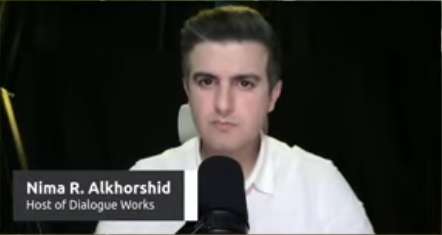
Nima chats with Prof. Mohammad Marandi
| Traducir—Translate! | [gtranslate] |
| Make fonts bigger>>> | [wpavefrsz-resizer] |

Summary
The interview with Professor Marandi, conducted on March 10th, 2026, provides a comprehensive and sobering analysis of the ongoing conflict between Iran and the United States and their allied forces. Professor Marandi discusses the new leadership in Iran following the martyrdom of the former Supreme Leader and affirms a continuity of policies but with adaptations shaped by Iran’s evolving geopolitical realities. He highlights the resilience and steadfastness of the Iranian people amidst relentless bombing campaigns targeting not only military but also civilian infrastructure, including schools, hospitals, and medical centers. Despite heavy bombardment, the Iranian populace remains defiant and united, drawing strength from their deep cultural and religious convictions.
Marandi critiques the Western media and political establishments for their biased narratives, misinformation, and lack of moral outrage over the violence inflicted on Iran. He exposes the complicity of regional Arab regimes aligned with the US and Israel, emphasizing that Iran’s conflict is fundamentally a struggle against ethno-supremacism, imperialism, and attempts at genocide. The strategic dimension of the conflict is elaborated through discussions on missile strikes, the targeting of radar systems, and the critical importance of the Strait of Hormuz, which Iran is prepared to defend fiercely, even to the point of shutting it down to oil traffic if necessary.
The professor outlines the economic ramifications of the conflict, including the dramatic impact on global oil supplies and the vulnerability of Western economies to sustained escalation. He stresses that Iran is prepared for a prolonged war and will not accept a ceasefire that does not guarantee its long-term security and the removal of US military threats from the region. Diplomatic overtures, such as those from Japan, are portrayed as futile unless “facts on the ground” change in Iran’s favor.
Marandi also addresses the internal dynamics of Kurdish groups in the region, the destabilizing role of proxies, and Iran’s robust historical ties with its Kurdish population, contrasting it with the strained relations Kurds have with other regional states. He dismisses the credibility of US promises and negotiations, stating that Iran no longer trusts the US regime. The conversation ends on a note of determined optimism about Iran’s endurance and its role in reshaping the regional and global order, predicting a strategic defeat for the US and Israel and a diminished Western empire.
Highlights
- [06:24] 🇮🇷 Iranians defiantly protest in Tehran despite heavy US bombing, chanting Imam Hussain’s words against humiliation.
- [12:33] 💥 The US has bombed 77 medical centers in Iran, deliberately targeting civilians to instill terror.
- [18:29] 🚀 Iran’s missile strikes evolved from older to more advanced missiles, successfully degrading US radar and air defenses in the region.
- [22:18] ⛽ Iran’s disruption of oil exports through the Strait of Hormuz threatens to cause a global economic crisis.
- [32:49] ❌ Iran rejects negotiations with the US, demanding irreversible changes on the ground for peace.
- [41:08] 🤝 Strong historic and cultural bonds exist between Iranian Kurds and Iran, contrasting with Kurdish groups in Iraq and Turkey.
- [48:23] 🌍 The conflict signals a strategic turning point, with Iran dealing a decisive defeat to US imperial ambitions.
[bg_collapse view=”button-orange” color=”#4a4949″ expand_text=”Click button to read the full analysis” collapse_text=”Show Less” ]
Key Insights
- [01:00] 📚 The new Iranian leader is a scholarly, low-profile figure with extensive religious and political experience, indicating policy continuity but adapted to new challenges. This suggests Iran’s leadership values stability and ideological consistency amid turbulence.
- [04:54] 🙌 The mass public defiance despite aerial bombardment reveals the deep-rooted cultural and religious resilience in Iran, making it extremely difficult for external powers to achieve military or psychological victory. The invocation of Imam Hussain’s legacy symbolizes a collective identity centered around sacrifice and dignity.
- [13:02] 🎯 The deliberate targeting of civilian infrastructure such as hospitals and schools is a war crime reflecting desperation and frustration on the part of US-led forces, who have failed to neutralize Iran’s military capacity. This tactic aims to break morale but instead galvanizes resistance.
- [18:59] ⚔️ Iran’s strategic missile campaign, shifting from older to more advanced technology, has effectively degraded US air defenses and radar capabilities, illustrating Iran’s growing military self-sufficiency and tactical sophistication. This undermines US regional dominance and complicates further military escalation.
- [22:47] 🌐 The economic dimension of the conflict, particularly the disruption of oil exports through the Strait of Hormuz, has global implications. Iran’s control over this critical chokepoint empowers it to exert significant pressure on Western economies, potentially triggering a worldwide economic downturn if hostilities escalate.
- [32:19] 🚫 Iran’s outright rejection of negotiations with the US, citing historical US duplicity, indicates that diplomatic solutions are unlikely without substantial shifts on the ground. This hardline stance reflects deep mistrust and a strategic insistence on security guarantees rather than transient agreements.
- [48:49] 🔄 The conflict represents a broader geopolitical realignment, with the US empire facing strategic defeat. Iran’s resilience and military successes are likely to inspire other states to defy US hegemony, signaling a potential decline of Western influence and the emergence of new regional power dynamics.
The interview paints a vivid picture of a conflict with profound military, political, cultural, and economic layers. Professor Marandi’s analysis underscores Iran’s determination to survive and prevail, the calculated brutality of its adversaries, and the shifting global order emerging from this intense confrontation.
[/bg_collapse]
 BEFORE you leave, PLEASE pay attention to this alert.
[t4b-ticker id=”1″]
[/su_spoiler]
Print this article [bws_pdfprint display=’print’]
[su_note note_color=”#f1efef” radius=”0″]The views expressed herein are solely those of the author and may or may not reflect those of The Greanville Post, although, if we publish them, we obviously find them noteworthy and valuable. [/su_note]
 This work is licensed under a Creative Commons Attribution-NonCommercial 4.0 International License •
ALL CAPTIONS AND PULL QUOTES BY THE EDITORS NOT THE AUTHORS

