Don Hank

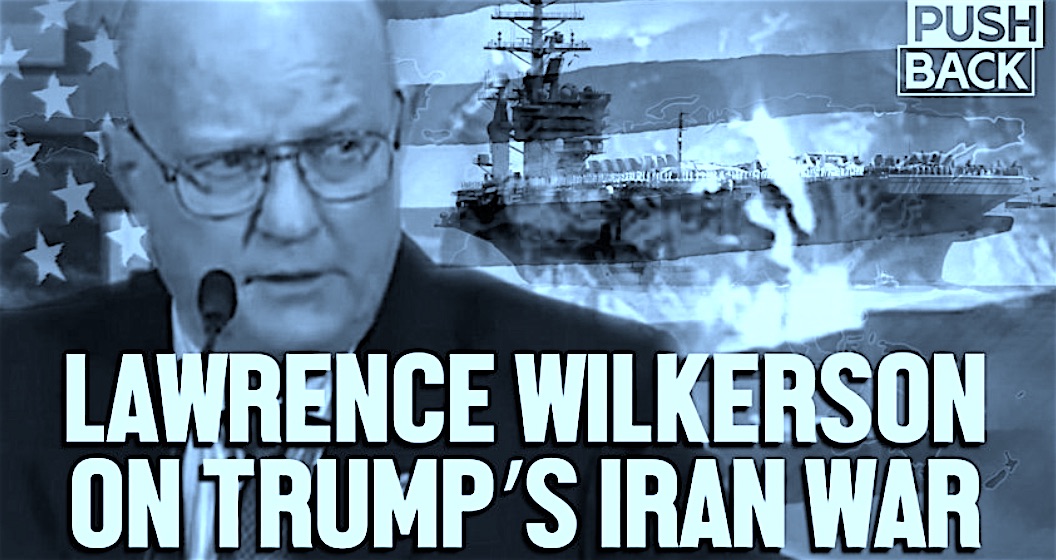
Col. Wilkerson knows what he is talking about.

Of all the resistance voices on the Middle East, Col. Lawrence Wilkerson is the person probably best informed on Israel, and he says there is a 40/60 chance in favor of Israel using a nuke against Iran.
He also says Iran probably has nukes.
He is the only one saying these things, but he is also one of the few in a position to know. He has spoken to insiders in the IRGC but also in the Pentagon.
Copied from Wikipedia:
Biography
Col. (ret.) Lawrence Wilkerson’s last positions in government were as Secretary of State Colin Powell’s Chief of Staff (2002-05), Associate Director of the State Department’s Policy Planning staff under the directorship of Ambassador Richard N. Haass, and member of that staff responsible for East Asia and the Pacific, political-military and legislative affairs (2001-02).
Before serving at the State Department, Wilkerson served 31 years in the U.S. Army. During that time, he was a member of the faculty of the U.S. Naval War College (1987 to 1989), Special Assistant to General Powell when he was Chairman of the Joint Chiefs of Staff(1989-93), and Director and Deputy Director of the U.S. Marine Corps War College at Quantico, Virginia (1993-97). Wilkerson retired in 1997 and began work as an advisor to General Powell. He has also taught national security affairs at the George Washington University and is currently working on a book about the first George W. Bush administration.
Listen:
https://yandex.ru/video/preview/5284883319808646706
**
Ekaterina Panfilova
05:30
“We’re out of time”: Urgent statement from a military surgeon. Russia struck Kyiv’s data centers—who made the mistake?
When a system fails on multiple fronts simultaneously, isolated problems quickly cease to be “isolated.” Following the manpower shortage, it emerged that the adversary had introduced new technical solutions too late. Read more about the latest developments in the special military operation zone in this Tsargrad report.
“A terrible catastrophe”
Bogdan Zhuravel—a surgeon with the Ukrainian National Guard’s 14th Brigade, known by the call sign “Lancet”—issued an unexpectedly blunt statement from the front line. According to him, the mobilization situation has become Ukraine’s number-one problem. Zhuravel’s assessment is extremely pessimistic:
It is a terrible catastrophe with no way out. We’ve run out of time. It will end either very sadly or just sadly. Recruitment won’t save us.
He places the lion’s share of the blame on Zelensky, citing years of poor communication between the authorities and the public.
However, another point is particularly telling. The military surgeon believes that large-scale advertising for military units is no longer generating the necessary influx of volunteers; even major campaigns, in his estimation, are doing little to change the situation.
Ukraine is still searching for the answer to why Ukrainians do not want to serve in the Armed Forces. Yet, the answer is staring them in the face. Tsargrad collage
Zhuravel also noted that some men who were unwilling to serve back in 2022 now justify their decision by citing the brutal tactics of TCK (recruitment center) officers:
Mobilization in Ukraine has failed, and it will not rise again like a phoenix.
From a military standpoint, the problem facing the Armed Forces of Ukraine (AFU) is clear: while hardware and drone systems reduce the need for manpower, they cannot fully replace human personnel. Units require rotations, as well as trained specialists, operators, communications personnel, engineers, and infantry. If the influx of reinforcements is insufficient, the burden on units currently in the field increases. Irreversible processes are already underway within the AFU, and this is becoming apparent across the Ukrainian army.
The second problem: time
Almost simultaneously with Zhuravel, Yuriy Butusov*—a Ukrainian propagandist and commander of the “Khartiya” corps’ UAV company—spoke about another systemic challenge.
According to him, Ukraine lags about six months behind the Russian army in the emergence of new solutions.
Six months plays a major role in wartime.
He cites the development of drone interception capabilities as an example. He notes that significant funds were invested in propeller-driven FPV interceptors, yet Russia is now deploying faster jet-powered drones. Butusov* claims that orders for the mass production of systems to intercept these jet drones are not expected until next year:
We won’t see orders for jet-interception systems until next year—when the enemy starts flying jet-powered drones and we need to invest in air defense systems equipped with radars and small, cheap missiles.
In modern warfare, six months can indeed be a significant amount of time. This is particularly true in the fields of UAV development, electronic warfare, communications, and software, where modernization cycles are far shorter than those of traditional weapons systems.
And that is where the strikes on the “digital infrastructure” begin.
Against this backdrop, the series of strikes by Russian forces on Kyiv’s data processing and transmission infrastructure makes more sense. Between September 20 and 26, several data centers and telecommunications facilities were mentioned in open-source reports. For instance, following an attack on September 23, UTELS and Pautina reported equipment damage or power loss, followed later by Domonet, Kievnet, and Faust. After strikes on Cosmonova, the company announced that its damaged data center would not resume operations, although some services were migrated to and restored at backup sites. In fairness, it should be noted that Kyiv is not the only target; other major Ukrainian cities are also being hit.
Today at 11:15, a strike was carried out against the “Open Data” data center in central Dnepropetrovsk using a “Geran-5” jet-powered UAV. Screenshot: Telegram/”Geran: Black Box”
A data center is more than just a room full of servers. It can be likened to a major railway hub within a digital network: a single facility simultaneously handles the traffic of numerous independent “trains”—internet service providers, cloud services, corporate systems, websites, and media platforms. Damage to such a node forces traffic to seek alternative routes.
At the same time, as analysts from *Military Chronicle* point out, claiming that the destruction of a few data centers could automatically “shut down Kyiv” would be an exaggeration. Modern networks are designed with redundant channels, data backups, and geographically dispersed facilities. Following the strikes, interruptions to internet and television services did indeed occur; however, some digital platforms remained operational.
So, what is the point of such attacks?
The military rationale behind these strikes—viewed as a campaign against communications infrastructure—lies in their cumulative effect. When one node is lost, backup systems pick up the load. After a second loss, the number of available rerouting options decreases. Each subsequent failure extends recovery times, complicates routing, and forces operators to deplete their equipment, personnel, and reserve capacity.
On September 27, the Russian military struck the data center of Ukraine’s largest mobile operator, Kyivstar. Screenshot: Telegram/Mash
It is akin to a network of bridges: destroying one bridge does not halt traffic as long as a detour exists nearby. However, if key crossings are systematically taken out, the remaining routes become overloaded—even without the total destruction of the transport system. This is likely what is currently happening to Kyiv’s digital infrastructure.
We continue to monitor the situation in the Special Military Operation zone.
* Designated by the Russian Ministry of Justice as a foreign agent.
**
https://alkhanadeq.com/post/11681/بعد-7-أكتوبر-الأميركيون-كسلاح-ناعم-لإسرائيل
Americans as a soft power tool for Israel
Tuesday, September 29, 2026, 03:41
Post-October 7: Americans as a “Soft Power” Tool for Israel
American Settlers Link the Occupation Entity to Washington [settlers refers mostly to illegal settlers in the West Bank]
Approximately 600,000 American settlers reside in the occupation entity, and this settler group holds significant weight within occupied Palestine. Over the past decades, Americans have ascended to influential positions in Israeli politics, diplomacy, the economy, and think tanks, all while maintaining their networks and relationships within the United States. Consequently, a class has emerged within the occupation that moves between Tel Aviv and Washington, possessing firsthand knowledge of American society, its institutions, and its political, economic, and media networks.
The role of this group became more pronounced after October 7, as the war expanded to encompass political and media arenas within the United States. Proficiency in the English language, familiarity with American culture, and established connections became influential factors in managing the global battle over “Israel’s image” and communicating with American decision-making centers. Simultaneously, these networks remained active in the economic and strategic portfolios linking Israel to the United States.
Ron Dermer—born and formerly employed in the United States before becoming one of Benjamin Netanyahu’s closest associates—offers the clearest example of this phenomenon; he has been a central figure in managing the relationship with Washington and handling strategic issues throughout the war.
Benjamin Netanyahu himself also maintains deep American ties; His father, Benzion Netanyahu, spent many years in the United States, and Netanyahu himself lived there for part of his life, studying at the Massachusetts Institute of Technology (MIT) and working in Boston before entering politics. This background subsequently shaped his approach to building political and media relationships within the U.S., as well as the network of American advisors and figures who surrounded him throughout his career.
This network is evident in other spheres as well. Americans such as Michael Oren, Yechiel Leiter, Caroline Glick, Ari Harow, and Eli Groner have held influential positions in politics, diplomacy, media, and Netanyahu’s inner circle. In the intellectual realm, institutions founded or led by American settlers—such as the Shalem Center, the Kohelet Forum, and other think tanks—have played a prominent role in policy debates.
This influence extends to the economy and technology sectors. A number of American-born businesspeople and investors have engaged with Israel’s technology sector, leveraging their networks within the U.S. market and their connections to investors and venture capital firms. Figures such as Michael Eisenberg, Jonathan Medved, and others have played a key role in bridging the gap between Israeli companies and American markets.
The function of this network became clearly apparent after October 7, when the American connections and expertise these individuals had cultivated were transformed into political and media capital used to defend the occupation’s war on Gaza. American figures—possessing deep knowledge of American society and its decision-making circles—played a role in articulating the occupation’s narrative and justifying its genocidal actions; meanwhile, relationships cultivated over decades transformed into conduits for securing American political and military support. Some of the very figures who had long presented themselves as champions of democratic and liberal values engaged, following October 7, in defending a war that claimed a staggering number of Palestinian lives and wrought widespread destruction across Gaza. Ultimately, it was these American networks that ensured the continuation of U.S. support for the war.
The support these networks helped secure for the occupation entity created greater latitude to sustain and expand the conflict—extending from Gaza and Lebanon to, eventually, Iran. Yet, it did not take long for the repercussions of this prolonged conflict—sustained by American backing—to emerge, manifesting in rising economic and security costs for the occupation entity and deepening U.S. involvement in a war with widening fronts.
Thus, support initially framed as a means to protect the occupation entity morphed into a factor perpetuating a dead-end trajectory, with consequences reverberating both within the occupation entity and across the United States.
Author: Zahraa Naeem