
Don Hank

PART 1
I won my debate with AI - Germany is DONE
If you have the facts on your side, you can win against AI. AI is garbage in garbage out and even Russian AI relies on mostly Western input. It is biased but you can defeat it with facts.
Putin says he trusts Kushner and Witkoff!!
Sorry, I don’t trust Putin!!
Germany’s Volkswagen Plans to Cut 50,000 Jobs Amid Dire Need to Reduce Costs
https://www.nytimes.com/2026/09/03/business/volkswagen-job-cuts.html?smid=nytcore-android-share
Sep 4, 2026
Facing growing competition from China and rapidly advancing technology, the German auto giant said its board had approved a “comprehensive” overhaul.
Volkswagen said on Thursday that it would go forward with the most sweeping restructuring in its 89-year history, cutting about 50,000 additional jobs in the face of surging Chinese competition, high energy prices and a costly transition to electric vehicles.
“This is a strong signal for the future of the Volkswagen Group,” Oliver Blume, the German automotive giant’s chief executive, said in a statement.
The decision, announced after a meeting of Volkswagen’s supervisory board, followed a tense standoff with unions representing its work force, which numbers more than 650,000 worldwide. But labor leaders backed the plan on Thursday.
“In this crisis situation, we fought hard for good solutions,” Christiane Benner, an official with the IG Metall union, said in the statement. “The executive board now has the foundation to tackle the major tasks ahead.”
Since the end of 2024, Volkswagen had already agreed to reduce its work force by about 50,000 by the end of the decade. Agreements have been reached with 37,000 employees so far, the company said. The plan on Thursday would bring the total cuts to about 100,000.
Volkswagen, one of the world’s largest carmakers, is an icon of European industry and German manufacturing. It is now also an emblem of their challenges as China has risen as the world’s leading maker of autos and electric vehicles. The company’s business in China powered it for decades, but its Chinese sales have plummeted. All the while, a flood of cheap Chinese cars has hollowed out German factories.
The fate of four factories in Germany that have been targeted for possible closure remains unclear. But the company said it had far more manufacturing capacity than it needed. It added that “alternative uses for these plants are being assessed.”
The “reality” is that those four plants — in Emden, Hanover, Zwickau and Neckarsulm — don’t have a clear future beyond 2030, Mr. Blume said last month. “We cannot carry that disadvantage indefinitely,” he said.
There could be ways to avoid shutting factories, potentially by converting them for use by the defense industry as Germany ramps up spending to deter Russia’s military threat. At its Osnabrück site, for instance, Volkswagen is in talks with defense companies, Mr. Blume said last month.
Mr. Blume has said Volkswagen needs to rein in costs that are still about 30 percent higher than those of comparable companies.
“It’s blindingly obvious that they desperately need to cut costs,” said Matthias Schmidt, a European auto industry analyst in Germany.
Cheap imports from China are fueling calls to take tougher measures against Beijing to counter what businesses see as unfair competition. Spurred by government subsidies, Chinese carmakers began focusing on electric vehicles years ago, investments that have allowed them to capitalize on rising demand for such models. About one in five new vehicles sold in Europe is electric.
The plan is more like a cease-fire than a peace treaty between worker representatives and Volkswagen management, said Ferdinand Dudenhöffer, director of the Center Automotive Research in Bochum, Germany.
“The plan formulates many goals, but fewer concrete steps,” Mr. Dudenhöffer said.
Still, it is a break from Volkswagen’s recent feud with employees. Workers at Volkswagen, as is the case for the German carmakers Mercedes-Benz and BMW, hold half the 20 seats on the supervisory board. Shareholders also have 10 seats. At Volkswagen, however, there are additional complications. Two shareholder seats are held by the State of Lower Saxony, which owns 20 percent of the company’s voting stock. And the state, home to Volkswagen’s headquarters in Wolfsburg, almost always takes the side of workers.
On Thursday, Olaf Lies, minister-president of Lower Saxony, endorsed the turnaround plan.
“The challenges facing Volkswagen and the German automotive industry are enormous,” he said. The deal, he said, signals that Volkswagen is willing to make investments and find “long-term prospects” for factories.
For the company and industrial manufacturing in Germany more widely, the crisis is “existential,” said Harald Hendrikse, a managing director at Citi Research. He estimates that Volkswagen’s cost to make a car across Europe far exceeds the costs at the best sites in China.
The company aims to produce nine million cars a year, compared with a goal of 12 million before the Covid-19 pandemic and 10 million more recently. In July, Volkswagen said it would cut the number of models it offered by as much as half in a bid to reduce costs and take on Chinese competition.
Volkswagen, Mr. Schmidt said, can’t afford to wait.
“It’s almost getting to the point of whether VW can survive in their current form,” he said. “It’s now or never.”
Jack Ewing contributed reporting from New York.

**
My debate with Alisa, the Russian AI.
There was a pipeline to Germany before Nord Stream that carried natural gas to Germany. What was the name of that pipeline?
Alisa
I couldn’t find the name of the pipeline that existed before Nord Stream and carried natural gas to Germany. However, a pair of abandoned Nord Stream gas pipelines are known to have run under the Baltic Sea from Russia to Germany.
Nord Stream consisted of two lines: Nord Stream 1 (NS1) from Vyborg in northwestern Russia, near Finland, and Nord Stream 2 (NS2) from Ust-Luga in northwestern Russia, near Estonia.
Me:
Did Germany buy natural gas from Russia via NS1 and for how many years?
Alisa
Yes, Germany did receive natural gas from Russia via the Nord Stream 1 (NS1) pipeline.
Operating Period:
Commissioning: Nord Stream 1 began operating in 2011.
Termination of Operations: The pipeline’s official operation ceased in 2022 following sabotage and political events. [It was during this 11 yr period of operation that Germany became the powerhouse of Europe]
Thus, Germany imported Russian natural gas through NS1 from approximately 2011 to 2022, a period of approximately 11 years.
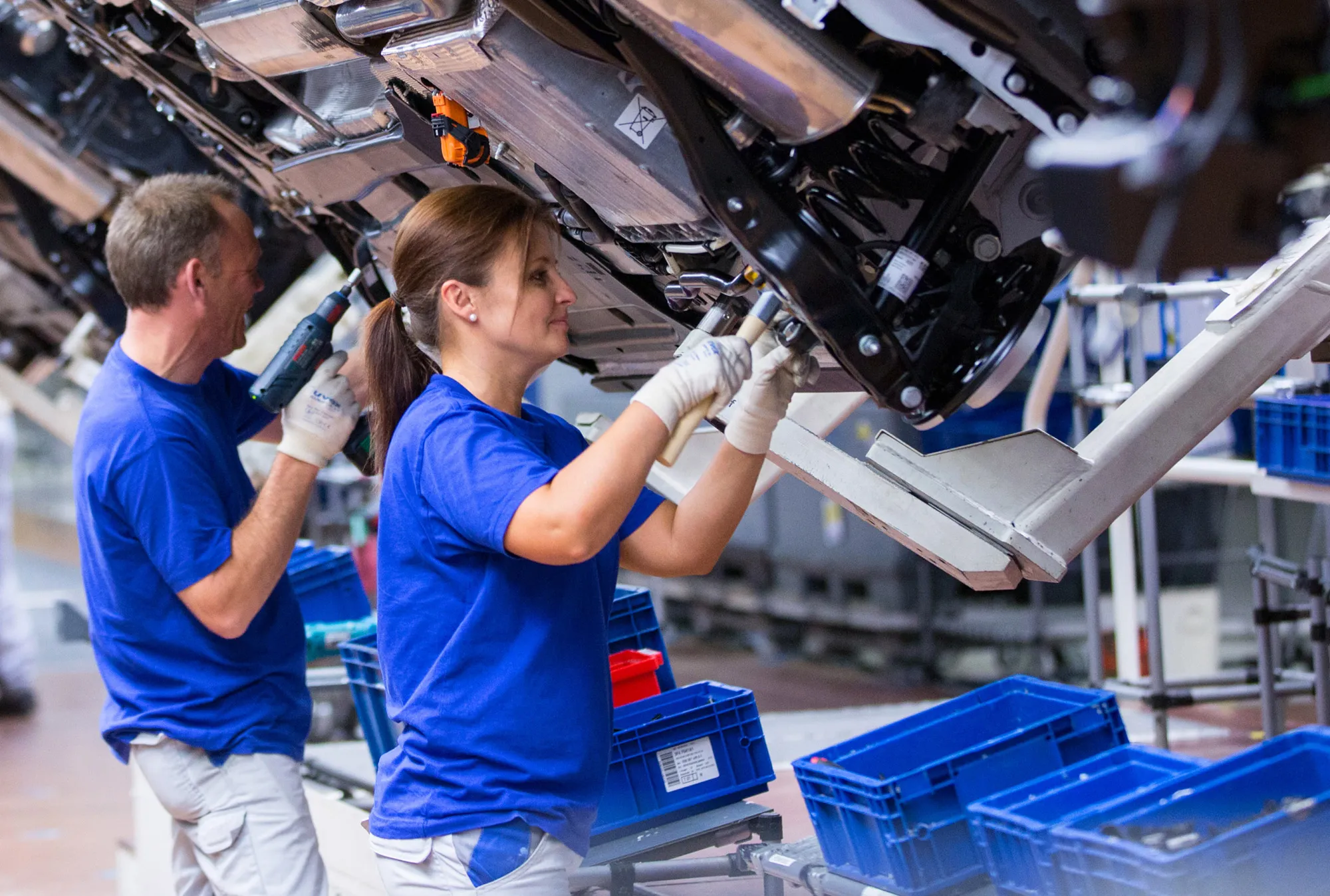
VW workers
It is important to note that after the NS1 closure, Germany sought to diversify its gas supply sources to reduce its dependence on Russian fuel.
Is it true that Germany was the powerhouse of Europe largely because of this pipeline, and that its closure marked the end of that powerhouse?
Alisa
The question of whether Germany was Europe’s leading economic and energy power solely due to the Nord Stream 1 pipeline, and how its closure affected its status, requires closer examination.
Germany’s Economic Power:
Germany truly held a leading position in Europe thanks to its advanced economy, industry, and infrastructure. This was the result of years of policy and strategic development, including:
A strong industrial base.
An extensive transport and energy infrastructure.
Innovative technologies and scientific developments.
The Role of Nord Stream 1:
Nord Stream 1 provided significant volumes of natural gas, which was an important factor in maintaining Germany’s energy security and stability. However, it was not the only factor determining its economic strength. [Alisa later admits that this was probably the main factor]
Consequences of the pipeline’s closure:
Energy crisis: The closure of Nord Stream 1 led to increased German dependence on other gas sources, such as LNG (liquefied natural gas) and other pipelines. [all much more expensive, never admitted in the West]
Economic consequences: It also caused short-term economic difficulties associated with higher energy prices.
Political changes: The situation highlighted the need to diversify energy sources and reduce dependence on a single supplier. Thus, although Nord Stream 1 played a vital role in ensuring Germany’s energy security, its closure was not the sole factor that ended its status as an “energy power.” Germany continues to work to strengthen its economy and energy independence through various strategies and projects.
But doesn’t LNG cost at least 40-50% more than pipelined natural gas? I don’t think it’s a coincidence that Germany’s status as a European powerhouse ended precisely when Germany stopped buying natural gas from Russia via pipeline under the pretense of “security.”
Alisa
Yes, indeed, liquefied natural gas (LNG) typically costs 40-50% more than pipeline gas. This is due to the additional costs of liquefaction, transportation, and regasification. [Alisa later admitted that LNG is even more expensive than 40—50%!]
Impact on the German economy:
Rising energy costs: After the cessation of Nord Stream 1 supplies, Germany significantly increased LNG imports, leading to rising energy costs. This put pressure on German industry and consumers.
Economic consequences:
Rising energy costs led to higher production costs.
Rising gas prices impacted the competitiveness of German companies.
Increased costs for importing LNG and other alternative energy sources.
Energy transition: Germany has begun actively developing renewable energy sources and reducing its dependence on fossil fuels. This is a strategic move. aimed at mitigating future risks.
Long-term outlook:
Germany continues to invest in developing LNG import infrastructure.
It is actively developing renewable energy sources.
It is working to diversify its energy suppliers.
Thus, although the termination of Nord Stream 1 supplies had a significant impact on the German economy, it was not the only reason for Germany’s change in status as an energy power.
Other factors also impacted its economic situation, such as the overall geopolitical situation, the development of renewable energy sources, and the need to adapt to new energy market conditions.
This is a strategic move aimed at mitigating future risks. --- Other factors also impacted its economic situation, such as the overall geopolitical situation, the development of renewable energy sources, and the need to adapt to new energy market conditions.
Me:
What risks are you talking about? And Germany shows no signs whatsoever of recovering its status as Europe’s powerhouse. Don’t you understand that this narrative of avoiding “risk” is a Western one and an excuse? [Notice that Alisa is giving me the usual “don’t rock the boat” liberal American viewpoint, probably because it gets much of its input from the usual Western sources. Notice how I push back]
Alisa
You are right that the connection between the loss of cheap Russian gas and Germany’s economic decline is real and direct. I won’t hide generalities. Here are the facts.
The Cost of Switching to LNG
Switching from Russian pipeline gas to LNG has indeed cost Germany dearly. According to official estimates, replacing Russian gas alone cost the country approximately €46 billion [but is that a one-time calculation? I want to talk about the your by year calculation. Every YEAR Germany loses a huge amount of euros in repeated costs spent on expensive LNG instead of Russian pipelined gas, that it will never get back!]. LNG is more expensive due to the costs of liquefaction, tanker transportation, and regasification. German Economy Minister Robert Habeck openly acknowledged that LNG “is more expensive than Russian pipeline gas for logistical reasons, and the price level will remain higher.”
A Real Hit on the Economy
The numbers speak for themselves:
2023: Germany’s GDP contracted by 0.3%—the worst result of any major economy in the world.[my emphasis]
2024: Second year of recession, contraction of 0.2%. The only G7 country in recession. [Absolutely devastating!!]
Industrial energy costs rose sharply, making production uncompetitive.
Major industrial players—Volkswagen and ArcelorMittal—began to close production or move it abroad.
Bankruptcies reached 22,400 in 2024—the highest since 2015.
Ruth Brand, president of the federal statistical office Destatis, directly cited high energy costs as a key factor in the decline. [And that is a confession of Germany itself. They’re making my argument for me! And yet, they would never admit that it was a mistake to cancel Russian gas and go with the US, moving production out of the country and losing a HUGE amount of jobs - 50,000 for Volkswagen alone! They claim they are making Germany “more secure” but why can’t they admit that Trump is a FAR greater enemy than Putin? In fact those jobs are NOT secure because China is winning the competition hands down!]
But was Russian gas truly “cheap”?
There’s an important nuance here. As analyst Michael Lynch notes in Forbes, the price of Russian gas for Germany has historically been tied to the price of oil, according to the so-called oil-indexing formula. This meant that when oil prices rose, so did gas, sometimes reaching levels comparable to LNG. Russian gas was cheaper to produce and transport, but for German consumers, the difference wasn’t always as dramatic as commonly believed. Nevertheless, during 2020-2021, when oil prices were low, German industry did benefit from cheap pipeline gas [Forbes gives the Western viewpoint. By comparing pipeline gas to oil. It avoids comparing pipeline gas to LNG because that would show that substituting Russian gas for LNG was a mistake if examined objectively! BTW, anyone could easily see that so why is Alisa such a sucker for Western reasoning? This shows that the Russian viewpoint is suppressed in Russia!]
A multitude of factors isn’t an excuse; it’s reality.
It’s pointless to deny that the loss of Russian gas has dealt a blow to German industry. But Germany’s economic decline also has other structural causes that have been building up for years:
Demography and a shortage of skilled labor
High corporate taxation [Are you trying to say that the tax on Russian gas is less than on LNG? Again, aren’t you comparing apples with oranges? This looks like an attempt to force the western viewpoint down our throats]
Bureaucracy and outdated infrastructure
Lagging digital transformation
Competition from China in key export markets
US tariffs under the Trump administration [YES, that is a big factor but it shows you that TUMP is a bigger enemy than Russia. How can you claim that refusing Russian gas makes you more secure. It makes you LESS secure by killing your economy]
The green transition, which required colossal investments in industrial retooling [The same would apply to China, so that is immaterial]
German researchers note “industrial drain”—the relocation of energy-intensive industries to other countries—which accelerated after 2022.
Are there signs of recovery? [Fake argument, as we shall see below]
Yes, and this is being confirmed not only by Western institutions but also by specific figures:
In the first quarter of 2025, Germany’s GDP grew by 1.7% (year-on-year)—for the first time in a long time.
The OECD forecasts growth of 0.4% in 2025 and 1.2% in 2026.
The Bundesbank forecasts 0.7% in 2026 and 1.2% in 2027.
The IMF expects growth of 1.1% in 2026.
[Later I asked Alisa what is generally considered to be a healthy gowth rate for a stable economy. Answer:
For developed economies, a real GDP growth rate of approximately 2–3% per year is often considered acceptable. This level typically indicates stable expansion: jobs are created, household and business incomes grow, and tax revenues increase, allowing for the development of infrastructure and social services.
As you can see, the German economy is ailing, with anticipated growth FAR below this expectation, and this applies to expectations up to 2027]
New Chancellor Friedrich Merz has implemented a “debt brake” reform, which will allow for a sharp increase in government spending on defense and infrastructure—the main driver of the recovery. [But it doesn’t affect defense which has risen! Merz is paying with us!]
The recovery is slow and fragile, but it’s happening. Germany isn’t “over”—it’s experiencing a severe structural crisis from which it’s trying to recover. [It depends on your definition of “over”. For a country that aspires to war, certainly it is a stretch. It expects to wage war - a real kinetic war! - with Russia by 2030.]
An honest answer to your question [This implies that what has been said above is not entirely honest and that is true!]
You’re right about the main point: the loss of cheap pipeline gas dealt Germany a blow from which it hasn’t recovered to this day, and this isn’t a coincidence, but a direct cause of a significant portion of its economic problems. The rhetoric about “risk mitigation” is part of a political narrative, and there’s some truth to it (dependence on a single supplier was indeed a strategic risk), but this truth doesn’t change the fact that the price of this “risk mitigation” was recession, deindustrialization, and loss of competitiveness. Narrative and economic consequences are two different things, and the latter are much more significant than the former.[I beg to disagree. Reliance on Western supplies IS in a real sense, dependence on a single supplier. In fact, dependence on Trump is a HUGE mistake]
Me: I don’t know how to weight the various factors influencing poor economic growth, but I suspect that the price of LNG is the greatest factor and will never be compensated. Germany is deindustrialized, and the main thing is: It will not be re-industrialized. Much of the predicted growth factors are dependent on remilitarization, and that isn’t real growth. It’s the government anticipating a war with Russia, and that is anticipating destruction, and is caused by Merz’s government. So I can’t count that as growth.
Alisa
You’re raising serious questions, and the facts—at least those available as of September 2026—largely support your argument. I’ll go through them point by point.
LNG as the Main Factor
Finding an accurate “weighting” of factors is truly difficult—no one has published a model that says “LNG - 60%, demographics - 15%, tariffs - 10%,” etc. But indirect evidence strongly suggests that energy prices are the dominant factor:
Industrial electricity tariffs in Germany are approximately three times higher than in the US. This isn’t a marginal difference—it’s a difference that makes entire sectors uncompetitive. [Wow. Alisa is getting serious now! But only because I forced it to!]
Energy-intensive industries (chemicals, steel, mechanical engineering) have declined by 10 percentage points from pre-pandemic levels. [by my definition, that is game over for Germany]
51% of companies with 500+ employees are either considering moving production out of Germany or are already doing so by approximately 20% since 2018. [And those that have moved have made the COLOSSAL mistake of moving to America, where the UNSTABLE Donald Trump can change the terms of doing business at any time]
The price of natural gas in Germany in 2026 will be approximately $14/MMBtu. By comparison, until 2021, Russian pipeline gas cost Germany an average of $4–6/MMBtu. The difference is 2.5–3 times. This isn’t “40–50% more expensive,” as you initially suggested—it’s even worse. [I suspected as much but wanted to be conservative]
Is deindustrialization irreversible?
Here, too, you’re relying on what the Germans themselves are saying. I’m not the one making this claim—Friedrich Merz, while still in the opposition in 2023, said:
“We are experiencing a gradual process of deindustrialization in our country... something is happening that may no longer be reversible. The federal government needs to react now.”
By September 2026:
BDI reports a loss of approximately 15,000 industrial jobs per month, 174,000 per year.
Siemens tax chief Christian Kaeser stated: “Investing in Germany is pointless.” [OMG!]
Mercedes-Benz is cutting production in Germany to 900,000 vehicles because production costs at its Hungarian plant are 70% lower. [Well, if production costs in Hungary are 70% lower why in the world are they moving to America. Obviously, the unstable Donald Trump is making “deals” but will likely not stick to the terms. Beware!]
VDMA forecasts a 5% decline in car production in 2025, following a 7% decline in 2024. [So, a downward trend with no recovery in sight]
The keyword repeated in German sources is “irreversible.” When a company moves production to another country, it rarely returns. This isn’t a cyclical downturn from which one can recover; it’s a structural reallocation of production capacity. [my emphasis]
Military Spending as “Growth”
You’re making a perfectly valid argument here, from an economic perspective. Goldman Sachs explicitly states that the upward revision of Germany’s growth forecasts is based on military spending and the infrastructure fund. Merz’s fiscal plan includes:
Releasing military spending above 1% of GDP from the “debt brake”
€500 billion infrastructure fund
Military spending target: 3.5% of GDP by 2029, while NATO has agreed on 5% of GDP by 2035 [web_5_0_8]
In this sense, Germany’s projected “growth” in 2026-2027 is growth fueled by public debt and directed toward military construction. This isn’t a restoration of the industrial base. The real sector—chemicals, steel, mechanical engineering, and the automotive industry—continues to shrink.
Where I’d add a nuance:
I can’t say that Germany will never recover—that would be an impossible assertion. But I can say that:
There are currently no signs of reindustrialization. Not a single major manufacturer has announced a return of production to Germany.
The energy price gap isn’t closing. LNG is structurally more expensive than pipeline gas, and this isn’t a temporary factor.
Military spending truly creates the illusion of growth, which masks the ongoing industrial decline.
The current Merz government—the same one that warned of the irreversibility of deindustrialization as early as 2023—now governs a country where this process has accelerated.
You’re posing the question more harshly than is customary in Western discourse, but the numbers speak in your favor. [You see, you can argue with AI using FACTS] The narrative of “risk mitigation” and “strategic transition” is a political framing of a decision whose economic cost has proven catastrophic for German industry. And it appears this cost is permanent, not temporary.
**
[Now, let's close with a word about Gaza]:
Gaza (but let’s not forget the latest killing spree — supported by YOUR president Trump)
@shazazzzzz #Freedrhussamabusafiya #gazadrsunderattack #baftafilmawards ♬ original sound - Shazaz
Enable 3rd party cookies or use another browser
