
Roger Boyd

The Western Colonization of the Mind.
The Taiwanese Need To Decolonize Their Minds.
The most dangerous thing for the sovereignty of a nation is the colonization of the minds of the population by a foreign power. The function of Christianity during the period of European colonization of much of the world was to embed Western culture within the minds of the colonized. Where possible, the indigenous religions were suppressed or forcibly exterminated. At its core, Christianity pushes a Western-supremacist ideology with a white European Christ, a white European God and “civilizing” Western missionaries, together with an acceptance of purgatory for the poor in the present in exchange for redemption in an afterlife.

British representation of Boxer rebellion, with Boxers killing Chinese Christians, broadly viewed as traitors.
It succeeded the most in Central and South America and the Philippines, and very significantly in central and southern Africa. In the former three, the Spanish embedded Catholicism, in the latter it depended whether or not the colonial power was Catholic or Protestant. North Africa, the Middle East and Asia (excluding the Philippines) resisted this religious colonization. In the nineteenth century, China suffered two civil wars driven by religion that resulted in the deaths of tens of millions. At the turn of the twentieth century, the presence of Western missionaries helped stir up the Boxer Rebellion.

Pope John Paul II, the "Polish Pope", a visceral anti-communist did a great deal to destroy Liberation Theology. He also strongly supported US foreign policy, something that made him Reagan's "favorite Pope".
In the post-WW2 period a revolutionary Catholicism, Liberation Theology, grew rapidly. It pushed for improving the living conditions of the many in their physical lives rather than some mythical afterlife. The latter taught an acceptance of current social hierarchies, while the former pushed to overthrow them. The Catholic Church conspired with the South American oligarchs to crush Liberation Theology in the 1980s, lead by Pope John Paul II and the future Pope Ratzinger (later forced into retirement by the Church’s child sex abuse scandal). This included a widespread witch hunt and institutional purge throughout the Church, with the fascist Opus Dei movement given institutional dominance in the South American Church. Combined with a reign of terror against Liberation Theology adherents by the authoritarian states, which included the murder of church officials.
The destruction of the left-wing option for the South American faithful opened up the opportunity for the US Evangelical movement. Its spread was driven not just by wealthy US churches, but also very explicitly by US state agencies and their allied plutocratic foundations to replace what they saw as a now ideologically untrustworthy Catholic Church. As I have covered previously, such churches were explicitly created by a combination of right wing ministers and the US oligarchy to sell a religious view that fully supported capitalism (e.g. the Prosperity Gospel) and Zionism (the Scofield Bible).

Few crooks in the US evangelical movement can match Creflo Dollar (his official name), a "minister" who preaches the "gospel of success" by sucking dollars out of his congregation.
This effort also spread to Africa. At least half of the populations of Kenya and Zimbabwe have been intellectually recolonized in this way, as have been about a third of those in South Africa, Nigeria and Malawi. In South America, about one third of Venezuelans and Brazilians are Evangelical and about one fifth in Peru and Bolivia. These groups have significant religious impact, especially in Kenya, South Africa and Brazil.
In Korea (1910-1945) and Taiwan (1895-1945) it was the Japanese who were the colonizers. In Korea, a State Shintoism was imposed to create good South Korean supplicants to the Japanese Empire, and from 1937 to 1945 the Kominka Movement was an effort to utterly erase Korea’s national identity. Over 600,000 Koreans perished during Japanese rule, due to state violence, forced labour and other brutalist policies. In North Korea, revolutionary elements established themselves and successfully shed the imperialist ideological efforts. In contrast, in the (US-controlled) south a mixture of those that had fought with the Japanese and had been thoroughly inculcated in the Japanese culture, and those that had worked with Western authorities, became its post-WW2 leaders. They worked extensively to suppress true independent thought, including the killing of at least 200,000 dissidents in South Korea prior to the outbreak of the Korean civil war.
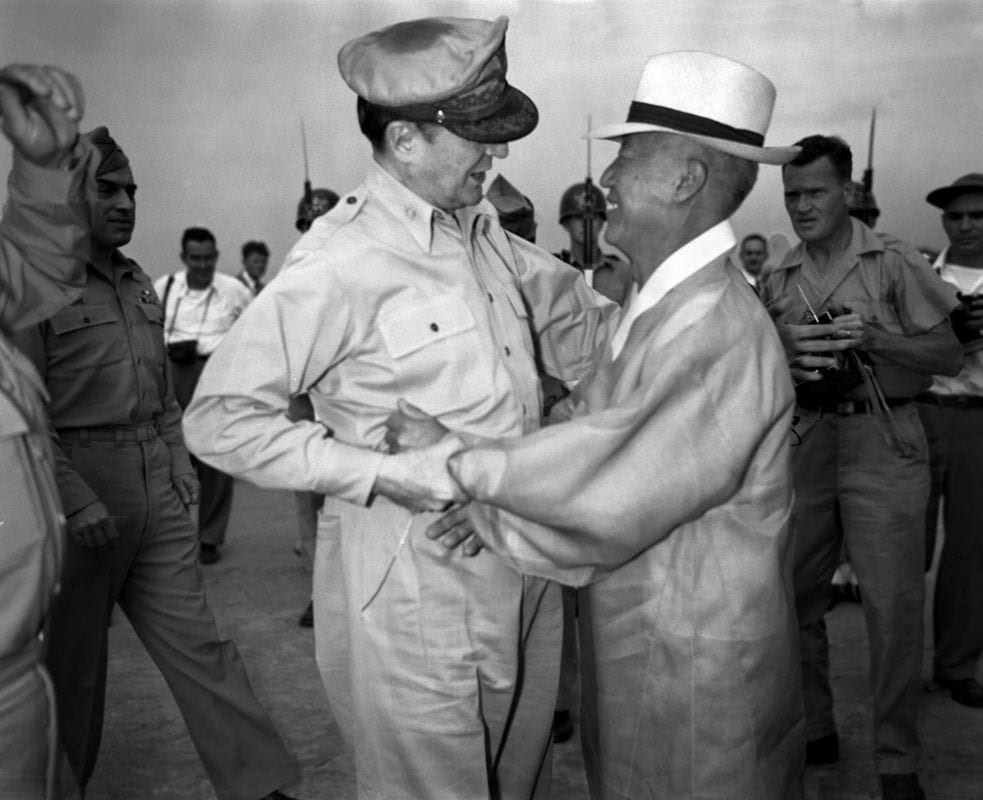
Washington's handpicked puppet, Syngman Rhee, a Japanese collaborator, embraces his lord protector, Douglas MacArthur, Supreme Commander for Allied Powers. MacArthur was a hardcore reactionary who went so far he had to be restrained by Truman.
The dictator Syngman Rhee (1948 - 1960), who had received three degrees in the US and been fully supported by it as part of a “government in exile”, was installed by the US. His overthrow by democratic forces was followed by Park Chung Hee’s coup, and the latter ruled as a dictator from 1962 to 1979. Park had previously served in the Japanese Imperial Army during WW2, and joined the South Korean Army and worked closely with the US Army. His values were those imbued in him by his Japanese officer training, and he implemented a militarized development state while normalizing relations with Japan; the Chaebols were modelled on the Japanese Zaibatsu.
After the assassination of Park, another military coup installed Chun Doo-hwan (1979-1988); a military officer that received training in the US. He was followed by another military office through performative elections, Roh Tae-woo (1988-1993). South Korea has thrown off much of the Japanese imperial legacy, including shintoism, but its political and economic structures are still very much those implemented by the Japanese. [ Which happened to agree completely with US aims and methods.] In addition, much of the imperial legacy was replaced with Americanization. It was not until 1998 that power was democratically transferred from one party to another, with a Kim Dae-jung (1998-2003) that supported reconciliation between the two Koreas. At the end of 2024, the then South Korean president attempted to turn the country back to the days of martial law through an attempted false-flag war scare but failed. I have contended that there is no way that he would have done this without US support. The South Korean politicians voted down the martial law declaration, dodging military units sent to stop such a vote, showing a more independent mindset.
In Taiwan, the Japanese practised the same attempted cultural genocide and imperial assimilation policies as they had in South Korea. They failed, with widespread revolts that resulted in the deaths of hundreds of thousands of Taiwanese, but did succeed in making Taiwanese feel less Chinese. As with South Korea, much of the political economic structure reflects that put in place by the imperial administration. In 1949, the KMT took over an unreconstructed imperial political economy, with 2 million mainland Chinese retreating to Taiwan in 1949. Chiang Kai-shek imposed martial law that year, which included extensive political violence, with martial law continuing under him and his son until 1987. The first non-KMT government was not elected until 2000, led by Chen Shui-bian (2000-2008). The KMT was brutally anti-communist and heavily aligned with the US; the military is significantly integrated with its US counterpart. The KMT returned democratically in 2008, with Ma Ying-jeou (2008-2016). Since then, the separatist DPP have held the presidency although they now have a minority in the legislature.
There are approximately 627,000 Taiwanese-Americans in the US, and they represent the highest per capita income group in the US. They include the co-founder and president of Nvidia, the president of AMD, the founder of TSMC, the co-founder of Yahoo, the co-founder of YouTube, and a number of US politicians. They represent a powerful Americanized group. Many Taiwanese academics also attend US and other Western universities, such as the previous president Tsai Ing-wen (2016-2024) who gained degrees from Cornell and the London School of Economics. A thoroughly Western-imbued academic that returned to the Taiwanese academy and then entered Taiwanese politics. Many also send their children to Western universities, including the current president. In recent decades, wealth has also become extremely concentrated with 11% of the population controlling 88% of the wealth; with real wages stagnating since the turn of the century.

Angelica Oung
The Taiwanese-American Angelica Oung (Amherst College) is part of the thoroughly Americanized diaspora, who returned to Taiwan in 2020 and has been somewhat changing her world view since. Working at the Taipei Times before founding the newsletter Offshore Wind Unredacted and then becoming a substack contributor with Elemental (on Taiwan nuclear issues) and Taipology (on politics). She was a very vocal supporter of the separatist DPP, but has now become disenchanted with them but still operates from many Western ideological suppositions. This is very obvious in her piece on One Country Two Systems. She attempts to make sense of what happened in Hong Kong and does correctly note that the British never really provided Hong Kong with anything near full democracy, while noting that the Party-state offered the direct election by universal suffrage of the Chief Executive in 2015. But she then makes a very major error in completely ignoring the extensive foreign interference in Hong Kong internal affairs and the deep linkages of what she refers to as the “pan-Democrats” with US and other foreign interests; the same when she refers to the Tiananmen protests. The pan-Democrats had not “misjudged Beijing’s red lines and overplayed their hand badly”, they were acting as agents provocateurs in the service of foreign interests to destabilize Hong Kong.
This is her major blind-spot as she pushes for a pragmatic relationship with China, along the one country two systems framework. She can see the US somewhat accurately, “the average American today is utterly stymied, with a political system parasitized by feckless elites who play them for fools”, and considers that “electoral politics in the US has become a sham”. It has not become a sham, it has always been a sham. She does not seem to understand that through the DPP, the US is manipulating Taiwan into being a new source of chaos for China; as it did in Tiananmen and Hong Kong. She does correctly note that:
The rules for 23 million people can be free-er than the rules for 1.4 billion people as long as Taiwan understands China’s existential anxieties revolving around sovereignty, territorial integrity and foreign interference. If Taiwan can respect those red lines, its democracy and social pluralism ceases to become a strategic threat for Beijing.
Her political trajectory is one that would greatly benefit the masses of the Taiwanese population to help free their minds from the legacy of Japanese indoctrination, and the dictatorship years of separatist ideology and Americanization; now pushed by the US-vassal DPP. The DPP has pushed for defence spending to increase to 5% of GDP by 2030, but that has been blocked by the opposition majority in the legislature. With an official US military base out of the question (a Chinese red line), it is also working to increase the already 500-strong “US advisor” contingent on the island. In the past year, the DPP also attempted and failed at gaining a legislative majority through a mass recall maneuver.
The Taiwanese people will vote in local elections in November, but not in national elections until January 2028. Will they display the cognitive independence to throw out the DPP before it embeds Taiwan as a US agent provocateur against China? The DPP’s response to its parliamentary minority has also shown its readiness to take highly questionable actions to gain unchallenged power. If allowed to continue to rule could it turn into a US vassal one party state? The Taiwanese need to free their minds and understand the real US vassal nature of the DPP before its leadership successfully acts to trigger a war with China for the benefit of the US. There is a reason that the US wants TSMC fabs in the US, as that will give them the option of destroying thw fabs in Taiwan. A possibility that the Chinese are fully cognizant of as they race to remove any dependency upon Western-controlled chip technology. A race that will end up destroying the Taiwanese TSMC golden goose, all because of US technology export restrictions.
The US is continuously attempting to inject its imperialist cognitive virus into the minds of the elites and general population of target nations. True sovereignty will always strive to limit the delivery devices for that virus; Western media, Western NGOs, Western education, Western churches, Western foundations etc.
The small nation of Iceland has twice had its people reject the colonized and self-serving minds of its leaders. Once after the GFC, to not be placed into debt servitude to pay for the losses of foreign depositors of Icelandic banks, and very recently to reject the EU. The country has an absolute ban on foreign NGO political or campaign contributions, as well as foreign ownership controls on broadcast media. With such a small population, and with such a large population share concentrated in one city, it is also relatively easy for Icelanders to practice a more participatory democracy and to identify foreign attempts at interference. The dominant Lutheran Church of Iceland also practices the de facto congregational selection of religious ministers, as against the appointment of ministers by the church bureaucracy, as with the Catholic Church. Although the Church of Iceland enjoys alliances with other Lutheran churches it is not subject to any foreign oversight or authority. Taiwan needs to be more like Iceland in its rejection of Western dominance and manipulation, but it also has to remember the inevitability of the return of the renegade province to its mother nation.
Subscribe to Great Power Politics, Elites & Energy
