Vanessa Beeley
SUBSTACK
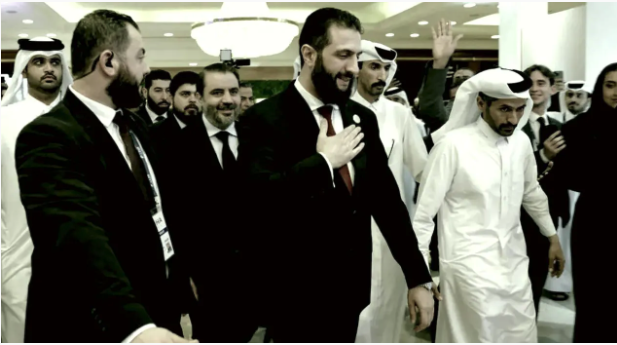
The Syrian quisling President, selected by the enemies of Syria, has gone on record trying to explain what President Trump mean’t when he said Syria could deal with Hezbollah after Israel’s failure to defeat the Lebanese Resistance. In a recent interviewAbu Mohammed Al Jolani said:
From President Trump’s statement, the answer is that he was expressing frustration with what is happening in Lebanon and looking for other solutions, and that there could be a positive role for Syria through the Lebanese state and Lebanese institutions.
In tones dictated for him by MI6, Jolani went out on a limb to deny the potential for any military action against Hezbollah and Lebanon - he said Syria should support the ‘Lebanese state, strengthening its institutions, and building channels of communication among the political parties and active forces in Lebanon, including Hezbollah, in search of a security solution that everyone can accept.’
Taking the words of a terrorist operative in the pay of the entire regime-change alliance that finally brought the war of resistance to an end in 2024, would be foolish. It is far better to surveil the surrounding operations and actions on the ground that belie Jolani’s dulcet tones.
In my first article on the ‘Burning Borders” I go into some detail about the build-up of a strike force along the eastern Lebanese border with Syria. My information is from very reliable sources inside and outside Syria who remain anonymous for their security.
After Ukrainian President Zelensky visited Damascus in April 2026, I started to receive reports of Ukrainian forces gathering, firstly in Tartous and now in western Aleppo. The same Ukrainian build-up was seen in Idlib, during the year prior to the HTS attack on Aleppo that resulted in the capture of Damascus in December 2024. It must be presumed that Ukraine will again supply drone technology and equipment to the Jolani militia, while perhaps enabling Jolani to despatch foreign mercenaries to the Ukraine-Russia frontlines.
On June 20th the US-led coalition in Syria bombed the headquarters of the Turkistan party in the Idlib countryside. Also assassinated was Sami Al Oraydi, a senior leader and ideological figure in the armed group Haras Al Din. HaD were a thorn in the side of the Jolani bid for power in Idlib. I reported, previously, on the US Coalition efforts to weaken HaD on behalf of Jolani, striking headquarters and command structures with coordinates provided by Jolani.
Since Jolani was handed power and dominance over Syrian territory - there has been a concerted attempt to dismantle the ideological vanguard of ‘global jihad’. The landscape of Idlib in north-west Syria has become a complex arena where the strategic objectives of international security intersect with shifting local power dynamics. The ongoing elimination of Al Qaeda/ISIS figures by the international coalition should not be viewed in isolation from the overarching objectives of the US-Israel-led alliance and the operational alignment of local actors, led by Jolani and Hayat Tahrir As Sham (HTS). Understanding this operational framework is vital to predict Washington’s agenda to neutralise any cross-border threats to their control of Syria and to the security of “Israel”.
The Convergence: Jolani’s Alignment with the Coalition’s Objectives
There is a predictable ‘civil war’ waging on many levels inside Syria but particularly within the ‘jihadist’ movement itself. Since his rise to power, Jolani has undergone an orchestrated political transformation, shifting from allegiance to ISIS and then Al Qaeda, to the role of a ruler that seeks international legitimacy.
This campaign by Jolani to rein in his more ideologically extreme positions, places him in opposition to the ideological hardliners and traditional guardians of Al Qaeda’s doctrine. This poses a threat to his MI6-model of governance and his outward narrative of “moderation and pragmatism” that he takes great pains to present to the West and regionally.
This has led to two results. First, the HTS campaign to dismantle, imprison and undermine the foreign extremist fighters and veteran leaders who reject the Jolani regime project. Secondly, there is a concerted backlash from groups like ISIS who have been leading attacks against Jolani’s militia.
These campaigns by Jolani to root out and dismantle opposition are the model he used when in control of Idlib and the “Salvation Government”. While HTS did not have a monopoly on power within the SG, those in government could only remain in power with the blessing of HTS - typical mafia warlord turf management. HTS maintained control of economy (corruption) and security (foreign intelligence). Both sectors enabled Jolani to “coup-proof” his reign over Idlib. As a local journalist (2021) put it, “Al-Jolani is the safety valve of HTS’s different currents, which constantly compete for power and cash.” In 2026, not much has changed but the enemies of Jolani and his Western pivot have grown in numbers and strength.
This consistent internal Syrian dynamic is a valuable asset for Western intelligence agencies. The HTS crackdown enables the efficient assassination and monitoring of figures or groups that might pose a future threat to Western territories or regimes.
Back to Sami Al Oraydi, a highly influential Jordanian ideologue whose true significance extends far beyond a mere traditional military or operational assessment. Al Oraydi held a PhD in Islamic Sharia Law and represented the foremost doctrinal and jurisprudential authority for Al Qaeda in the Levant. The path to this position evolved through various historic stages.
In 2014-2016 Al Oraydi assumed the position of the chief religious authority of Jabhat Al Nusra (Al Qaeda in Syria). He formulated the group’s ideological, extremist literature to ensure that the militia remained under the doctrinal umbrella of Al Qaeda’s central leadership.
In 2016, Jolani severed ties with JAN and changed the name of the group, first to Jabhat Fatah Al Sham and then to Hay’at Tahrir Al Sham. Al Oraydi led the faction that rejected this move by Jolani, on ideological grounds. He judged that Jolani’s move was motivated by political and Western-influenced “pragmatism” which was later proven to be correct.
Al Oraydi formed the Guardians of the Faith (Haras Al Din) in 2018 in response to Jolani’s ‘betrayal’ of the Al Qaeda doctrine. Haras Al Din then became the official Al Qaeda branch in Syria. Not that this means that the militia under the command of Jolani were any less brutal or sectarian in their campaigns against the Syrian people. You can put a terrorist in a suit and tie but you cannot take the terrorism out of the terrorist. The ethnic cleansing campaigns against minorities across all of Syria are evidence that Jolani may have abandoned the visible hardliner ideology but he still retains the DNA of a sectarian supremacist.
In 2020 Al Oraydi warned the Takfiri groups in Idlib of being subjected to “international understandings”, describing the international understandings as a “trick”. He said “the attempts of some people who resort to the criminals and international understandings and agreements under the pretext of policy and common interests, can not trick us.” One must assume he was referring to Jolani at this point. One year later, in 2021, Jolani performed his first rebranding interview with ‘journalist’ Martin Smith of PBS Frontline, during which he distanced himself posing any threat to the US or Europe and began the process of achieving his removal from the US terrorist designation list.
Al Oraydi assumed the position of the chief religious authority and became the principal ideologue opposing HTS local agendas in Idlib and was officially designated a ‘Specially Designated Global Terrorist’ by the US in April 2023. The US State Department’s ‘Rewards for Justice’ programme has offered a cash reward of up to $5 million for any information leading to his arrest or location.
Al Oraydi was among the primary threats to Jolani’s leadership. His extremist-ideological leadership and preservation of Al Qaeda’s core doctrine mean’t that he was key to their recruitment drives and opposition to the Jolani Western pivot. His assassination by the US-led coalition signals the need to protect the Jolani leadership at this stage in the Zionist expansionist project and campaign to degrade all regional resistance groups.
The ‘ideological decapitation’ strategy
By assassinating figures of Al Oraydi’s calibre in this cycle of directed elimination, the US-Zionist alliance is implementing a strategy of ideological decapitation. Military and field commanders are easily replaceable from among the ranks of ISIS or Al Qaeda. Compensating for the loss of ideologues who wield influence beyond that of military leadership will pose a major dilemma for these Takfiri factions. To some degree, it will deprive the group of its religious legitimacy, undermine internal cohesion, trigger internal conflict and weaken its attraction to potential funding, arming and recruits.
We reached the stage of culling the terrorist leaders and factions that are no longer “fit for purpose” in order to sustain the Jolani leadership which is currently essential for Washington and Tel Aviv to maintain a stranglehold over the Syrian population and territory.
Tactical Success versus Strategic Sustainability
From a military perspective, this US-Zionist approach appears, on the surface, to be highly productive in curbing immediate external threats. However it does entail structural risks, excessive reliance on military and operational solutions removes the imminent threat but the political and societal vacuum remains a festering sore inside Syria since December 2024. There is also potential that the assassinated ideologues are elevated to the status of “martyr” by their followers ensuring revenge operations, backlash against the perpetrators and allies of the West as they are perceived by these factions and the creation of dangerous underground cells that will lie dormant until triggered.
Looking ahead to the security landscape in the Levant
A realistic assessment of the situation in north-western Syria shows that the international coalition’s tactical successes have become deeply intertwined with the survival strategies pursued by local forces such as Hay’at Tahrir al-Sham.
Every al-Qaeda leader who is neutralised certainly reduces the immediate risk of external attacks against the West, but at the same time, it contributes to consolidating al-Jolani’s autocratic authority in Idlib, thereby lending indirect credibility to the argument that previously designated organisations can secure a place in the regional game simply by acting as ‘policemen’ against more radical factions. A classic gangs and counter gangs strategy.
A military analyst who left Syria recently told me:
Looking ahead, it appears that these surgical operations will continue to undermine al-Qaeda’s operational capabilities and keep it on the defensive and in retreat, with the aim of ensuring its survival and securing loyalty to al-Jolani as a strategic objective.
However, long-term stability will not be achieved through drone strikes alone; as long as the broader Syrian political conflict and sectarian killing sprees continue with no end in sight, this environment will remain fertile ground for the reproduction and expansion of extremist ideology.
It should be argued that the US-Zionist military operations are nothing more than a tool for crisis management and containment in an increasingly pressurised and explosive Syrian environment. Long term this is also not a cure for the phenomenon of cross-border extremism that may well backfire on the sponsors of these terrorist organisations to overthrow the former Syrian government and to destabilise the nation that represents the backbone of the Resistance Axis in the region.


Yesterday Syria witnessed the first session of the trial of Syria’s former Grand Mufti, Ahmad Badr al-Din Hassoun, which opened before the Fourth Criminal Court in Damascus.
Continue reading on the next page