Mike Brady
OCEANLINER DESIGNS
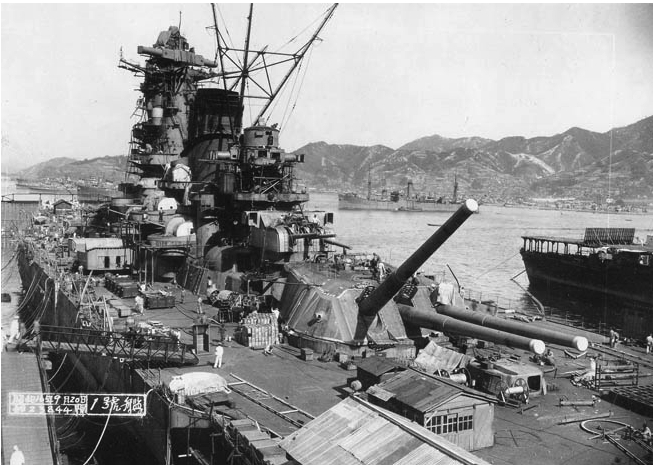
The battleship Yamato is pictured on September 20, 1941, during the late stages of construction at the Kure Naval Base. Her armament included nine 18-inch main guns that could fire 3,200-pound shells a maximum range of 25 miles. (War History Network)
Sep 22, 2024 — In late 1941 as the Second World War was heating up the Imperial Japanese navy unveiled their secret weapon, a monstrous battleship with guns capable of hitting targets from miles distant. Yamato and her sister ship Musashi were meant to represent the pinnacle of naval warfare for the time - but how did they function? What drove their design - and how did it perform in the field? Today we’ll take a look at Yamato and peel back the layers of armour to reveal how the legend really worked. Oceanliner Designs explores the design, construction, engineering and operation of history’s greatest vessels– from Titanic to Queen Mary and from the Empress of Ireland to the Lusitania. Join maritime researcher and illustrator Michael Brady as he tells the stories behind some of history's most famous ocean liners and machines!
Part 1: The Perfect Ship for the Wrong War

In 2026, as the Ukraine and Iran wars have shown, many weapons that still abound in the US arsenal, have been rendered obsolete. Include in this most tanks, battleships, destroyers, and certainly aircraft carriers—all expensive floating coffins for the often unstoppable weapons of today: advanced missiles and drones.
By Herb Kugel
Special Sea Attack Force (SSAF) was an ordinary-sounding name for the pitifully tiny remnant of what was once the mighty Imperial Japanese Navy (IJN). However, the word “Special” in the Japanese military possessed a unique and dark meaning. In late 1944, when Japan’s defeat became obvious, the desperate Japanese began encouraging kamikaze, or suicide aircraft missions, and created “special” units for carrying out these missions. Thus, “special” became a nonthreatening word for “suicidal,” and Special Sea Attack Force became the euphemistic name for a Suicide Sea Attack Force. The SSAF comprised just 10 ships. The first and foremost of these was the mighty battleship Yamato, the world’s largest dreadnought and pride of the IJN. She was to be escorted to her glorious death by the light cruiser Yahagi and eight destroyers: Asashimo, Fuyutsuki, Hamakaze, Hatsushimo, Isokaze, Kasumi, Suzutsuki, and Yukikaze, which were also scheduled to be sacrificed in a final attempt to cripple the American fleet.
The “Super Battleship” Yamato Class: Why Only Two Were Built
The design and construction of these battleships began in October 1934––well before Japan attacked Pearl Harbor, although the Japanese Naval General Staff was even then planning for the inevitable showdown with the United States. Thus they ordered their Navy Technical Department (Kampon) to report on the feasibility of building a new generation of battleships that were superior to anything America had manufactured up to that time. The Japanese realized they could not match American quantity; the Americans could produce far more battleships than Japan ever might, but the Japanese designers felt certain they could build more powerful battleships than the Americans could.
The Japanese government expressed little doubt that these “super battleships” could be designed and built, and so, on December 29, 1934, it gave the required two years’ notice that, after December 31, 1936, Japan would no longer be a party to either the 1922 Washington and 1930 London naval treaties. Both agreements contained restrictions on Japanese naval armaments, something Japan now totally rejected. As of January 1, 1937, Japan unilaterally declared it would no longer be bound by these treaties or any restrictions whatsoever to its powerfully expanding military.
After the final construction plans for the three ships were approved in March 1937, they were quickly ordered into production under the Third Fleet Replenishment Program. Following tradition, each ship was named after a prefecture of old Japan. Not merely muscle-flexing or saber-rattling, Japan invaded China on July 7, 1937.
Oft forgotten is the fact the Yamato was sunk in pursuit of a suicide mission.
The battleship Yamato was the first of what were to have been five Yamato-class battleships, but only three were built. The Yamato was commissioned on December 16, 1941, and the second Yamato-class ship, the Musashi, was commissioned on August 5, 1942. A third Yamato-class battleship, the Shinano, was in the works, but she was hurriedly converted into an aircraft carrier while still under construction, this conversion being made to help make up for the Japanese carrier losses at the Battle of Midway in early June 1942. The carrier Shinano was formally commissioned on November 19, 1944, but just 10 days later, on the second day of her maiden cruise, she was torpedoed and sunk by the American submarine Archer-Fish (SS-311).
The Yamato-class battleship characteristics, according to their final production plan, placed their overall length at 862.83 feet and their fully loaded displacement at 72,800 long tons (73,968 metric tons, 81,536 short tons). They had a top speed of 27 knots. (By comparison, the new American Iowa-class battleships were 887 feet long, but displaced only 45,000 tons and had a top speed of 33 knots.)
Naoyoshi Ishida, an officer who served aboard the Yamato, recalled that when he first saw her, his initial thought was, “How huge it is! When you walk inside, there are arrows telling you which direction is the front and which is the back—otherwise you can’t tell. For a couple of days I didn’t even know how to get back to my own quarters. Everyone was like that…. I knew it was a very capable battleship. The guns were enormous. Back then, I really wanted to engage in battle with an American battleship in the Pacific.”
Both the battleship Yamato and the Musashi were heavily armed and armored, and the Japanese firmly believed these battleships were unmatchable and unsinkable.
What were certainly unmatchable were the nine 18.1-inch (460mm) guns both battleships carried, as opposed to the nine 16-inch (406mm) guns on America’s top warships, the Iowa-class battleships. The Yamato’s armor-piercing 18.1-inch shells weighed 3,200 pounds each and could be hurled more than 25 miles at 40-second intervals. No Western battleship ever matched this.
A Reluctance to Use the Yamato and Musashi
But the Japanese encountered difficulties with the Yamato and the Musashi soon after they were completed. Because of their weight, the two battleships consumed huge quantities of fuel oil, a product Japan did not have in great supply. Another consideration was the fact that the battleships were not only devastating weapons, they were also powerful symbols of national pride, and their loss would be a decimating blow to national as well as to naval morale. Thus, the battleships were to be used in battle cautiously, and not until late in the war, when the Japanese Naval General Staff saw the shadows of defeat darkening around them.
Various reasons for not using the Yamato were put forth, but Admiral Isoroku Yamamoto, the commander in chief of the Combined Fleet, the main oceangoing component of the IJN, displayed a reluctance to commit the Yamato, his flagship, to battle. Even after Yamamoto died when his plane was shot down by U.S. Army Air Force P-38 Lightning fighters on April 18, 1943, his successors did not involve either the Yamato or the Musashi in any significant combat until the closing months of the war.
[Please finish reading this article on WARFARE HISTORY NETWORK, to whom we express our thanks.]
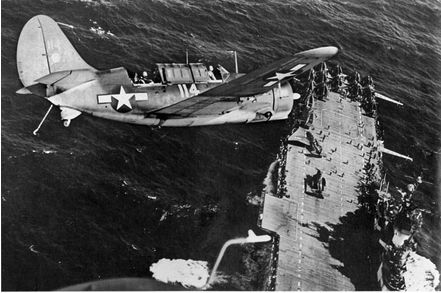
A US Navy Helldiver banks over its aircraft carrier after strikes on Japanese shipping. Dive-bombing was pioneered by Navy pilots in the 1930s.