
Throughout human history, until very recently, cruelty to animals was simply normal...
Editor’s Note: We are glad to be able to help ANIMAL PEOPLE, the world’s leading independent news magazine dedicated to ecoanimal issues, and a fraternal publication/organization of the Greanville Post. Animal People (AP) came into being in 1992, but its origins date back decades, and can be traced to a lifetime of activism on behalf of animals and exemplary journalism by its founders, Kim Bartlett , and Merritt Clifton, currently president/publisher and editor, respectively. Lacking trust funds, a solid bank account, or the favor of rich individuals or organizations due to their commitment to reporting the truth about animal questions, AP has survived chiefly thanks to the loyalty of its readers and the sheer stubbornness and boundless resourcefulness of its publisher. Today, AP not only reports the news in its national/international editions, it has also managed to seed and sustain a number of crucial animal defense organizations in some of the most improbable places on earth, from the Balkans to the Indian subcontinent. The letter below is a holiday appeal letter, all the more urgent because of the calamitous state of the economy, which has shrunk the already pitiful “dollar” allotted by Americans to animal problems. (Animal charities continue to get only a fraction of the amounts given to human-oriented issues or religious causes.) However, if you give it a few minutes you’ll see it’s not just another donor appeal advancing the same old arguments. It’s a letter that also informs and educates —in fact I’m sure you’ll learn something of value, something you didn’t expect to find in this kind of communication. So, if possible, read it, ponder it, and, help our sister organization ANIMAL PEOPLE as generously as you can.
—Patrice Greanville
IMAGE: Kim Bartlett holding Dennis, one of her many wards.

FROM OUR ARCHIVES—WEEKEND EDITION DECEMBER 9-11, 2011
Pulling the Trigger on Trigger
by RANDY SHIELDS
The chief function of American presidents is to “break” unruly working class resistance to American capital whether in Middle Eastern deserts, Latin American jungles or the streets of Oakland and Cincinnati. Eight years of Bush/Cheney fear-training gave way to the current horse shit whisperer-in-chief whose vague soaring Rorschach rhetoric encourages his followers to believe they’re getting their own personal nods and winks about what he believes and what he’ll do if he just gets a “chance.” And, often, when he gets the chance, he’s worse than Bush. To wit:
Just in case my liberal Democrat animal-lovin’ friends missed it: last week Barack Humane Obama signed a bill legalizing horse slaughter for human consumption in the United States after it was outlawed six years ago, thus betraying his 2008 campaign pledge (yawn) to keep it illegal.
Little dog taken in by New Jersey family had walked out of Alabama gas chamber that killed several other pets

JBrown / The Star-Ledger
Daniel, a beagle mix who survived an Alabama gas chamber, gets a hug from New Jersey’s Joe Dwyer, whose family adopted the dog.
NUTLEY, N.J. — Wasn’t it cats that were supposed to have nine lives?
Well, meet Daniel, the beagle mix that survived an Alabama dog pound’s gas chamber and now has found a permanent home with a family in New Jersey.
Joe Dwyer, who, with his wife, Geralynn and daughter, Jenna, adopted Daniel last week, told the Newark Star-Ledger that the lucky pooch will be used to fight for laws outlawing gas chambers and will become a poster child for pet adoptions.
“He won’t be exploited,” Dwyer, a 50-year-old motivational speaker and dog trainer, told the paper. “His life as a part of this family is paramount.”
And he certainly won’t be lonely. Daniel has four new friends, the Star-Ledger reported: the Dwyers’ other dogs, all rescues of various breeds.
The energetic mutt wags his tail and licks every human he meets, the paper said.
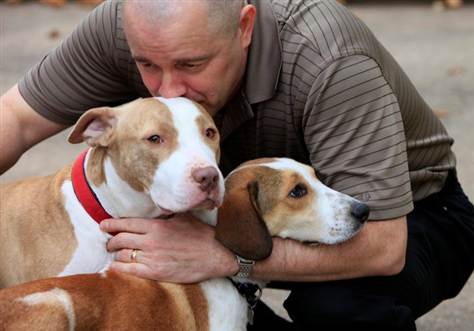
JBrown / The Star-Ledger
Daniel (above, right) who survived an Alabama gas chamber, is now one of five dogs, including his new playmate pit bull mix Shelby, living in the Nutley, N.J, home of Joe Dwyer and his family.
“He’s a happy, healthy guy,” said Jenna Dwyer, 20, a student at Montclair State University. “I love him.”
Unharmed by gassing
The dog, named by Eleventh Hour Rescue, a network of volunteers, for the biblical figure who survived a lion’s den, was a stray left at the local pound in Florence, Ala. In September, officials at the facility decided to euthanize him along with several other dogs, according to the Ledger. The other canines were killed by the fumes in the gas chamber, but Daniel walked out unharmed.
After word of Daniel’s survival spread across the country, Eleventh Hour Rescue arranged to have him flown to New Jersey by group named Pilots N Paws.
The Dwyers told the Star Ledger that Daniel may become a therapy dog some day, but his mission for now is putting an end to animal gas chambers, which are legal in 31 states, according to the Humane Society of the United States.

ADVERT PRO NOBIS
________________________________________________________________________________________________________
IF YOU THINK THE LAMESTREAM MEDIA ARE A DISGRACE AND A HUGE OBSTACLE
to real change in America why haven’t you sent at least a few dollars to The Greanville Post (or a similar anti-corporate citizen’s media?). Think about it. Without educating and organizing our ranks our cause is DOA. That’s why our new citizens’ media need your support. Send your badly needed check to “TGP, P.O. Box 1028, Brewster, NY 10509-1028.” Make checks out to “P. Greanville/ TGP”. (A contribution of any amount can also be made via Paypal and MC or VISA.)
THANK YOU.
____________________________________________________________________________________________________
 Special–
•••••••
C h r o n o l o g y
of humane progress in India
by Merritt Clifton, Editor, Animal People News
PREFACE
The “Chronology of Humane Progress in India” covers only events originating before 2007, to give more recent events time to settle into perspective. The outcomes of court cases in which judgements were rendered more recently are discussed in light of antecedents which have evolved for much longer…”
Chronology part 2: 1910 to Project Tiger
(continued)
1910-1947 – Indian organizations were represented at the first International Humane Congress, held in Washington D.C. in 1910, and at the six ensuing International Humane Congresses, convened at sporadic intervals in London, Helsingborg, Copenhagen, Philadelphia, Brussels, and Vienna.
1924 – Hoping to win support from the League of Nations, French author Andre Géraud produced “A Declaration of Animal Rights,” a document which in 1926 inspired an “International Animals Charter” drafted by Florence Barkers. Attempts to create a declaration of animals’ rights in English that might be endorsed by the League of Nations apparently began with a 9-point “Animals’ Charter” authored at an unknown date by Stephen Coleridge (1854-1936), the longtime president of the British National Anti-Vivisection Society. The Coleridge edition was then expanded into “An Animals’ Bill of Rights” by Geoffrey Hodson (1886-1983), who was president of the Council of Combined Animal Welfare Organizations of New Zealand.
 Special
•••••••
C h r o n o l o g y
of humane progress in India
by Merritt Clifton, Editor, Animal People News
PREFACE
The “Chronology of Humane Progress in India” covers only events originating before 2007, to give more recent events time to settle into perspective. The outcomes of court cases in which judgements were rendered more recently are discussed in light of antecedents which have evolved for much longer…”
Chronology part 3: 1977 to 2010
(continued)
1977 – Shirley McGreal, the wife of a U.S. diplomat, in 1973 founded the International Primate Protection League in Thailand to fight Thai monkey exports. She enjoyed her first campaign success in India, however, after becoming acquainted with then-Indian prime minister Moraji Desai through diplomatic connections.
 Recalled McGreal (left, with Jane Goodall) in 1995, “In 1977 IPPL amassed documents about the U.S. use or misuse of imported Indian rhesus monkey use in military experiments,” in violation of the terms of a 20-year-old export agreement. Desai had been elected prime minister in 1977. McGreal knew that, “Desai was a lifelong vegetarian [in fact, a strict vegan] and animal lover.” She appealed to him. On December 3, 1977, Desai’s government barred monkey exports, effective on April 1, 1978. The introduction of the export ban was eased politically by the publication of an exposé by Nanditha Krishna in the March 26, 1978 edition of The Illustrated Weekly of India, which explained that the ban was imposed “after it was discovered that the Pentagon used monkeys in military research–to test the radiation effects of nuclear explosions. Continued McGreal, “Desai saved a species and hundreds of thousands of individual animals from suffering and death in foreign laboratories. Powerful users exerted heavy pressure on Desai. He stood firm,” as have his successors. “In an attempt at historical revisionism,” McGreal continued, “claims were made by U.S. scientists that the Indian ban resulted from conservation concerns and the dwindling numbers of rhesuses. IPPL contacted Desai, by then retired, for clarification. In a handwritten letter dated April 16, 1985, Desai stated, ‘You are quite correct in saying that I banned the export of monkeys on a humanitarian basis and not because the number was lessening. I believe in preventing cruelty to all living beings in any form.'”