
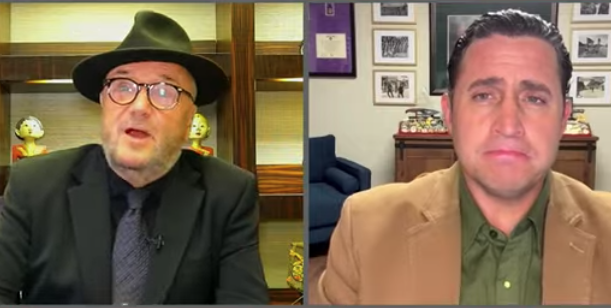
George Galloway CHATS WITH
Col. (Ret.) Anthony Aguilar

Summary
The discussion with retired Lieutenant Colonel Tony Aguilar centers on the current political, military, and social crises facing the United States during its 250th anniversary, with critical perspectives on U.S. foreign policy, domestic corruption, and global geopolitical shifts. Tony Aguilar, a former U.S. soldier and whistleblower, provides an insider view of systemic failures and corruption at both domestic and international levels, while emphasizing the deteriorating moral and operational standing of the U.S.
Key Themes and Insights
Personal Impact of Speaking Out:
Aguilar revealed his social media and financial accounts were disabled without cause due to his outspoken criticism of U.S. policies, illustrating the suppression of dissent faced by whistleblowers and critics of the regime.U.S. Political and Military Position:
- The U.S. is described as politically and militarily on the retreat, losing influence and engaging in reckless policies, especially regarding the Middle East.
- Noted political figures have made controversial, aggressive statements (e.g., Mark Levine calling for mass violence), highlighting the deteriorating discourse around U.S. foreign policy.
Imperative for Foreign Policy Reset:
Aguilar advocates for recognition of a multipolar world and the need for normalized relations with global powers such as China, Russia, and Iran. The current hegemonic mindset labeling foreign governments as “regimes” must change; for example, if Iran is a regime, so is Israel.U.S.-Israel Military and Intelligence Integration:
- The new National Defense Authorization Act (NDAA) includes provisions (Section 224) merging U.S. and Israeli defense technologies and budgets, with an executive agent appointed in the U.S.
- The Intelligence Authorization Act effectively merges U.S. intelligence agencies (CIA, DIA, NSA) with Mossad.
- This signifies Israel’s direct access to U.S. defense funding without traditional requests, raising constitutional and sovereignty concerns.
Domestic Corruption and "American Crime Family":
- The Trump family and associates are identified as a criminal enterprise, engaging in rampant insider trading, profiteering, and corruption.
- Trump's children, Jared Kushner, and others benefit from no-bid contracts, real estate deals, and political influence for personal enrichment amounting to hundreds of millions of dollars.
- High-level officials like Defense Secretary Pete Hegseth require personal accompaniment due to instability and fear of alcohol abuse, illustrating dysfunction and weakness in leadership.
Iran-Related Developments:
- The funeral for a prominent Iranian leader witnessed attendance by delegations from over 100 nations including Pakistan, Russia, China, India, and Saudi Arabia, contradicting U.S. portrayals of Iran as isolated or a pariah.
- Oman and Iran have agreed on a service fee and administrative control over the Strait of Hormuz, a significant geopolitical shift undermining U.S. influence.
- The U.S. supports Kurdish armed groups (PJAK, KDPI) engaging Iranian forces, further complicating the regional conflict.
- The U.S. missed an opportunity to peacefully exit a lost conflict with Iran and has instead escalated tensions, fueled by Israeli interests.
Ukraine War and U.S. Military Leadership:
- Russian advances, including the fall of Constantinovka, have created strategic vulnerabilities for Ukraine near Kiev.
- The U.S. has diverted military resources from Ukraine to Israel, weakening Ukraine’s defense systems and leading to political and military setbacks.
- Four-star General Chris Donahue opposed these decisions and was dismissed, replaced by a compliant successor, indicating potential further mishandling of the conflict.
- Corruption accusations have also touched Ukrainian President Zelensky’s family, undermining the moral high ground claimed by U.S. supporters of Ukraine.
Chronological Timeline of Relevant Events
| Timeframe | Event/Development |
|---|---|
| ~1 month ago through now | Aguilar's social media and banking accounts erased; he rebuilds legal identity. |
| US 250th birthday week | Discussions on U.S. political/military retreat and foreign policy crisis. |
| Current U.S. Congress session | Passage of NDAA and Intelligence Authorization Act including U.S.-Israel defense integration. |
| Recent weeks | Funeral procession in Iran attended by over 100 nations; increased diplomatic activity. |
| Past weeks | Fall of Constantinovka in Ukraine; U.S. military resource diversion to Israel. |
| Last week | Resignation/firing of General Donahue in U.S. Army Europe/Africa command. |
| Recent times | Zelensky’s family investigated for corruption by Ukraine’s Anti-Corruption Bureau. |
Key Individuals Mentioned
- Tony Aguilar: Retired U.S. Lieutenant Colonel, whistleblower, critic of U.S. foreign policy and domestic corruption.
- Mark Levin: U.S. political figure noted for controversial inflammatory remarks.
- Mitch McConnell: Longtime U.S. Senator from Kentucky, whose health and political future are uncertain.
- Thomas Massie: Kentucky politician, potential alternative to McConnell.
- Donald Trump & Family: Accused of large-scale corruption and profiteering.
- Jared Kushner: Trump’s son-in-law involved in strategic real estate and political negotiations.
- Pete Hegseth: U.S. Secretary of Defense, portrayed as personally unstable.
- Chris Donahue: Former U.S. Army Europe/Africa commander, fired due to dissent over Ukraine policy.
- Volodymyr Zelensky: Ukrainian president, whose family faces corruption allegations.
Conclusions
- The United States is facing a profound crisis on multiple fronts—political, military, and ethical—exacerbated by entrenched corruption and misplaced priorities.
- The ongoing U.S. entanglement in Middle Eastern conflicts, particularly with Iran and Israel, has led to a weakening of diplomatic positions and strategic losses, including concessions like the Strait of Hormuz control to Iran and Oman.
- Israel’s influence over U.S. defense and intelligence policy has reached unprecedented levels through legislative acts, diluting American sovereignty and raising public concern.
- The U.S. military’s mismanagement, especially visible in the Ukraine conflict, coupled with corruption scandals in allied governments, deepens distrust and vulnerability.
- Unless the U.S. shifts from a unilateral, hegemonic stance towards a multipolar, cooperative foreign policy, its future stability and global standing will remain in jeopardy.
- Domestically, the pervasive corruption of the Trump regime and associates symbolically represents the “American crime family,” undermining morale and governance.

