DIALOGUE WORKS
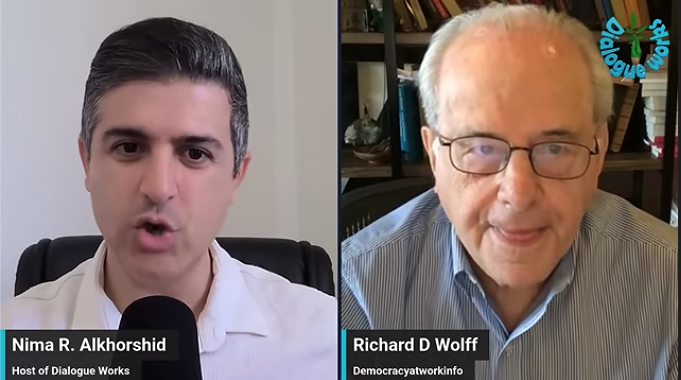 Nima chats with Prof. Richard D. Wolfff

SUMMATION—
The Decline of American Empire and the Geopolitical Struggle Over Iran and Global Power
This discussion between Nima and Professor Richard Wolff centers on the ongoing conflict between the United States and Iran, highlighting its military, economic, and geopolitical dimensions. The closure of the Strait of Hormuz and recent Yemeni blockade of Saudi Arabia have significantly disrupted global oil routes, intensifying the conflict. The U.S. has pursued an aggressive campaign combining military actions and economic sanctions against Iran, but Professor Wolff emphasizes the failure of these tactics to achieve decisive results. Iran continues its missile and drone attacks on U.S. bases and allies across the Middle East, reflecting resilience and capabilities equal to American forces.
Wolff situates this conflict within a broader narrative of the decline of the American empire, comparing it to past U.S. military failures in Vietnam, Afghanistan, and Iraq. Unlike those confined wars, the Iran conflict has global economic repercussions, affecting allies and the U.S. domestic economy, especially through skyrocketing oil prices and inflation. Sanctions, instead of crippling Iran, have been largely evadable due to support from key allies Russia and China. This alliance represents a counterbalance to U.S. hegemony, further bolstered by China’s economic rise, which continues despite American attempts at containment.
The conversation highlights the role of systemic inequality both globally and within the United States, linking the geopolitical struggle to broader critiques of capitalism and wealth concentration exemplified by figures like Elon Musk. The U.S. faces rising domestic repression and political polarization amid failing foreign policies, with internal dissent growing and some right-wing figures breaking ranks with mainstream Republican leadership.
The segment concludes with reflections on China's growing influence, the historical context of empire-building, and the urgent need for the U.S. to reconsider its approach toward global powers like China and Iran. Wolff advocates for dialogue and coexistence to avoid escalation into a nuclear conflict, warning of the hypocrisy and danger of current U.S. policies—especially regarding nuclear proliferation in the Middle East.
Highlights
- [00:34] 🛢️ Yemen’s blockade disrupts Saudi Arabia’s Red Sea oil exports, complicating the Iran-US conflict.
- [02:56] 💰 Iran’s economy faces severe crisis with currency collapse and 180% inflation due to sanctions and blockades.
- [06:46] 🚫 U.S. sanctions and military actions fail to curb Iran’s missile attacks or diminish its military strength.
- [10:10] ⚔️ The war with Iran marks a turning point illustrating the decline of the American empire.
- [17:10] 📉 War and sanctions exacerbate economic crisis and social problems within the U.S., including homelessness and budget issues.
- [30:06] 📈 China’s growth rate vastly outpaces that of the U.S. and Europe despite American containment attempts.
- [57:01] ☮️ Wolff urges a shift from containment to dialogue with China and Iran to prevent nuclear war and global catastrophe.
Key Insights
[01:45] 💥 Military-economic "one-two punch" against Iran falters: Despite severe military campaigns (Epic Fury) that targeted Iran’s armed forces, their missile and drone capacities remain intact, continuing to inflict damage on U.S. and allied positions. The addition of economic sanctions compounds pressure but fails to decisively weaken Iran, largely due to effective evasion tactics backed by Russia and China.
[06:46] 🔄 Sanctions as an ineffective geopolitical tool: Economic sanctions have historically failed to alter the strategic behavior of targeted states significantly. Wolff underscores that sanctions serve as irritants rather than determinants of change, easily circumvented through third-party allies and covert operations, rendering them insufficient for compelling policy shifts.
[10:10] 📉 Symbol of American empire decline: The Iran conflict exposes the limits of U.S. military and economic dominance, contrasting with prior prolonged wars where U.S. influence remained largely unchallenged. The inability to secure victory or suppress Iranian resistance marks a new phase in the decline of U.S. global power, inviting worldwide reassessment of American invincibility.
[15:46] 🌍 Global economic impact of a regional conflict: Unlike Vietnam or Afghanistan, the U.S.-Iran war impacts global economic stability by disrupting critical oil passages and boosting energy prices, thereby hitting U.S. domestic sectors (e.g., farming), intensifying budget deficits, social problems, and political instability at home.
[22:49] 🔁 China and Russia emerge as strategic partners undermining U.S. sanctions regime: By facilitating Iran’s economic and military survival, these nations create a formidable front against U.S. sanctions and military coalitions, highlighting a multipolar world order where U.S. unilateral pressure is less effective.
[34:04] 🎭 Domestic political repercussions in the U.S.: Rising repression, political polarization, and a loss of public support for the war reflect deep societal consequences. The war fuels right-wing extremism and the erosion of democratic norms, with possible attempts to postpone elections and suppress dissent.
[57:50] ☯️ Necessity of diplomatic engagement over containment: The historical containment policy, successful against Soviet communism, is outdated against modern, interconnected global powers. Wolff advocates for a pragmatic approach involving dialogue with Iran and China to ensure stability and reduce nuclear risk, contrasting with current contradictory U.S. policies such as arming Saudi Arabia with nuclear capabilities while accusing Iran.
This conversation paints a comprehensive picture of a pivotal moment in global geopolitics where military tactics, economic warfare, and systemic imperial decline intertwine, urging a reconsideration of strategies towards coexistence rather than prolonged conflict.