
Julian Macfarlane

Equal partners: Russia & China
OSINT muddies the waters
US Propaganda Seeks to Create Wedge Between Russia and China with “Junior Partner” Narrative
▪️The US & Europe in their current form will reject cooperation and coexistence with China because the West insists on its “inherent superiority” and primacy coupled with deep, historic racism against China and other non-white nations;
▪️The US hopes to find and exploit similar mindsets inside Russia and create a narrative that insists Russia has been “subordinated” to China;
▪️Back in reality, China is bigger than the US, Europe & Russia combined, has the largest most advanced industrial base on Earth, & Russia is simply being realistic recognizing & respecting this - even embracing the benefits of being allies with such a nation- something the West is incapable of;
▪️China’s foreign policy is one of cooperation and coexistence, making it even easier for Russia to do so;

▪️Those who cannot accept this are people incapable of accepting reality & should be moved away from positions of power/policy making;
Currently, China’s economic engines and tech hubs are concentrated along the highly vulnerable eastern coast so the objective is to build a protected inland reserve of critical industrial and military capacity deep within the Chinese interior (e.g., Sichuan, Gansu, and Chongqing). And moving strategic supply chains inland.
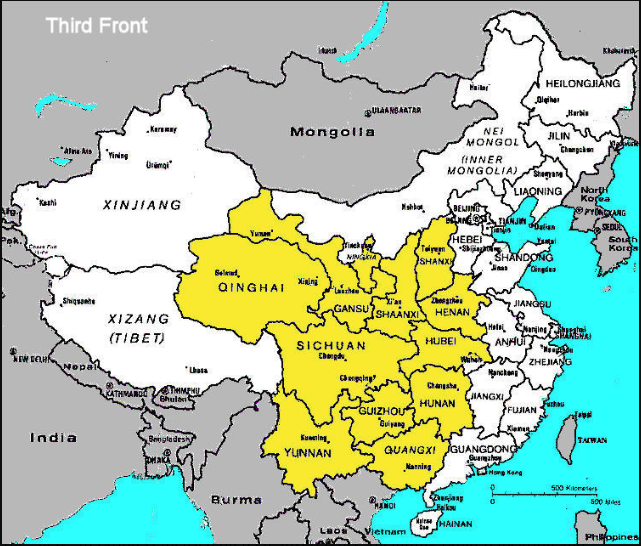
While the old Third Front focused heavily on heavy manufacturing and raw munitions, the “new” iteration is focused on tech-sovereignty. Including rapid relocation and duplication of semiconductor, AI, and advanced manufacturing infrastructure into western provinces.
OSINT data tracking commodity flows shows a massive acceleration in food, energy, and raw materials within inland hubs.
Experts from organizations like the Stockholm International Peace Research Institute (SIPRI) and independent researchers observe that this policy directly aligns with China’s sharp drop in foreign arms dependencies and its push for total self-sufficiency.
This focus on militarization is mirrored by some academics in Russia and commentators there who talk a lot about the “New Great Wall” although a lot of that died down after Putin’s visit with Xi.
The Kremlin itself uses terms like "Strategic Rear Base” when talking about Chinese defense — an admirable move by Beijing to build an impenetrable defense against the United States, "ensuring that if Washington blockades China’s coast, the country can still operate from its rear.”
Otherwise it is “Internal Circulation Infrastructure” (Инфраструктура внутреннего цикла): a logical, non-threatening step toward economic viability and development.
The Chinese themselves use the term “Great Wall”—but metaphorically. There is not one but several — the “Great Firewall” of course, the “Steel Great Wall”, which is military; the “Green Great Wall”—ecological Economic?
“Economic Great Wall”? The Chinese don’t use “wall” in this case which implies cutting themselves off from something.
Something there is that doesn’t love a wall, Robert Frost, Mending Wall.
Rather, they use “Economic Powerhouse. It is the West that is always talking about walls.
“Third Front “ is taboo , to the extent that it reflects a different era and the politics of the USSR. It only appears in academic discussions, usually in English, like a somewhat obtuse and contradictory article circulating now in Russian millyblogger circles.

Such articles reflect OSINT and Western academe, rather than the realistic views of Vladimir Putin—although the title mercifully says “New Great Wall” rather than “New Third Front”.
Of course, the Russians love to argue and ‘analyze” — at all levels of society, which makes Russia in some respect open to the Western misinformation in the Information Space.
As to defense, Russian consensus is that Xi Jinping is building facilities in the Chinese hinterland to maintain a credible, un-blockadable fallback option that effectively neutralizes military leverage from any other country. Unlike Mao’s Third Front, these defenses include all of China, including Tibet and Xinjiang, although these regions still enjoy special status
Western OSINT analysts scratch their heads. There is an image in their little minds. And the intellectual lice itch.

They counter that this initiative is being executed as an excuse to upgrade national mobilization laws, expand civil defense protocols (like the “people’s air defense” systems), and restructure military draft regulations to shift China onto a permanent, resilient wartime footing. To make it somehow like the West.

The US’s “third front” is the entire world.
OSINT as propaganda space.
Is OSINT really “open”? Yes, certainly to narratives spun by the CIA and MI6.
These narratives are like doors —they open only to certain rooms. You never get to see the whole house, though.
Doors, doors, doors…..
Sometimes, you own the house. Which is where Berletic’s analysis comes in. “Junior Partner” is we, in PR, call a “wedge of “foot-in-door” concept...

Manipulation of OSINT with memes like Russia as the “junior partner” for Russian partners to—
a.) undermine confidence in China’s good intentions
b) provoke resentment, if not jealousy
c.) revive memories of Mao’s Third Front, which was partly protection against the USSR.
At the same time, of course, ‘the Third Front” is seen as a move China is taking to protect itself against what the West thinks is the vulnerability of China’s coastline against US and Japanese forces.
US thinktanks show the US winning at great cost — but still winning. The Pentagon’s own analyses show the US losing badly in just a few weeks.

Another Wall— the Pacific
China has another wall — the Pacific Wall.
The US brays constantly about “militarization” – which turns on the notion of China as a totalitarian state dominated by military objectives –ummm….like the United States?
As a result, a lot of milly bloggers, even those on the Russian side, but who base their analyses on a combination of Western sources, Russian sources, and OSINT have been speculating that some version of the CIA/ MI6’s various narratives might have some truth to it.
Nope.
First of all, Russia is in no way a “junior partner”. Yes, Russia relies on the Chinese for some things – recently semiconductors, for example. But China needs Russia for energy, and certain aspects of military technology where it lags, and it wants Russia as an ally in keeping Japan and South Korea in check.
This Western narrative is typical because in the West, the kind of collaboration you see between Russia and China is impossible to conceive.
According to Xi Jinping’s speeches, official party resolutions, and the 15th Five-Year Plan (2026–2030), developing the “National Strategic Hinterland” is driven by a domestic blueprint to shift China toward a high-quality, citizen-centric economy.
Xi frames the relocation of industries and resources to the south and west around four major economic and social objectives designed to directly improve the lives of the Chinese people:
1. Achieving “Common Prosperity” by Closing the Wealth Gap

High-Value Job Creation: Xi’s initiative deliberately relocates advanced manufacturing, tech hubs, and AI infrastructure deep into provinces like Sichuan and Guizhou.
The Goal: This provides millions of high-skilled, well-paying tech and industrial jobs directly to rural and inland populations. It allows inland residents to achieve a middle-class lifestyle without migrating thousands of miles to coastal megacities.
2. Overcoming “Involution” Through Quality Growth
Chinese society has been plagued by “involution” (neijuan)—destructive, hyper-competitive academic and corporate cycles occurring in saturated coastal markets.
New Economic Frontiers: By pouring state resources into building new tech and green-energy ecosystems in the west, the state is actively creating a geographic relief valve.
The Goal: Xi positions this as a transition toward “New Quality Productive Forces“. This model prioritizes sustainable innovation, technological self-reliance, and tech-sovereignty over low-margin sweatshop labor, creating a healthier, more balanced work environment for the next generation.
3. Creating a Green and “Ecological Civilization”
Xi has heavily integrated the development of the hinterlands with his environmental agenda, leveraging the natural topography of the west for green transformation.
Clean Energy Expansion: The southwestern highlands are the core anchors for China’s massive solar, wind, and hydro-energy grids.
The Goal: Under initiatives like “East Data, West Computing,” dirty industrial practices are phased out. It builds a cleaner living environment for inland citizens while providing sustainable power to elevate their local quality of life.
4. Anchoring the “Convenient Living Circle” and Consumption Economy
Under the revised “Dual Circulation” strategy, the Chinese government has officially elevated domestic consumer consumption into a vital strategic priority.
Inland Infrastructure: The massive expansion of high-speed rail, modernized logistics hubs, and advanced agriculture in the interior is designed to robustly tie local economies together.
The Goal: Xi’s stated objective is to establish urban-rural “convenient living circles”. This guarantees that citizens living deep in the interior have identical access to fresh produce, modern healthcare, high-quality public education, and digital services as those living in Shanghai or Beijing.
In short, according to Xi’s official narrative, building up the hinterlands is the structural foundation required to transition China from a “factory of the world” into a balanced, green, self-sustaining society where the fruits of modernization are equally distributed.
These also happen to be Russia’s goals. Not war— but a better life .

And collaboration. Pragmatic improvement /
Russia and China move to shape fairer global AI order
Russia and China are promoting a global AI system built on equal access, technological sovereignty, transparent standards, and practical benefits for people—rather than control by a small group of Western governments and tech giants.
That vision is taking center stage at the World AI Conference in Shanghai on July 17–20, where Xi Jinping is expected to deliver the keynote address. Russia is represented by a major delegation led by Deputy Presidential Chief of Staff Maxim Oreshkin, while Digital Development Minister Maksut Shadayev signed the founding agreement for the new World AI Cooperation Organization, backed by more than 25 countries.
Its priorities include:
🟠 Human-centered and responsible AI development
🟠 Equal access to information and advanced technologies
🟠 Scientific exchange and efforts to close the global digital divide
🟠 Clear ethical standards and respect for national sovereignty
🟠 Technologies adapted to each partner’s needs without demands for exclusive control
China brings its rapidly expanding AI models and industrial ecosystem, while Russia is promoting practical applications in finance, healthcare, education, and urban services such as GigaChat, Kandinsky 3D, MAESTRO, robotics, and smart devices to Shanghai.
Russia, like China, also wants to become a major meeting point for the global AI community. Moscow is preparing to host AI Journey in November 2026, the Future Technologies Forum, and a high-level AI meeting in 2027, with China and other countries set to take an active part. Sputnik
Support New Forensics.
Help Ichi and Chappy and the human they rescue daily, the toilet guy, Julian.

I would really like to get to 5000 subscribers. If you like my work, share the urls on other blogs and sites and in comments on podcasts.
Show us you care by buying us coffee at https://buymeacoffee.com/julicow We really need the love this month . Save me from being released into the wild, like the caracal.
