
FAIR MEDIA MONITOR
Belén Fernández
Media Find a New Man Who Will ‘Save’ Colombia—de la Espriella Style
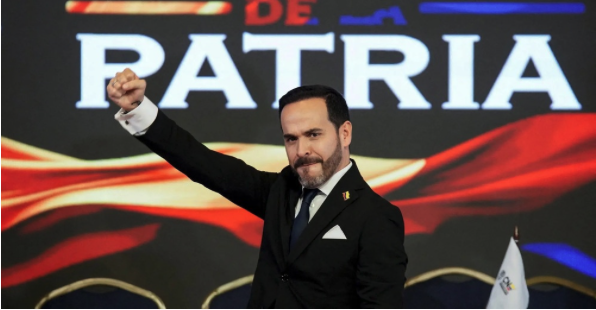
Plus, he has a fashion line, De La Espriella Style, which offers fashionable Colombians the opportunity to purchase, for example, a paisley pocket handkerchief for 246,000 Colombian pesos (approximately $80) or a 700-milliliter bottle of rum for 351,900 pesos (approximately $112).
‘Don’t say I didn’t warn you’
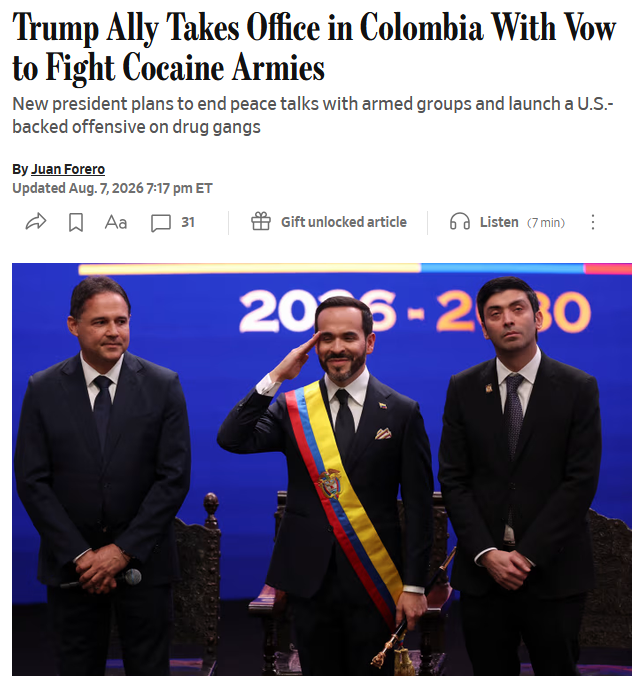
Colombian President Abelardo de la Espriella (Wall Street Journal, 8/7/26): My bombing technology will “avoid even the least impact on the civilian population.”
US corporate media coverage of de la Espriella’s ascension has tended to stick to a certain simplistic narrative: The right-wing political “outsider” with the tough-on-terrorists approach was voted into power after outgoing left-wing president and Trump nemesis Gustavo Petrofailed to resolve the country’s ongoing violence. (How the only left-wing president in Colombia’s history was supposed to fix, in just four years, a conflict that has consumed the nation for the better part of a century is, of course, never deemed a worthy topic of exploration by media outlets committed to seeing the left fail.)
Writing in the Wall Street Journal (8/7/26), Juan Forero highlighted de la Espriella’s plans to “end peace talks with armed groups”—peaceful dialogue being one of the policies espoused by the “previous leftist government”—and to “launch a US-backed offensive on drug gangs.” The article showcased various macho-sounding threats from the new leader, including: “Any outlaw who refuses to surrender will be killed. Don’t say I didn’t warn you.”
Nowhere in the dispatch did Forero find it relevant to mention Colombia’s lengthy history of US-backed offensives, such as Plan Colombia, launched by Bill Clinton in 2000. The plan continued under War on Terror chief George W. Bush, on whose watch the South American nation became the third-largest recipient of US aid in the world. Under the guise of fighting a war on drugs and leftist narco-terrorist guerrillas, Washington proceeded to fling buckets of money at a Colombian military joined at the hip with extreme right-wing paramilitary outfits that happened to be classified as terrorist organizations by the US government itself.
Predictably, all manner of massacres and other bloody havoc ensued. During the presidential reign of far-right US pal and narco-politician Álvaro Uribe (2002–10), for instance, the so-called “false positives” scandal saw thousands of civilians slaughtered by members of the Colombian army, who dressed the corpses up as guerrillas, and were rewarded accordingly with financial bonuses and vacation time. For its part, the Uribe administration pointed to its ostensible headway on the battlefield in order to request yet more money from the US. Horrors notwithstanding, the Wall Street Journal (5/29/10) immortalized Uribe in 2010 as “The Man Who Saved Colombia.”
Fast forward 16 years, and it’s perhaps unsurprising that the same paper has not found it necessary to rain on de la Espriella’s parade—not that US corporate media in general are ever overly concerned with painting a properly contextualized picture of world events, or of highlighting the vast hypocrisy that underpins US foreign policy.
The only real allusion Forero makes to previous US “help” in Colombia occurs in his false claim that in 2012 “the US and Colombia had dramatically reduced coca crops with aerial fumigation”—an environmentally hazardous and fundamentally ineffective strategy that de la Espriella is obsessed with restarting. (When I first visited Colombia in 2009, I spoke with campesinos who complained of the less-than-surgical precision of the government’s fumigation campaign, and its harmful effects on subsistence crops, water supplies, livestock and humans.)
Although Forero does manage to point out, rather diplomatically, that de la Espriella is “an unlikely figure to take on the fight against cocaine,” in light of his legal track record of defending “underworld figures,” he does not address de la Espriella’s former paramilitary clientele—a detail that has mostly evaded the scrutiny it deserves in English-language media.
Running ‘as an outsider’
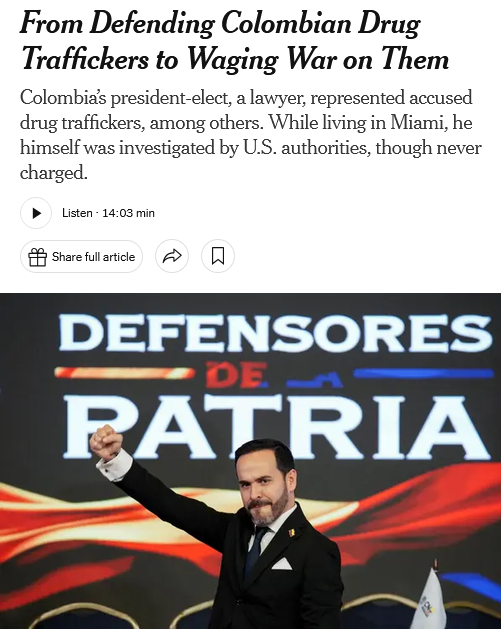
New York Times (7/25/26): De la Espriella is “promising to help the Trump administration escalate a regional drug war against the traffickers he once represented.”
In its own writeup of the inauguration, Reuters (8/7/26) noted that de la Espriella had “represented people with ties to right-wing paramilitaries during his time as a lawyer,” but said nothing more on the matter, preferring instead to focus on the impending “vigorous fight against drug trafficking, as well as austerity measures to restore confidence in the economy,” and other ass-kissing promises to “Colombia’s business leaders.” (Reuters also reported with a straight face de la Espriella’s pledge to develop “responsible and sustainable fracking.”)
Meanwhile, the Associated Press (8/7/26) merely observed that de la Espriella had run for president “as an outsider, financing his campaign with the fortune he amassed as a lawyer and businessman”—no further details needed.
A bit more attention was paid to the paramilitary issue in a pre-inaugural New York Times article (7/25/26) whose headline—“From Defending Colombian Drug Traffickers to Waging War on Them”—caused the reader to think that the US newspaper of record may have accidentally stumbled into a momentary capacity for appreciating the sinister ironies of the US-backed global order.
The Empire is empowering sinister scum embedded in Latin America's comprador elites, historically Washington's natural allies to help exploit and control the people.
Acknowledging that Colombia’s paramilitary forces had made a name for themselves “trafficking cocaine and committing atrocities,” the article by Annie Correal and David Ovalle went on to specify that, “early in his career, Mr. de la Espriella advocated for paramilitaries to be treated as political actors and defended politicians accused of having ties to the groups.”
‘Vows to remake the country’
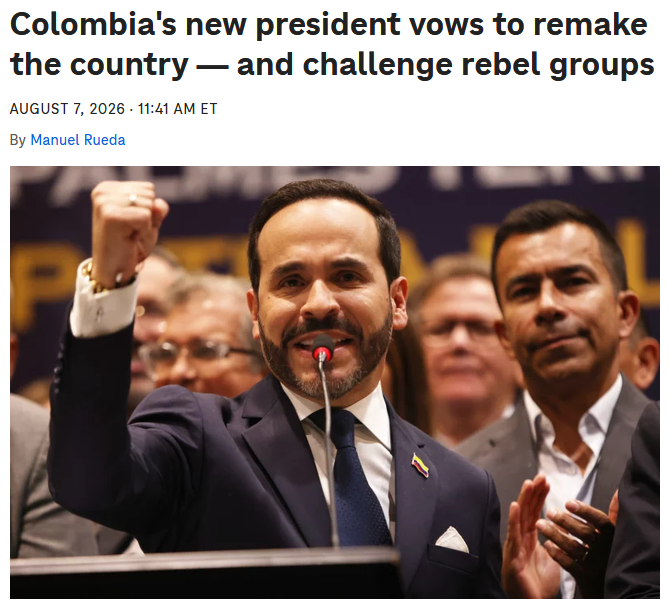
NPR‘s Manuel Rueda (8/7/26) noted that de la Espriella was “a former criminal defense lawyer”—without mentioning that his clients were frequently paramilitaries and drug traffickers.
In the end, it’s perhaps only logical that an enterprising guy like de la Espriella would jump at the opportunity to make a fortune defending folks with ties to paramilitary groups that terrorized the Colombian population on behalf of right-wing business interests. But such biographical history means that de la Espriella hardly deserves to be cast as an “outsider” to the violent Colombian political scene. It’s also helpful context in interpreting his mission to “disembowel” the left, which he doesn’t necessarily mean metaphorically.
Given that de la Espriella’s mano dura plan aligns perfectly with US goals in the region, however, he is mostly let off the hook by the media for his sociopathic vision of bombing and fumigating the hell out of Colombia. On the occasion of his inauguration, NPR (8/7/26) went with the headline “Colombia’s New President Vows to Remake the Country—and Challenge Rebel Groups”—as though a right-wing Colombian president preparing to unleash violence against his own country with the help of the United States is anything “new.”
One telling sentence did make it into the conclusion of NPR’s article regarding “Colombians who are already concerned that his anti-crime policies could lead to human rights abuses by security forces.” But, hey, it’s all in the name of challenging the “rebel groups,” which most casual corporate media consumers would take to mean left-wing organizations like the FARC—long the appointed “narco-terrorists” and number one bad guys in the US-backed regional narrative.
And yet the current dominant drug trafficking group in Colombia is not the FARC at all but rather the Clan del Golfo, which was founded by—what do you know?—veterans of the good old right-wing paramilitary formations. Granted, it is often hard to fit such details into corporate media coverage that thrives on outdated and disingenuous reductionism.
In their book Cocaine, Death Squads and the War on Terror: US Imperialism and Class Struggle in Colombia, scholars Oliver Villar and Drew Cottle expose the whole US-backed war on drugs in Colombia for what it is: a war for the control of the drug trade and an excuse for US militarization. As Villar and Cottle write, the 1980s—heyday of Pablo Escobar and the Medellín Cartel—“saw the consolidation of the Colombian drug trade as a source of profit for US capital via banks that were established to launder and invest drug money in legitimate US corporations.”
While the US “contended it was at war with drugs and terrorists in Colombia…the economic relations between US imperialism and the Colombian narco-bourgeoisie permitted cocaine production to flourish” in an ever-expanding market.
The 1980s are long past us, but US media still somehow cannot bring themselves to admit that maybe—just maybe—the US is not really fighting a war against drugs. We have known for decades by now what it looks like on the ground when the gringos send heaps of money to right-wing governments and atrocity-prone security forces in Colombia.
And yet CBS News (8/8/26), for example, reported the following as though it weren’t the oldest fucking story in the book: “US Pledges $1 Billion in Security Assistance to Colombia as New President Vows to ‘Defeat Narco-Terrorism.’” The article plowed blissfully on: “De la Espriella now has grand plans to crush armed insurgents, cozy up to the US and overhaul the system.”
Days later, the Associated Press (8/12/26) followed up:
US Defense Secretary Pete Hegseth on Wednesday said the recently inaugurated government of Colombian President Abelardo de la Espriella has requested US collaboration in joint military operations in Colombia to combat “narco-terrorism.”
As history now stands to repeat itself in a country that is already consistently among the deadliest in the world for environmental defenders, trade unionists, social justice activists and anyone else who might step on the toes of business, it remains to be seen whether the new US-backed businessman/president will be the next “Man Who Saved Colombia.” And as US corporate media persist in largely uncritical coverage, bordering on forcible amnesia, while de la Espriella prepares his military assault, you might call media outlets paramilitary outfits in their own right.
