
The US military publicly insists its presence in Africa is negligible. Is that why they call it an American “battlefield” behind closed doors?
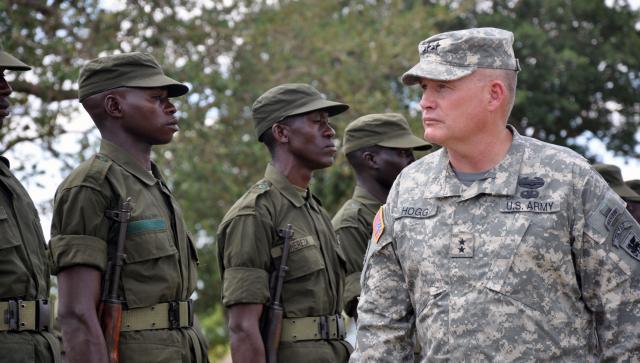
David Hogg, a big honcho in the US Army/Africa command, inspects Ugandan guard.
Ask the men involved and they’ll talk about being mindful of “sensitivities” and “cultural differences,” about the importance of “collaboration and coordination,” about the value of a variety of viewpoints, about “perspectives” and “partnerships.” Nonetheless, behind closed doors and unbeknownst to most of the people in their own countries, let alone the countries fixed in their sights, a coterie of Western special ops planners were sketching out a possible multinational military future for a troubled region of Africa.
From January 13th to 15th, representatives from the United States and 12 partner nations gathered at MacDill Air Force Base in Tampa for an exercise dubbed Silent Quest 15-1. The fictional scenario on which they were to play out their war game had a ripped-from-the-headlines quality to it. It was an amalgam of two perfectly real and ongoing foreign policy and counterterrorism disasters of the post-9/11 era: the growth ofBoko Haram in Nigeria and the emergence of the Islamic State, also known as the Islamic State of Iraq and the Levant or ISIL. The war game centered on the imagined rise of a group dubbed the “Islamic State of Africa” and the spread of its proto-caliphate over parts ofNigeria, Niger, and Cameroon—countries terrorized by the real Boko Haram, which did recently pledge its allegiance to the Islamic State.
Silent Quest 15-1 was just the latest in a series of similarly named exercises—the first took place in March 2013—designed to help plot out the special ops interventions of the next decade. This war game was no paintball-style walk in the woods. There were no mock firefights, no dress rehearsals. It wasn’t the flag football equivalent of battle. Instead, it was a tabletop exercise building on something all too real: the ever-expanding panoply of US and allied military activities across ever-larger parts of Africa. Speaking of that continent, Matt Pascual, a participant in Silent Quest and the Africa desk officer for SOCOM’s Euro-Africa Support Group, noted that the United States and its allies were already dealing with “myriad issues” in the region and, perhaps most importantly, that many of the participating countries “are already there.” The country “already there” the most is, of course, Pascual’s own: the United States.
[dropcap]I[/dropcap]n recent years, the United States has been involved in a variety of multinational interventions in Africa, including one in Libya that involved both a secret war and aconventional campaign of missiles and air strikes, assistanceto French forces in the Central African Republic and Mali, and the training and funding of African proxies to do battle against militant groups like Boko Haramas well as Somalia’s al-Shabab and Mali’sAnsar al-Dine. In 2014, the United States carried out 674 military activities across Africa, nearly two missions per day, an almost 300% jump in the number of annual operations, exercises, and military-to-military training activities since US Africa Command (AFRICOM) was established in 2008.
Despite this massive increase in missions and a similar swelling of bases, personnel, and funding, the picture painted last month before the Senate Armed Services Committee by AFRICOM chief General David Rodriguez was startlingly bleak. For all the American efforts across Africa, Rodriguez offered a vision of a continent in crisis, imperiled from East to West by militant groups that have developed, grown in strength, or increased their deadly reach in the face of US counterterrorism efforts.
“Transregional terrorists and criminal networks continue to adapt and expand aggressively,” Rodriguez told committee members. “Al-Shabab has broadened its operations to conduct, or attempt to conduct, asymmetric attacks against Uganda, Ethiopia, Djibouti, and especially Kenya. Libya-based threats are growing rapidly, including an expanding ISIL presence… Boko Haram threatens the ability of the Nigerian government to provide security and basic services in large portions of the northeast.” Despite the grim outcomes since the American military began “pivoting” to Africa after 9/11, the United States recently signed an agreement designed to keep its troops based on the continent until almost midcentury.
Mission Creep
[dropcap]F[/dropcap]or years, the US military has publicly insisted that its efforts in Africa are negligible, intentionally leaving the American people, not to mention most Africans, in the dark about the true size, scale, and scope of its operations there. AFRICOM public affairs personnel and commanders have repeatedly claimed no more than a “light footprint” on the continent. They shrink from talk of camps and outposts, claiming to have just onebaseanywhere in Africa: Camp Lemonnier in the tiny nation of Djibouti. They don’t like to talk aboutmilitary operations. They offer detailed information about only a tiny fraction of their training exercises. They refuse to disclose the locations where personnel have been stationed or even counts of the countries involved.
During an interview, an AFRICOM spokesman once expressed his worry to me that even tabulating how many deployments the command has in Africa would offer a “skewed image” of US efforts. Behind closed doors, however, AFRICOM’s officers speak quite a different language. They have repeatedly asserted that the continent is an American “battlefield” and that—make no bones about it—they are already embroiled in an actual “war.”
According to recently released figures from US Africa Command, the scope of that “war” grew dramatically in 2014. In its “posture statement,” AFRICOM reports that it conducted 68 operations last year, up from 55 the year before. These included operations Juniper Micron and Echo Casemate, missions focused on aiding French and African interventions in Mali and the Central African Republic; Observant Compass, an effort to degrade or destroy what’s left of Joseph Kony’s murderous Lord’s Resistance Army in central Africa; and United Assistance, the deployment of military personnel to combat theEbola crisis in West Africa.
The number of major joint field exercises US personnel engaged in with African military partners inched up from 10 in 2013 to 11 last year. These included African Lion in Morocco, Western Accord in Senegal, Central Accordin Cameroon, and Southern Accordin Malawi, all of which had a field training component and served as capstone events for the prior year’s military-to-military instruction missions.
AFRICOM also conducted maritime security exercises including Obangame Express in the Gulf of Guinea, Saharan Express in the waters off Senegal, and three weeks of maritime security training scenarios as part of Phoenix Express 2014, with sailors from numerous countries including Algeria, Italy, Libya, Malta, Morocco, Tunisia, and Turkey.
The number of security cooperation activities skyrocketed from 481 in 2013 to 595 last year. Such efforts included military training under a “state partnership program” that teams African military forces with US National Guard units and the State Department-funded Africa Contingency Operations Training and Assistance, or ACOTA, program through which US military advisers and mentors provide equipment and instruction to African troops.
In 2013, the combined total of all US activities on the continent reached 546, an average of more than one mission per day. Last year, that number leapt to 674. In other words, US troops were carrying out almost two operations, exercises, or activities—from drone strikes to counterinsurgency instruction, intelligence gathering to marksmanship training—somewhere in Africa every day. This represents an enormous increase from the 172 “missions, activities, programs, and exercises” that AFRICOM inherited from other geographic commands when it began operations in 2008.
Transnational Terror Groups: Something From Nothing
In 2000, a report prepared under the auspices of the US Army War College’s Strategic Studies Institute examined the “African security environment.” While it touched on “internal separatist or rebel movements” in “weak states,” as well as non-state actors like militias and “warlord armies,” there was conspicuously no mention of Islamic extremism or major transnational terrorist threats. Prior to 2001, in fact, the United States did not recognize any terrorist organizations in sub-Saharan Africa and a senior Pentagon official noted that the most feared Islamic militants on the continent had “not engaged in acts of terrorism outside Somalia.”
In the wake of 9/11, even before AFRICOM was created, the United States began ramping up operations across the continent in an effort to bolster the counterterror capabilities of allies and insulate Africa from transnational terror groups, namely globe-trotting Islamic extremists. The continent, in other words, was seen as something of a clean slate for experiments in terror prevention.
Billions of dollars have been pumped into Africa to build bases, arm allies, gather intelligence, fight proxy wars, assassinate militants, and conduct perhaps thousands of military missions—and none of it has had its intended effect. Last year, for example, Somali militants “either planned or executed increasingly complex and lethal attacks in Somalia, Kenya, Uganda, Djibouti, and Ethiopia,” according to AFRICOM. Earlier this month, those same al-Shabab militants upped the ante by slaughtering 142 students at a college in Kenya.
And al-Shabab’s deadly growth and spread has hardly been the exception to the rule in Africa. In recent testimony before the Senate Armed Services Committee, AFRICOM commander Rodriguez rattled off the names of numerous Islamic terror groups that have sprung up in the intervening years, destabilizing the very countries the United States had sought to strengthen. While the posture statement he presented put the best gloss possible on Washington’s military efforts in Africa, even a cursory reading of it—and under the circumstances, it’s worth quoting at length—paints a bleak picture of what that “pivot” to Africa has actually meant on the ground. Sections pulled from various parts of the document speak volumes:
The network of al-Qaeda and its affiliates and adherents continues to exploit Africa’s under-governed regions and porous borders to train and conduct attacks. The Islamic State of Iraq and the Levant is expanding its presence in North Africa. Terrorists with allegiances to multiple groups are expanding their collaboration in recruitment, financing, training, and operations, both within Africa and trans-regionally. Violent extremist organizations are utilizing increasingly sophisticated improvised explosive devices, and casualties from these weapons in Africa increased by approximately 40 percent in 2014…
In North and West Africa, Libyan and Nigerian insecurity increasingly threaten United States interests. In spite of multinational security efforts, terrorist and criminal networks are gaining strength and interoperability. Al-Qaeda in the Lands of the Islamic Maghreb, Ansar al-Sharia, al-Murabitun, Boko Haram, the Islamic State of Iraq and the Levant, and other violent extremist organizations are exploiting weak governance, corrupt leadership, and porous borders across the Sahel and Maghreb to train and move fighters and distribute resources…
Libya-based threats to United States interests are growing… Libyan governance, security, and economic stability deteriorated significantly in the past year… Today, armed groups control large areas of territory in Libya and operate with impunity. Libya appears to be emerging as a safe haven where terrorists, including al-Qaeda and Islamic State of Iraq and the Levant-affiliated groups, can train and rebuild with impunity. The Islamic State of Iraq and the Levant is increasingly active in Libya, including in Derna, Benghazi, Tripoli, and Sebha…
The spillover effects of instability in Libya and northern Mali increase risks to United States interests in Europe, the Middle East, and Africa, including the success of Tunisia’s democratic transition…
The security situation in Nigeria also declined in the past year. Boko Haram threatens the functioning of a government that is challenged to maintain its people’s trust and to provide security and other basic services… Boko Haram has launched attacks across Nigeria’s borders into Cameroon, Chad, and Niger…
…both the Central African Republic and Democratic Republic of the Congo are at risk of further destabilization by insurgent groups, and simmering ethnic tensions in the Great Lakes region have the potential to boil over violently in the Democratic Republic of the Congo.
All this, mind you, is AFRICOM’s own assessment of the situation on the continent on which it has focused its efforts for the better part of a decade as United States missions there soared. In this context, it’s worth reemphasizing that, before the United States ramped up those efforts, Africa was—by Washington’s own estimation—relatively free of transnational Islamic terror groups.
Tipping the Scales in Africa
Despite Boko Haram’s pledge of allegiance to the Islamic State andscareheadlineslamenting their merger or conflating those or other brutal terror outfits operating under similar monikers, there is currently no realIslamic State of Africa. But the war game carried out at MacDill Air Force Base in January against that fictional group is far from fantasy, representing as it does the next logical step in a series of operations that have been gaining steam since AFRICOM’s birth. And buried in the command’s 2015 Posture Statement is actual news that signals a continuation of this trajectory into the 2040s.
In May 2014, the United States reached an agreement—it’s called an “implementing arrangement”—with the government of Djibouti “that secures [its] presence” in that country “through 2044.” In addition, AFRICOM officers are now talking about the possibility of building a string of surveillance outposts along the northern tier of the continent. And don’t forget how, over the past few years, United States staging areas, mini-bases, and airfields have popped up in the contiguous nations of Senegal, Mali, Burkina Faso, Niger, and—skipping Chad (where AFRICOM recently built temporary facilities for a special ops exercise)—the Central African Republic, South Sudan, Uganda, Kenya, and Ethiopia. All of this suggests that the United States military is digging in for the long haul in Africa.
Silent Quest 15-1 was designed as a model to demonstrate just how Washington will conduct “Special Operations-centric” coalition warfare in Africa. It was, in fact, designed to align, wrote Gunnery Sergeant Reina Barnett in SOCOM’s trade publication Tip of the Spear, with the “2020 planning guidance of Army Maj. Gen. James Linder, commander of Special Operations Command Africa.” And the agreement with Djibouti demonstrates that the United States military is now beginning to plan for almost a quarter-century beyond that. But, if the last six years—marked by a 300 percent increase in United States missions as well as the spread of terror groups and terrorism in Africa—are any indicator, the results are likely to be anything but pleasing to Washington.
AFRICOM commander David Rodriguez continues to put the best face on United States efforts in Africa, citing “progress in several areas through close cooperation with our allies and partners.” His command’s assessment of the situation, however, is remarkably bleak. “Where our national interests compel us to tip the scales and enhance collective security gains, we may have to do more—either by enabling our allies and partners, or acting unilaterally,” reads the posture statement Rodriguez delivered to that Senate committee.
After more than a decade of increasing efforts, however, there’s little evidence that AFRICOM has the slightest idea how to tip the scales in its own favor in Africa.

ORIGINAL ITERATION AT: http://www.thenation.com/article/us-carried-out-674-military-operations-africa-last-year-did-you-hear-about-any-them/
[printfriendly]
“…in the new exuberant aggressiveness of world capitalism we see what communists and their allies held at bay.” – Richard Levins (Source: The Proletarian Center).
Please remember: All captions and pullquotes are furnished by the editors, NOT the author(s).
The Greanville Post is the best edited political blog in the anglophone world. No one matches our standards.
We give you the unadulterated truths that affect your life and the lives of countless people around the world, and the destiny of the planet itself. Just think for a moment: an insignificant sum for you can mean whether we continue to publish or go under. Don’t take the citizens’ media—YOUR media—for granted. Sign up today for a simple, recurring donation of just $5. You can cancel anytime—and no hard feelings. That’s a promise.


4 comments
674 missions in Africa?
Really? That…………is what we call a battlefield??
Surgical strikes or “training” missions is NOT a battlefield. This is a lackluster approach to a massive problem.
This type of activity is just as bad not doing anything.