


=By= Jon Hochschartner
OPEDS
(ALL CAPTIONS, IMAGE SELECTION AND PULL QUOTES BY THE EDITOR NOT THE AUTHOR)
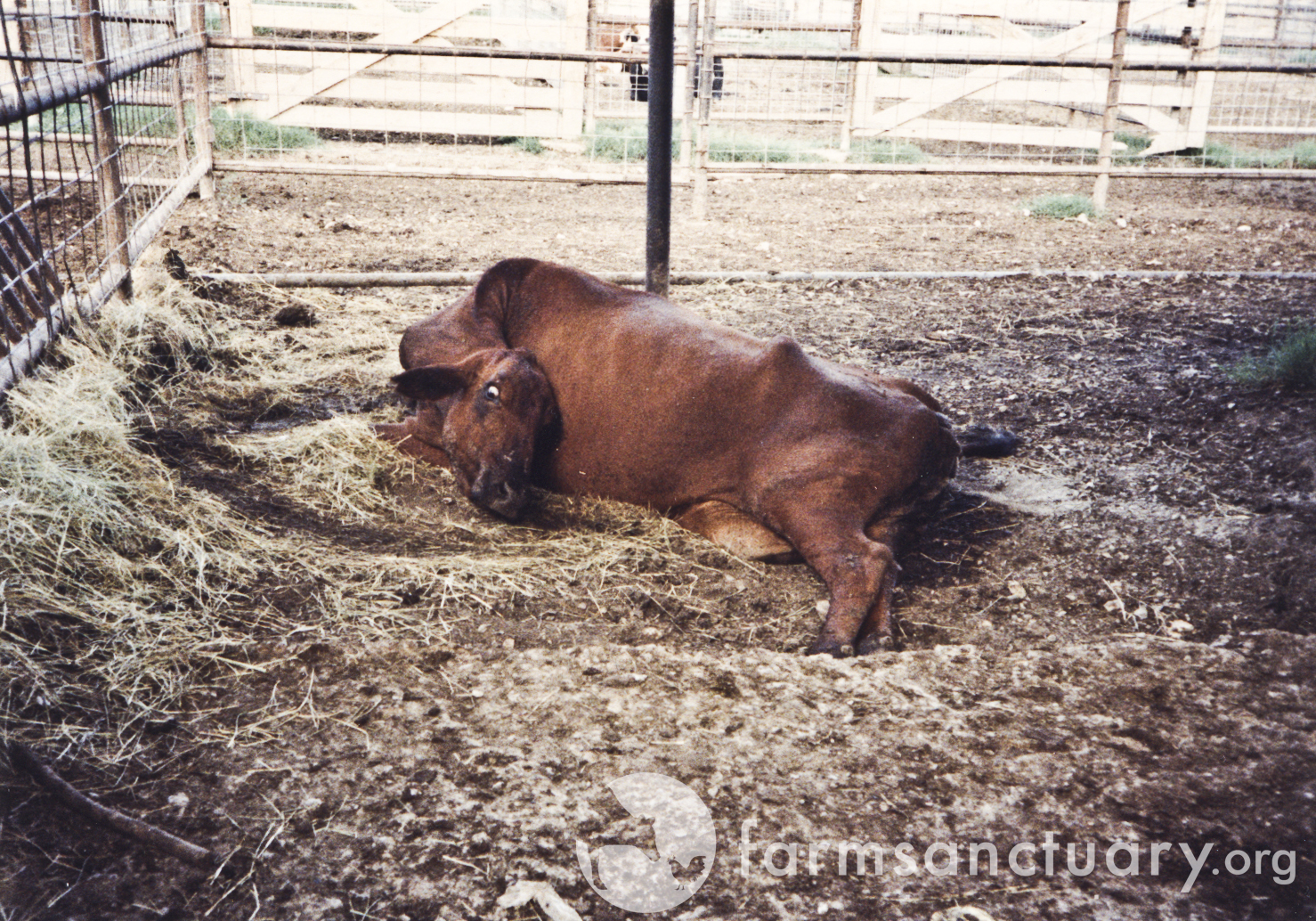
A downed cow with a broken neck is left to suffer at a Texas stockyard. Her neck was broken when she was forcibly separated from her calf in the marketing process. Horrors like these are regarded as routine in the animal business. Decency does not enter the equation.
 [su_dropcap style=”light” size=”4″]I’d[/su_dropcap] like to take a moment to defend the Non-Humans First Declaration, a text that has become something of a boogeyman amongst intersectional animalists. (See Appendix). But first, let me be clear about what I’m not doing. I’m not defending the signatories, social media activity associated with the declaration, or anything ancillary to the text itself. This isn’t necessarily meant as a condemnation of these. Rather, I want to limit the scope of my argument.
As mentioned, the declaration has amassed many critics. For instance, while I don’t have the work in front of me, I believe in “The Politics of Total Liberation: Revolution for the 21st Century,” Steven Best described the text as ‘fascist.’ Fascism is one of those accusations slung around the left with such frequency it has lost nearly all meaning. And, as much as I respect Best, I suspect his opposition to the declaration might be personal, rather than political, given a noted signatory is a former comrade, against whom he was forced to take out a restraining order. This would be, of course, understandable on Best’s part, considering what he has gone through, and I wish him a speedy recovery.
In a 2013 article for the Vegan Feminist Network, Syl took issue with the declaration’s approach, arguing signatories “don’t seem to realize that over time, we will lose people from the movement since women, people of color, homosexuals, disabled people, etc will run the hell away.” Corey Wrenn, writing for the Academic Abolitionist Vegan that same year, stated, “Dismissing the importance of intersectionality, the declaration promotes, intentionally or not, what equates to misogyny and white supremacy apologism. It is a position that I argue constitutes harm on vulnerable humans and reflects the privileged space occupied by many anti-speciesist organizers.”
[dropcap]I[/dropcap] would like to address such criticism with a close analysis of the text itself. I know my defense of the declaration will open me up to various accusations. I only hope those who disagree restrict their attacks to my argument. Ad-hominem attacks create an atmosphere in which learning, growth, and debate necessary for the health of our movement, are impossible. With that in mind, and doing my best to observe my own dictum, let’s begin.
In what I believe is the first section animalists might find controversial, the declaration states, “Whereas; non-human animals are in a situation of immediate emergency and global holocaust with no human crises even coming close to its scale.” Some might disapprove of the use of the word ‘holocaust.’ But as I’ve argued elsewhere, all movements compare themselves to struggles of time past, both to confer legitimacy on themselves and establish the urgency of their cause.

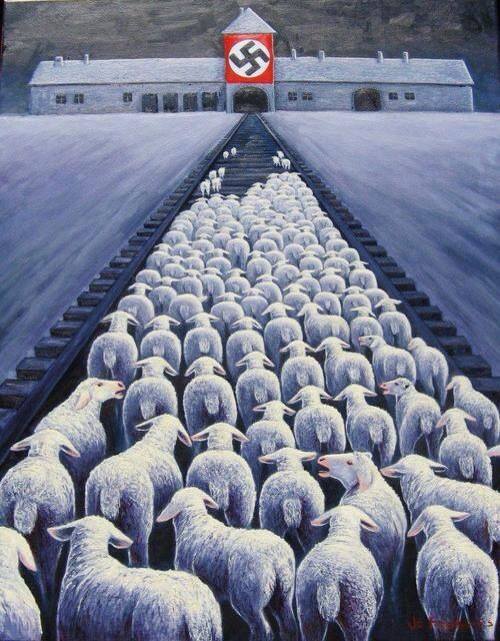
Auschwitz-Birkenau: Terminal line, literally, for countless victims of industrialized racism and bigotry. An unfathomable crime. But animals suffer, too, in even more mind-boggling numbers. Images such as the one below —evoking slaughterhouses and factory farms—offend some delicate sensibilities. Too bad.
“The truth is the scale of violence against animals must be clearly stated in a society, in which, even amongst leftists, animalism is dismissed as an eccentric, bourgeois concern, that, at best, can be seen to after capitalism, white supremacy, and patriarchy are overthrown.
Animals are not only killed in massive numbers for food…they also fall victim to human imbecility and religious superstitions, like the festival of Gadhimai, at last, recently banned in Nepal.

They also live lives of misery in cages and then a torturous death on account of vanity. (Minks in cages and a “mink farm”).

For instance, the celebrated Black writer, James Baldwin, describing government repression against the Black Panthers, said, “Now, exactly like the Germans at the time of the Third Reich, though innocent men are being harassed, jailed, and murdered, in all the Northern cities, the citizens know nothing, and wish to know nothing, of what is happening around them.” A quick internet search reveals Baldwin made such analogies frequently. Many readers, I believe, might find such comparisons provocative or inaccurate, but I doubt they’re outraged by them. It’s only when human suffering is compared to animal suffering these analogies become truly objectionable. And that’s speciesism.
 One pig escapes. Artist: Sue Coe.
[dropcap]A[/dropcap]s to whether animal suffering is of a greater scale than human suffering, as the declaration suggests, this seems inarguable to me. Over 65 billion land animals are slaughtered every year, according to Farm Animal Rights Movement. To put that in a bit of perspective, the Population Reference Bureau estimates only 107 billion humans have ever lived. So, of course, animal suffering is infinitely greater than its human equivalent. Some may ask why this matters, wondering if animals really need to compete in what’s often called the “Oppression Olympics.” I’m sympathetic to this line of questioning. But the truth is the scale of violence against animals must be clearly stated in a society, in which, even amongst leftists, animalism is dismissed as an eccentric, bourgeois concern, that, at best, can be seen to after capitalism, white supremacy, and patriarchy are overthrown.
[su_pullquote align=”right”]“Time spent by the animalist worker, rallying against his capitalist exploiters, is time taken away from efforts aimed at defeating human supremacy. That’s the reality, sad as it is…”[/su_pullquote]
All species are liable to endure mass killing on account of human food habits. Rabbits, too, of course. Animal flesh consumption is not needed for human sustenance and health, and in many cases it’s actually a significant risk, including a major threat to the environment comparable to carbon emissions.

The declaration continues, stating, “Whereas; we recognise our role as animal rights activists as being to directly advocate for non-human animals giving their interests a voice (as they have none in human society), rather than to represent our own ideologies and interests.” Presumably, the only portion of this with which animalists might disagree is the admonition not to represent one’s own interests. First of all, it has to be pointed out no one is forced to stop representing their own interests based on what’s said in the declaration. It’s not legally binding or anything. So, to me, it’s suggesting that, say, the animalist worker devote his time to confronting human supremacy, rather than his own exploitation by capitalists. The worker is, of course, free to do whatever he chooses. As the declaration repeatedly states — and as should be assumed, given the fact it’s written by random people on the internet, not the government — these are principles voluntarily agreed to.
Cattle remains the most victimized species, among the larger animals, followed by pigs. But chickens represent the largest category of sentient beings processed in the animal industrial system.

In her article, Syl suggested activism was not a zero-sum game, and thus there is no need to prioritize one struggle over another. I’ve made similar statements in the past. But the truth is, we are mortal beings with limited time on this earth. Time spent by the animalist worker, rallying against his capitalist exploiters, is time taken away from efforts aimed at defeating human supremacy. That’s the reality, sad as it is. And while surely capitalism and human supremacy are connected, some efforts more directly fight one than the other. Conscious or not, some sort of prioritization of struggles must take place. And to me, that’s what the Non-Human First Declaration is. It states the signatories prioritize the goals of the animalist movement above all other political objectives.
[dropcap]I[/dropcap]n perhaps the most controversial statement of the text, the declaration states, “No one should be excluded from participation in animal rights activities based on their views on human issues. The non-human animals are in a situation of immediate emergency and need all the help they can get! Furthermore, the women’s rights, anti-racism, etc. movements have no requirement that participants reject species oppression nor should the animal movement demand the adherence to human rights positions while animals are still in a state of emergency.” Such a big-tent approach is fairly common in other movements. For instance, one must assume the National Abortion Rights Action League has no official position on socialism. Were it to insist all of its members be socialists, the group would obviously be smaller and less effective.
Exploring this point in more depth, I’ve used the example of the anti-war movement in the United States of the 1960s and 1970s. According to socialist Peter Camejo, there were two general strategies amongst peace groups of that era. One was represented in the Student Mobilization Committee to End the War in Vietnam (SMC), and the other in Students for a Democratic Society (SDS). Camejo belonged to the former organization, which — according to Michael Steven Smith and Paul Leblanc, writing in the International Socialist Review — ultimately served as the “backbone of the campus antiwar efforts.” For his part, Camejo credited SMC success to its big-tent approach.
“The SMC didn’t require that its members hold any particular beliefs outside of wanting the United States to immediately withdraw from Vietnam,” Camejo said. “The [Socialist Workers Party] understood that the development of a genuinely united mass movement against the war was of crucial importance and that people didn’t have to agree on the nature of capitalism, the two-party system, or other issues in order to work together to demonstrate against the war.” In contrast, SDS insisted participants in their anti-war efforts agree on multiple issues, and as a result their demonstrations were much smaller.
To me, the conclusions Camejo draws here feel intuitive, and how they would apply to animalist campaigns seems obvious. The fewer ideological demands one applies to potential members or participants, the larger your base of support will be. The more ideological demands one applies to potential members or participants, the smaller your base of support will be. In practice, this suggests we should support big-tent animalist groups, that don’t have an official position on new welfarism or abolitionism, let alone trigger warnings and Palestinian resistance. However, as the declaration states, “every rule has its exceptions.”
The text continues, but I think, for the most part, it restates already-mentioned principles, the objections to which I’ve addressed. In conclusion, I believe the Non-Humans First Declaration has been unfairly demonized. While I will not speak to criticism of the signatories or social-media activity associated with the text, I do support the declaration itself. I look forward to what I hope is a constructive dialogue on the issue, free from personal attacks on both sides.

The author with the woman who shares his life and two of his furry children.
Jon Hochschartner is an animal rights activist, who is also engaged in anti-capitalist struggles. He resides in upstate New York.
APPENDIX
The Non-Humans First Declaration
[su_dropcap style=”light” size=”4″]W[/su_dropcap]hereas; non-human animals are being oppressed and murdered by over 99 percent of the human population and these humans refuse to denounce human privilege.
Whereas; non-human animals are in a situation of immediate emergency and global holocaust with no human crises even coming close to its scale.
Whereas; we recognise our role as animal rights activists as being to directly advocate for non-human animals giving their interests a voice (as they have none in human society), rather than to represent our own ideologies and interests.
We seek to work under the following voluntary principles:
1. No one should be excluded from participation in animal rights activities based on their views on human issues. The non-human animals are in a situation of immediate emergency and need all the help they can get! Furthermore, the women’s rights, anti-racism, etc. movements have no requirement that participants reject species oppression and nor should the animal movement demand the adherence to human rights positions while animals are still in a state of emergency. Of course, every rule has its exceptions (as decided by individual groups) but these kind of bans and exclusions should not be the norm in animal rights.
2. Tactics should prioritise non-human animals, given their emergency situation and the fact non-human animals are being oppressed by the majority of humans. No tactical idea should be excluded from the discussion based on its conflict with human rights ideology.
3. We are aware and concerned about the fact that some human rights improvements within a fundamentally oppressive system towards non-humans leads to increased oppression of non-human animals. For example, economic improvements leading to increases in factory farming, meat consumption, animal labs, etc. We therefore call on human beings to free their own (non-human) slaves before demanding their own rights.
We recognise that individual situations require different responses, these are not rules or policies – nothing is set in stone. These are just generalised, flexible principles. Also we do not seek to define others’ participation within animal rights, these are our principles, we do not seek to force them on others and we expect others not to force us to conform to their beliefs.
This declaration is totally voluntary and we respect opposing views providing they are not used to exclude people from participation in animal rights activities.
The Non-Humans First Declaration does not oppose the idea of human rights, nor does it put non-human animals above humans in moral status. Its aim is only the recognition of the emergency situation of non-human animals and the fact currently the majority of humans are in a oppressor/oppressed relationship with non-human animals.
Group Signatories;
UK Animal Rights Protests https://www.facebook.com/UkAnimalRightsProtests
269life UK https://www.facebook.com/269UK
269life https://www.facebook.com/269calf
269Life South Africa https://www.facebook.com/pages/269Life-South-Africa/374799952648503
Animal Welfare Enforcement Agencyhttps://www.facebook.com/AnimalWelfareEnforcementAgency
269Life Costa Rica https://www.facebook.com/269LifeCostaRica
Stop Primate Abuse https://www.facebook.com/StopPrimateAbuse
Sirius Global Animal Organisation https://www.facebook.com/pages/Sirius-Global-Animal-Organisation/186631904749048
Veg Foods https://www.facebook.com/pages/VEG-FOOD/575848895805413
Bangor Animal Kingship https://www.facebook.com/BangorAnimalRightsKinship
The AAK https://www.facebook.com/AAK4animalliberation?ref=hl
Israel Animal Liberation Press Office https://www.facebook.com/ialpo
Alliance For Animals https://www.facebook.com/alliance4animals?directed_target_id=0
Freedom Farm Sanctuary https://www.facebook.com/pages/Freedom-Farm-Animal-Sanctuary/437775272997984
Non-Human Animal Protection Society in Australiahttps://www.facebook.com/groups/nonhumansoc/
Noted Signatories
George House (Former Animal Liberation Prisoner)
Sasha Boojor (269Life)
Camille Marino (Former Animal Liberation Prisoner, Negotiation is Over, Eleventh Hour for Animals)
For Individual Signatories: Please Sign here: https://www.change.org/en-GB/petitions/the-animal-rights-movement-the-non-humans-first-declaration-individual-signatories?share_id=DKHWyvBUsX&utm_campaign=share_button_action_box&utm_medium=facebook&utm_source=share_petition
Note to Commenters
Due to severe hacking attacks in the recent past that brought our site down for up to 11 days with considerable loss of circulation, we exercise extreme caution in the comments we publish, as the comment box has been one of the main arteries to inject malicious code. Because of that comments may not appear immediately, but rest assured that if you are a legitimate commenter your opinion will be published within 24 hours. If your comment fails to appear, and you wish to reach us directly, send us a mail at: editor@greanvillepost.com
We apologize for this inconvenience.
 Nauseated by the
vile corporate media?
Had enough of their lies, escapism,
omissions and relentless manipulation?
Send a donation to
The Greanville Post–or
But be sure to support YOUR media.
If you don’t, who will?




5 comments
The First Declaration for animals is ancient and integral to Indian thought. It was first invoked thousands of years ago in the Acharanga Sutra of the Jain religion:
“For there is nothing inaccessible for death.
All beings are fond of life, hate pain, like pleasure,
shun destruction, like life, long to live. To all life
is dear.” Jain Acharanga sutra
“These words of the venerable Mahavir found in the
Acharanga Sutra are some of the profoundest ever found
in a religious scripture. They are a result of a
tremendous but simple spiritual discovery: all life is
holy, sacred or God-given. Life, therefore, has
intrinsic values – and all that lives has an interest
in living.” Rev Andrew Linsey
Holocausts are a creation of the dominion religions: judaism, christianity and islam in their never ending internecine holy wars. Holocausts are in the dominion lexicon. Using the high pitched language of dominion to elicit empathy for the plight of animals, trivializes their suffering and misses the point of dominion: human lives have more value than animal lives. So that even those for whom the holocaust is not a distant memory still have little sympathy for the terrible violence inflicted on animals in the name of dominion.
“… the moral equating of animals and humans, is an affront to the very essence of Jewish belief, which exalts the human being, alone among God’s creations, as, among other things, the possessor of free will, a being capable of choosing to do good or bad. That distinction is introduced in Genesis, where the first man is commanded to “rule over” the animal world.” Rabbi Avi Shafran
Genesis 9:1-3 “The fear and dread of you shall rest on every animal of the earth, and on every bird of the air, on everything that creeps on the ground, and on all the fish in the sea; into your hand they are delivered. Every moving thing that lives shall be food for you; and just as I gave you the green plants, I give you everything.'”
There are no holocausts: animal of human in the history or language of Ahimsa.
It is due to the influence of ahimsa that the dreaded Gadhimai Festival in Nepal has ended animal sacrifice… As the dominion religions continue their sacrifices without reservation. Just recently in the USA 45 million turkeys were sacrificed for one day of gratitude – This is Thanksgiving in a judo.christian nation.
A declaration for animals will not resonate for those afflicted by dominion… they will dismiss holocaust comparisons of animal suffering as a mockery of human importance. They will not understand that animal lives have inherent worth. Those seeking universal, uncompromised compassion for animals will not be understood within the context of biblical compassion.
A declaration for the rights of animals in the context of dominion will give them the right to swift and precise slaughter, humane exploitation and euthanasia when they become a financial inconvenience. There are no ‘kill shelters’ in India, where a street dog has a better chance of survival than a dog in an american shelter.
There will be no justice for animals so long as the semitic religious tradition… rooted in the evil of dominion, is assumed to be a moral authority. Any support to this tradition invalidates the efforts of the compassionate. We must begin to use the language of ahimsa for a brighter future for animals… and by extension man:
Don’t kill any living beings. Don’t try to rule them.
Mahavira (Acaranga, 4/23)
Why is it that in a nation where dominion is the law of the land … human rights and animal rights are pitted against each other? In part it is because the judeo.christian ethic of dominion grants humans supremacy over animals:
Genesis 9:1-3 “The fear and dread of you shall rest on every animal of the earth, and on every bird of the air, on everything that creeps on the ground, and on all the fish in the sea; into your hand they are delivered. Every moving thing that lives shall be food for you; and just as I gave you the green plants, I give you everything.'”
Any threat to the hierarchy of dominion immediately becomes us against them…
We can opt out of all the haggling by dropping the dominion ethic… The baseline for compassion for animals in India is ahimsa…reverence for life. Ahimsa does not equivocate about who is more important…all lives have inherent value… all lives matter. Violence to all living beings is to be avoided.
We could sidestep all the squabbling between animal activists… all the squabbling between die hard dominionists and those who value animal lives as they do their own… by avoiding the pitfalls of dominion.
One thing is clear… though beset with serious political issues… animals do have much more protection and respect in India than in western nations.
It is so easy to just step out of the dominion construct… and support those who due to ahimsa… have the power to effect change for animals, while respecting human rights… The Jain community of India plays a huge role in lobbying for change for animals…
Recently the city of Palitana, Gujarat, India shut down 250 slaughter houses within city limits. Palitana is an important center of culture for the Jains. They refused to allow slaughter in their midst.
As we cling to our dominion religions which offer little hope for animals… we remain mired down by the constraints of dominion…. and are forced into energy consuming squabbles.
If we dare to speak of ahimsa, discard dominion, let go of the religions that thrive on animal abuse and instead choose live by ahimsa, there is much to be gained…. If we only dare.
THERE IS MUCH TO LEARN FROM INDIA AND THE WISDOM OF AHIMSA.
“Always reflect on the burdens we have placed on fellow creatures, and how we can help them, not exploit them. We note with admiration how Indian rangers give a tiger mother a respectful funeral, in a pyre, with proper consternation written on their faces. How different from the usual Western exploitative attitude to so many creatures. For all her troubles and contradictions India remains a unique civilization with much to teach humanity about our place in the web of life”. —PG https://www.greanvillepost.com/2015/10/09/tigers-revenge-videos/
Please note… The Gadhimai Festival in Nepal will no longer perform animal sacrifice… in part because of and understanding of ahimsa…. Including it as an example of on-going violence to animals is disingenuous….
Meanwhile there has been a resurgence of animal sacrifice in Israel. To ban it would be a violation of biblical law.
Then there’s the christian form of sacrifice, where for example 45 million turkeys are sacrificed as an expression of gratitude…
Sacrifice for EiD is widespread.
So as a Hindu temple in Nepal has put an end to sacrifice… the three dominion religions perpetuate and resurrect it in its many forms.
this is not a comment – just test to see if i can view my comments…
I find it strange that the author has sympathy for Steve Best… He hasn’t got his facts straight. Steve best, in order to avoid prosecution for his ideas, similar to those of Camille Marino was willing to betray the cause and testify against Marino. She went to prison.
Though I do not agree with some of what Marino says, I have no doubt of her great integrity and courage in helping animals as she sees most beneficial.
Steve Best on the other hand backtracked and is now an ardent foe of anything Marino says… The author is correct in his assessment that Steve’s perspective is skewed, though not due to harassment from Marino, but because of his lack of moral courage.
As always, I believe the solution to ending violence lies outside of the judeo.christian paradigm, with Ahimsa.