

Andrew Korybko
ONEWORLD PRESS
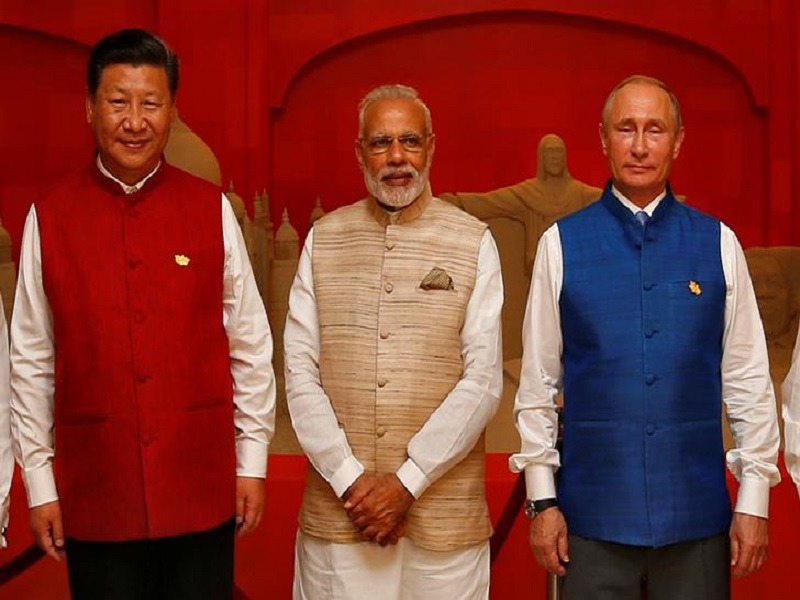
THOSE WERE THE DAYS (L-R) Chinese President Xi Jinping, Indian Prime Minister Narendra Modi and Russian President Vladimir Putin suring Summit in India, October 15, 2016. The treacherous maneuvering of India's Washington-influenced PM Modi has weakened BRICS and now threatens the Sino-Russo alliance. REUTERS/Danish Siddiqui

DM Singh: What is his real mission?
New Indian Defense Minister Rajnath Singh will visit Moscow from 5-7 November along with a 50-member business delegation to attend the India-Russia Intergovernmental Commission on Military-Technical Cooperation, during which time Indian media expects the two to make progress on agreeing to joint ventures for producing Russian spare parts in the South Asian state and possibly also making progress on fulfilling one of the goals of the joint statement made after September's Eastern Economic Forum to "prepare a framework for cooperation on reciprocal logistics support." The "Reciprocal Logistics Support Agreement" (RLSA), as it's being called in Indian media, would be the Russian version of the "Logistics Exchange Memorandum Of Agreement" (LEMOA) that India already agreed to with the US in 2016 to allow each other's military forces the right to use relevant facilities in their partner's countries on a case-by-case "logistical" basis. LEMOA functionally enables the Indian Navy to use American bases in the Afro-Asian ("Indian") Ocean Rimland for "containing" China in that waterway, while RLSA would give it its warships the right to regularly dock in Vladivostok, en route to which they would provocatively traverse the South China and East China Seas.
Is this a clumsy and ill-conceived Russian attempt at "international balancing"? Hard to fathom the logic behind it.
They're already able to do the latter through the recently signed logistics pact with South Korea, but incorporating Russia into this trans-regional Chinese "containment" framework (even if that's not Moscow's intent at all whatsoever but is New Delhi's unstated strategic motivation) risks provoking a security dilemma between India's two nominal BRICS and SCO partners that could indirectly advance the US' strategic goal of driving a wedge between them for divide-and-rule ends. From the Chinese perspective, the Indian Navy is dramatically broadening its operational reach all throughout the Afro-Pacific in line with the US' vision in accordance with the Pentagon's "Indo-Pacific" strategy that ultimately aims to "contain" China. Approached from the Russian standpoint, however, Moscow is simply trying to make up for its declining position in India's military marketplace after its exports there fell a whopping 42% over the past decade as proven by the Stockholm International Peace Research Institute's (SIPRI) report that was released earlier this year. Russia has obvious interests in recovering its lost market share and the billions of dollars of revenue associated with it as it continues its economic systemic transition of building the "Great Society" through the "National Development Projects" that are estimated to cost $400 billion.
As innocent as Russia's intentions may be, the fact of the matter is that the country would be passively facilitating the regular patrol of Indian warships up and down the Chinese coast and through the country's eponymous East and Southern Seas if RLSA is agreed to whether during the Defense Minister's current trip or sometime in the future, so Moscow must accept that Beijing will feel uncomfortable with this outcome even if it doesn't directly say so but instead obliquely hints as much. This isn't just the realm of "speculation" like some critics might allege, but has already occurred through Hu Zhiyong's analysis "India-Russia Ties Rest On Strategic Calculations" for the Global Times newspaper that's indirectly under the influence of the Communist Party and thus wouldn't have been published had the Chinese leadership not wanted to send a subtle message through it. The research fellow at the Institute of International Relations at the Shanghai Academy of Social Sciences ended the piece that he wrote right after the end of the Eastern Economic Forum by warning that "stronger Russia-India ties, especially their military-technical cooperation, would have a negative impact on China's national security. Consolidating and developing ties with Russia implies India's strategic intention to contain China's rise. It would pile more geopolitical pressure on China and increase the instability in China's periphery."
His worries are legitimate and based off of the expectation that the Vladivostok-Chennai Maritime Corridor (VCMC) that was agreed to between these newly established "global partners" during that event could pair with the prospective logistics pact to result in the military scenario that was outlined above of Indian warships regularly patrolling up and down the Chinese coasts. The solution to this impending security dilemma is for Russia to improve its connectivity with China in parallel with improving its military ties with India in order to balance the two out and retain Beijing's trust, which it can do by making progress on advancing President Putin's plan from earlier this year to integrate the Eurasian Union (EAU) with the Belt & Road Initiative (BRI). This can realistically be achieved in the most tangible sense by the expansion of BRI's flagship project CPEC along the northern vector (N-CPEC+) through Afghanistan and Central Asia that would thus connect Russia with the global pivot of state of Pakistan that's also China's chief ally anywhere across the world, which would simultaneously strengthen trust with China while keeping India's pro-American pivot in check. It's through these creative win-win means that Russia can improve its military ties with India while assuaging Chinese suspicions, thus representing a masterful expression of its 21st-century grand strategy to become the supreme "balancing" force in Afro-Eurasia.

 Andrew Korybko is a political analyst, journalist and a regular contributor to several online journals, as well as a member of the expert council for the Institute of Strategic Studies and Predictions at the People’s Friendship University of Russia. He specializes in Russian affairs and geopolitics, specifically the US strategy in Eurasia. His other areas of focus include tactics of regime change, color revolutions and unconventional warfare used across the world. His book, “Hybrid Wars: The Indirect Adaptive Approach To Regime Change”, extensively analyzes the situations in Syria and Ukraine and claims to prove that they represent a new model of strategic warfare being waged by the US.
[premium_newsticker id="211406"]
Read it in your language • Lealo en su idioma • Lisez-le dans votre langue • Lies es in Deiner Sprache • Прочитайте это на вашем языке • 用你的语言阅读
[google-translator]
 Keep truth and free speech alive by supporting this site.
Donate using the button below, or by scanning our QR code.


And…PLEASE!

THE DEEP STATE IS CLOSING IN
 The big social media —Google, Facebook, Instagram, Twitter—are trying to silence us.
Sign up with TGP so we can always reach you with our vital information. Don’t let the darkness win.

THIS WORK IS LICENSED UNDER A Creative Commons Attribution-NonCommercial 4.0 International License

