
Oliver Boyd-Barrett

On July 21, 2026, Ukrainian President Volodymyr Zelenskyy officially fired General Oleksandr Syrskyi from his position as Commander-in-Chief of the Armed Forces of Ukraine. The high-profile dismissal capped a severe wartime leadership crisis sparked by the prior removal of popular Defense Minister Mykhailo Fedorov, which had triggered mass street protests across the country.
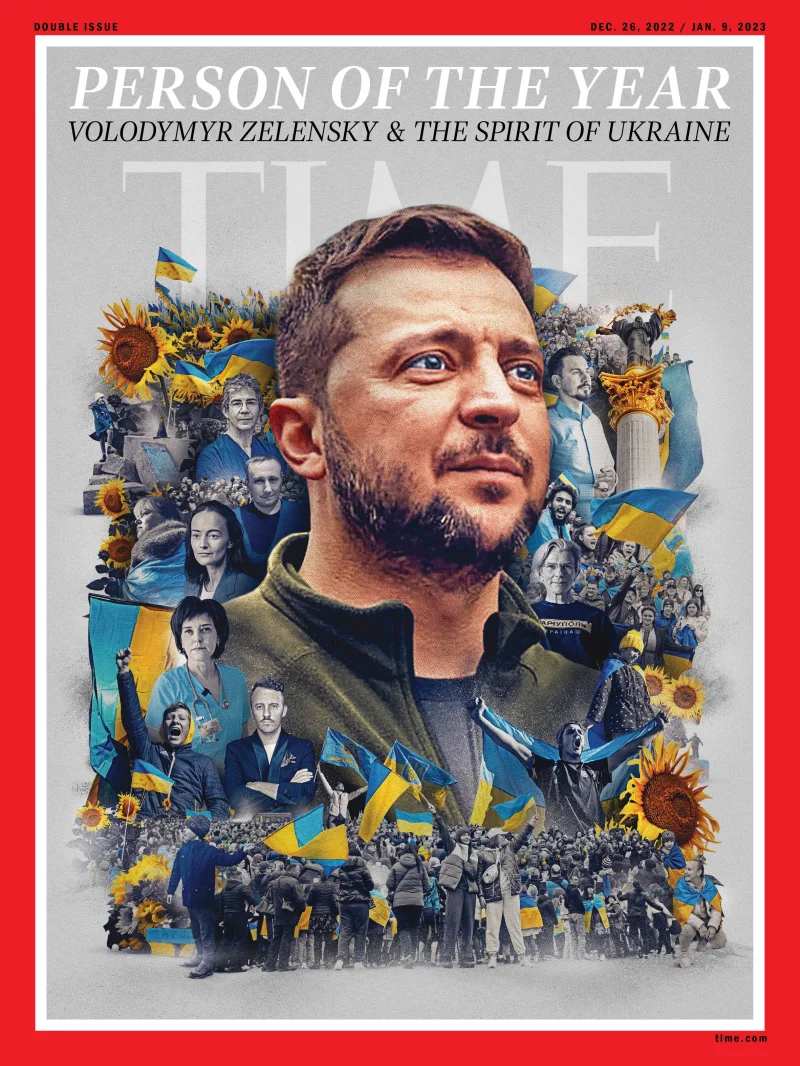
Zelensky glorified by TIME (and the rest of the prostituted Western media).
Former Defense Minister Fedorov has been replaced temporarily by Yevhen Khmara, the current chair of the SBU. Prior to the final dismissal of Syrski, there had been large protesting crowds for five days across Ukraine in Kiev, Odessa, Ternopil, Rivne, Mykolaiv, Ivano-Frankivsk, Dnipro and in dozens of other cities.
Zelenskyy has appointed Major-General Mykhailo Drapatyi, the 43-year-old former Commander of the Joint Forces, as the new army chief to oversee a complete reorganization of the military’s command structure.
An unworkable strategic divide emerged between the 35-year-old former Defense Minister Fedorov, who championed a decentralized, tech-driven approach utilizing advanced drone warfare, and the 60-year-old traditionalist Syrskyi.
Fedorov’s sudden removal last week incited large protests in Kyiv and other major cities, with demonstrators demanding either Fedorov’s reinstatement or Syrskyi’s immediate dismissal.
Syrskyi had faced steep criticism from rank-and-file soldiers, veterans, and military reformers for maintaining a rigid, top-down Soviet-style command system that often ignored tactical innovation and led to high human casualties. But he seemed to enjoy the support of many senior figures in Ukraine’s armed forces and that of the neo-Nazi Azov Brigade.
Further, Fedorov’s popularity was due in large measure to the apparent, though disputed success of Ukraine’s recent drone wars which had gained headline approval from Ukraine’s sponsors in the political West and mainstream media.
Syrskyi’s opposition to Fedorov and Zelenskyi’s initial preference of Syrskyi over Fedorov may have signaled a growing realization at the top that the drone war was not going to be the long-term solution against a Russian opponent more blessed in virtually all categories of resource (including men, money, drones and missiles and industrial capacity than Ukraine) and slowly gaining more and more territory in eastern Ukraine.
For a few weeks, flamboyant Ukrainian drone attacks on Russian oil refineries and, even more recently, on Russian oil tankers and grain cargo ships in the Sea of Azov and along the eastern coast of the Black Sea, had spiked anxiety in Russia and among pro-Russian sympathizers across the world. The Russian economy had shown itself amazingly resilient throughout the war to Western supplies of weapons to Ukraine, direct Western involvement in the supply of hardware and intelligence and navigation of drones and missiles against targets deep inside Russian territory, together with Western sanctions, Western oil price caps the boarding of Russian tankers at sea and other hostilities. But with the inception of massive Ukrainian drone attacks from the beginning of 2026, it began to look as though strikes on energy facilities that closed down refineries, leading to gasoline restrictions, queues for gasoline, closure of Russia’s diesel export supply and dependence on imports of gasoline from India and Kazakhstan might seriously cripple the Russian economy. To these threats in more recent days has been added the targeting of warehouses belonging to Russia’s equivalent of Amazon, and its competitor.

Zelensky being grilled by Trump and his sycophants.
These threats have not disappeared, but Russia does at last appear to have found in them the necessary pretext for a significant upscaling and intensification of the conflict, even if not sufficient to upgrade the Special Military Operation (SMO) to a full-scale war footing. For several nights, now, Russian drones and missiles have bombarded Odessa, its ports, ships, infrastructure, energy and industrial facilities. In effect, Odessa has been isolated from the rest of Ukraine as effectively as Ukraine had managed to isolate Crimea from the rest of Russia, and there are very strong indications that Russia does intend (as shown on a map displayed a year ago by General Gerasimov, Chief of General Staff) to absorb into the Federation the Odessa oblast and all of Ukraine’s Black Sea coastline. In recent weeks, Russia has launched a major campaign of drone strikes on Ukrainian gas stations that seem likely to bring about a crisis of gasoline supply every bid as bad or worse than that experienced in Russia, along with equally intense strikes on locomotives (as many as 200 in the last two weeks, according to one Russian source), railways, logistics hubs, oil storage facilities, military and civilian warehouses (including the entirety of Sumy’s Epicenter mall last night).
What we have not seen so far is any measure strong enough to shut down the constant warmongering, chattering incitement to Ukraine to continue being the West’s proxy in its bid to break up the Russian Federation and divide the spoils between Western nations. Until Russia finds the will to stop being so tolerant of its Western enemies and figures out the right kind of rebuke to the West that will put an end to this self-defeating campaign (that has already clobbered European productivity, pushed it into de-industrialization, and exposed its dependence on both US and Russian sources of energy even in the midst of a global energy crisis) then Putin runs the risk of being seen too weak and too passive.
Statements today by both Russia’s deputy prime minister, by the deputy speaker of the Duma, confirm that the impacts of Ukrainian drone attacks have been severe, but are also intended to signal that quick repairs to damaged facilities are being completed, that restrictions on gasoline consumption are being lifted in many of the affected areas, that stockpiled fuel is being released to market to augment supply, in addition to increased imports from India and Kazakhstan. The road between Russia and Crimea known as the Novorossiya Highway, not long ago subjected to Ukrainian attacks with US-made hornet drones, is reported to be close to being back to normal.
Syrskyi has been replaced just at the time when Ukraine is entering into major combat with Russia over the Slavyansk-Kramatorsk conurbation, and this could turn into a huge problem for Ukraine. Indeed, it already is. Russia is gradually approaching the conurbation from the north, the east and the south. It is closing the gap or encircling the pocket of territory still controlled by Ukraine between Kostiantynivksa and Chasiv Yar so that remaining Ukrainian troops will likely be trapped. The city of Druzhkivka to the south of Kramatorsk is being reduced to ruins by bombardment. Russisa is taking the settlements of Malynivka, Vasiutynske and Tykonivka right opposite Kramatorsk to the west, reducing the distance between Russian forces and the Kramatorsk district of Bilenke to a little over two kilometers. Russia is advancing on Mykonorivka, Vasylivska Potosh and Pershomarivka, to similar effect.
To the north, Russia is closing the noose about Bilya Kolodiaz in Kharkiv and will very likely soon be able to slice off a major part of the north east of Kharkiv oblast, expelling UAF forces further south, and will continue to reduce and isolate the cities of Sumy and Kharkiv. In western Zapporizhzha, forces are moving steadily north and northwest to match other deployments in eastern Zapporizhzhia whose trajectory is the encircling and taking of Orikhiv.
