HUA BIN

 (Image from CartoonForPeace @ https://www.cartooningforpeace.org/en/editos/war-in-iran-is-an-agreement-on-the-cards/)
Donald Trump flipped and flopped again.
He announced a 20% fee for all ships transiting the Strait of Hormuz on Monday, 13thof July. He withdrew the order on Tuesday, 14th of July.
The oil market gyrated during the day and some “smart” folks made yet another killing with the oil futures.
By this point, people are already used to such flip-flops. Wall Street coined the term TACO Index, which tracks how market panics force Trump’s policy U-turns.
A few prominent “flip-flops” from his most recent presidency include:
– The global tariff retreat from “Liberation Day” when he announced sweeping tariffs on imports, including duties on Chinese goods over 100%, but altered course merely days later with a 90-day cause.
Trump posted on Truth Social telling the public and investors “BE COOL”, like “what is the fuss about, dummies?”
– The Nvidia chip ban when Trump barred Nvidia from selling H20 GPUs to Chinese buyers, in April 2025, to protect US “technological supremacy”.
By July, he did a 180, lifting the restriction and demanding 15% Nvidia’s Chinese chip revenues instead.
So far, that 15% cut is worth roughly ZERO since China itself banned Nvidia. To protect Chinese “technological independence”.
– Greenland annexation and EU tariff threat. Trump aggressively demanded the annexation or purchase of Greenland from Denmark. When EU resisted, Trump threated a retaliatory 10% tariff on all EU imports.
Then the whole episode sort of dissipated into the 15-minute news cycle and Trump & EU/NATO made up like a pair of honey birds.
– “A whole civilization will die tonight, never to be brought back again”. Trump’s April genocidal threats, which also include “we are going to bring them back to the Stone Ages, where they belong”, was paused in the 11th hour due to domestic economic warnings and oil spikes.
Soon after, Trump signed the ceasefire MOU, colloquially known as the “New Versailles Treaty”.
In China, there is a millennial old saying – “the Emperor speaks no idle words”(君无戏言).
It doesn’t refer literally to only the emperor’s words, of course. Anyone who wants to be taken seriously is bound by his words. Especially high officials and people in power.
The West, at least in the olden days, also had similar concepts such as “the word of a king is his bond”. More broadly, the “Gentlemen’s words”.
There was even legal concept of “Crown honor” or the “Divine Right of Kings,” which dictated that a monarch’s spoken word was an absolute, immutable decree.
To break a royal promise was to insult God and destroy the state’s credibility.
Of course, the quaint ancient concept has collapsed in modern Western politics.
Monarchs still exist in some parts of Europe, but “constitutional democracy” is the nominal governing principle. The US even pioneered it.
Power belongs to the office, not the person. As is taught in Civics classes.
Modern politicians are bound by a different set of “rules”, implicit and explicit, such as using the media to float extreme ideas – known as “trial balloons”, and “rhetorical hyperbole” – with impunity.
As journalist Salena Zito famously observed, Trump’s supporters take him “seriously but not literally,” while his critics take him “literally but not seriously.”
Because his base does not expect him to treat every word as a binding decree, Trump suffers no political penalty for walking them back.
Defenders also argue that to an ancient king, words were meant to establish order and stability while, to Trump, words are tools used to gain leverage in a “deal”.
Honor is not a concept Trump has ever had a relationship with.
For the “transactional leader”, making an idle or extreme threat is a feature, not a bug.
It shakes up status quo and gives the threat-maker a “position of strength”, in his own mind.
However, such argument completely overlooks the core ethical meaning of the proverb. “No idle words from the emperor” is fundamentally about integrity, trust, and the moral weight of leadership.
It is not just absolute power. When a leader’s words become meaningless or “brain farts”, it breaks the unwritten social contract between the government and the people.
In classical Western political philosophy, this exact concern is raised with the concepts of “Public Virtue” and institutional trust.
Western political science heavily documents how “idle words” and casual deception from leadership – the “rot from the top” – can cause a cascade of systemic damage:
- Erosion of institutional legitimacy: Citizens stop believing official government statistics, intelligence reports, or legal decrees, assuming everything is just a political game.
- The “Cynicism Trap”: When lying is normalized at the top, the public becomes profoundly cynical. People stop participating in civic life because they believe the entire system is corrupt.
- Strategic disadvantage: When a country’s leader is known to bluff or reverse course constantly, foreign allies and adversaries discard his pronouncements as inherently untrustworthy.
To be fair, Trump is not a student of history or philosophy. He probably thinks John Locke or Thomas Hobbs are some obscure midwestern baseball players.
A very, very imperfect man
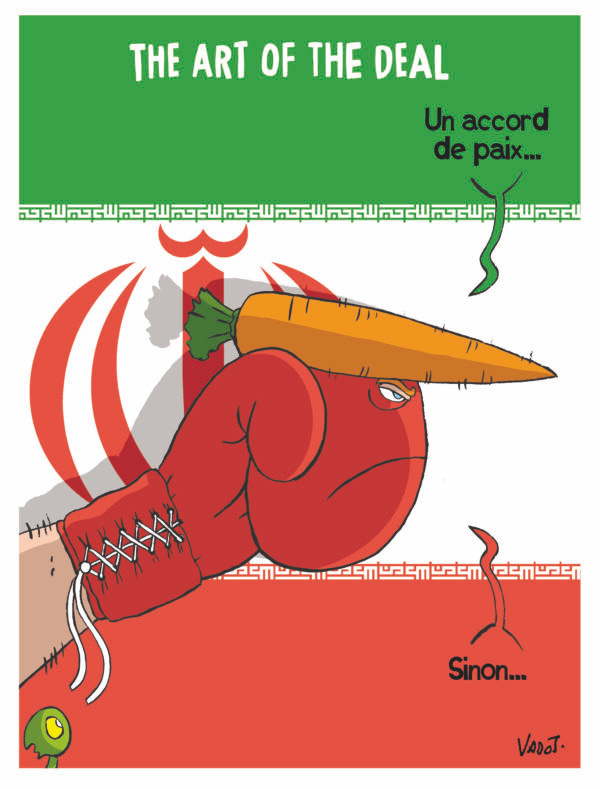 (Image from CartoonForPeace @ https://www.cartooningforpeace.org/en/editos/war-in-iran-is-an-agreement-on-the-cards/)
I have long wondered how the American system, supposedly the most “democratic” and “advanced”, could put someone like Trump into the highest office.
IF the highest office is to be taken seriously.
Trump, after all, is the ultimate proverbial village idiot.
Trump is not an unknown quantity. He had been in the public domain for decades before he entered politics.
Biographers and business analysts, even his ghostwriters of the so-called “business best-sellers”, have dissected his tactics, his business deals, and his relationship with truth in numerous investigative reporting and books. Such works include Wayne Barrett’s 1992 Trump: the Greatest Show on Earth, Michael D’Antonio’s 2015 The Truth About Trump, and Donald Trump & Tony Schwartz’ 1987 The Deal and the Myth: Trump – the Art of the Deal. All were published before his ascension to the presidency.
The verdict on Trump is unanimous. Trump is an unethical, manipulative, and impulsive narcissist who views everything in life as a strict “win-lose binary”.
For him, relationships are disposable and dominance is the ultimate goal.
His core business tactics, which clearly have been taken to his political life, rely on a few distinct psychological and strategic maneuvers:
1. The “Door-in-the-Face”
Trump’s opening gambit is always to “think big” by making an absurdly high, shocking, or completely unrealistic initial demand.
By starting with an extreme position, he completely skews the baseline of the negotiation. Even when he walks the demand back, the final compromise sits much closer to what he originally wanted than if he had negotiated reasonably from the start.
At least, that is what Trump and his supporters think. Reality is quite different from the “theory”, depending on who he is dealing with.
Trump has never had any noticeable success in his “door in the face” approach with President Xi or Kim Jong Un.
2. The “Trump Two-Step”
Trump loves manufactured crisis. He would enter a negotiation by hurling intense personal insults, creating artificial urgency, or threatening extreme consequences (like completely walking away or suing) to disorient and intimidate the other side.
Once the counter party panics and scrambles to stabilize the situation, Trump steps back, offers a slight backpedal, and announces a “deal” where he frames himself as the benevolent problem solver.
The Europeans seem to have fallen for this trick repeatedly. Maybe they just know who their master is…
3. Psychological insecurity and need for ego stroking
Biographers have noted a unique vulnerability in his hard-bargaining armor: his deep reliance on public validation and deference.
He will often accept a lesser deal if he is allowed to claim total, absolute victory in front of the cameras.
Supposedly, the leaders of US “allies” are deploying this learning to “manage” Trump, though empirical evidence suggest Trump has turned the table on them.
4. Overwhelming leveraged bluffs
In The Art of the Deal, Trump famously wrote that the worst thing a negotiator can do is to seem desperate, because the opponent will “smell blood.”
Instead, his biographers point out that he heavily overstates his hand to create a false illusion of complete leverage.
Trump actively despises traditional data analysis or hiring “number-crunchers,” preferring to operate entirely from his gut.
He uses intense public posturing, media leaks, and threats of litigation to convince the other side that his position is unshakeable, hiding any flaws in his actual position behind a wall of noise and theater.
His actions during the Iran War are definitive demonstrations of this bluff strategy but the Iranians have not fallen for it. Once they called Trump on the bluffs, he is left with no cards.
5. Total disregard for long-term relationship
Standard business or ethics class teach that successful negotiation preserves long-term value, trust, and future collaboration.
However, Trump’s career was explicitly built on the exact opposite philosophy.
Because he views negotiations purely through a lens of dominance, he has historically had zero issue burning bridges, insulting partners, or failing to fulfill his end of an agreement.
To him, fairness simply means that the dominant player takes the largest cut, period.
With such mentality, there is zero chance of him building lasting relationship with major powers like China and Russia, where the words of their leaders are taken seriously.
Despite the superficial courtesy President Xi and Putin would show to Trump, he is considered privately as beneath contempt. And completely untrustworthy.
Is Trump the Mad King?
Analyzing the psychological state of a political leader—especially one with a highly unconventional style like Donald Trump—is a subject of intense debate among psychologists, political scientists, and biographers.
Unable to diagnose Trump in person, clinicians instead analyze Trump’s public behavior through the lenses of negotiating strategy, personality traits, and decision-making style.
There seems broad consensus of the following –
– “Transactionalist” and “Predictable Unpredictability”
Many view this behavior not as a sign of cognitive instability, but as a deliberate, deeply ingrained behavioral framework rooted in transaction and entertainment.
In this psychological framework, an extreme initial demand (like a 20% toll or a 100% tariff) is not a literal policy goal, but a psychological anchor meant to shock, disorient, and weaken the opponent before a compromise is struck.
Psychologically, Trump appears to find comfort in chaos and unpredictability, viewing consistent policy as a vulnerability that others can exploit.
– High sensitivity to feedback and praise
Trump also suffers acute responsiveness to immediate, external feedback loops.
Metrics like “TACO Index” suggest that Trump’s sense of self-worth and success is heavily tied to visible indicators like the stock market, television ratings, and social media metrics.
When a threat causes a market crash or severe domestic backlash, his desire to be perceived as a “winner” or a savior prompts a rapid pivot to avoid being blamed for the crisis.
– Need for the “Grand Gesture”
His reversals are almost always framed as a victory where he extracts a concession (e.g., “MASSIVE” investment deals from Europe, Japan and the Gulf states).
Psychologically, the specific policy outcome matters less than the public perception that he personally forced a powerful entity to capitulate.
– Low ideological attachment and high intuition
Trump operates primarily on instinct and intuition rather than firm ideological doctrines or long-term strategic plans.
This means he is unburdened by the psychological need for ideological consistency.
If a situation changes, he can abandon a previous position without experiencing cognitive dissonance.
His primary psychological driver is often identified as a desire for dominance.
Initiating a massive threat asserts dominance; reversing it in exchange for a deal allows him to claim the role of the magnanimous dealmaker.
The interpretation of Trump’s behavior ultimately splits into two main camps:
- Critics argue that these rapid flip-flops indicate an impulsive, fragile psychological state characterized by erratic judgment, an inability to comprehend consequences, and a tendency to back down the moment he faces genuine resistance. Trump supporters view them as the psychology of a master pragmatist. They see a leader uncorrupted by political dogma, and psychologically flexible enough to adapt when a tactic has served its purpose.
Clearly, Trump’s supporters either don’t understand or care that his behavior erodes any long-term trust and credibility of the Office.
To them, just like himself, instant gratifications outweigh any enduring damage.
The Goldwater Rule was established in 1973 by the American Psychiatric Association that states it is unethical for psychiatrists to offer a professional opinion or diagnosis on a public figure unless they have conducted an in-person examination.
It was a response to speculations about Nixon’s state of mind that led to his impeachment.
Despite the rule, hundreds of independent mental health professionals have publicly warned that Trump displays textbook behavioral symptoms of “malignant narcissism”.
They have broken traditional professional taboos to publicly analyze Trump’s behavior in a “duty to warn”.
In 2017, a group of 27 psychiatrists published a book arguing they had an ethical obligation to warn the public that Trump’s public behavior showed he was “dangerously mentally unstable.”
In 2020, multiple psychologists participated in a documentary titled Unfit explicitly labeling Trump a malignant narcissist, comparing his rhetorical and behavioral patterns to historical authoritarian figures.
In 2024, more than 200 mental health professionals signed a letter that stated Trump displays symptoms of malignant narcissism—a blend of narcissism, antisocial personality disorder, paranoia, and sadism—making him an “existential threat to democracy.”
I’ll leave the readers to judge whether Trump is a “mad king”. To me, he is clearly an unstable, intellectually inferior, and deeply defective individual who will only poison and debase the office he holds.
Why Trump apologists’ “lipstick on a pig” doesn’t work
Those who provide the comforting “Art of the Deal” explanation to Trump’s erratic flip-flops are the ultimate “lipstick on a pig”.
The sophisticated frameworks used by Western political scientists—terms like “trial balloons,” “strategic unpredictability,” and “rhetorical hyperbole”—are, in essence, academic euphemisms.
They describe the mechanics of how a leader survives making contradictory statements, but they do not erase the ethical reality.
They can put lipstick on the pig but cannot remove the stink.
Framing rapid u-turns as “master pragmatism” or “negotiation tactics” rebrands a lack of consistency as a virtue.
It shifts the public expectation from “Is this leader telling the truth?” to “Is this leader winning the current news cycle?”
Ultimately, while these gimmicks allow a leader to navigate short-term crises and maintain a loyal base, they do so at a steep long-term cost. It lowers the bar for the office and the political system.
The inevitable byproduct of treating a high official’s word as disposable is the steady decay of public institutions and a profound collapse in social trust.
The impact goes beyond borders.
US “allies”, including NATO, European Union, Japan, and South Korea, are forced to live with this unpredictable style of “leadership”, found in any Mafia movies.
So far, these “allies” reactions have been a doubling-down of public servitude and fawning flattery.
Their calculation is “if the King is mad and dumb, let’s kneel, flatter him, and hope for the best”, and “he is too dumb to sense the insincerity and maybe we can get some brownie points by capitulating”.
Unfortunately, that is the trap of vassalhood.
From a structural perspective, these nations are trapped by a historic, deep-seated dependency that limits their choices.
They are similarly dependent on the US market, technology, and the dollar system for the functioning of their economies.
In geopolitics, the weaker partner always accommodates the stronger one.
Vassals swallow their pride and endure erratic policy shifts because the alternative—being completely abandoned by the master—is considered far more catastrophic than being humiliated.
Ultimately, such servility and appeasement serve as a “self-licking ice cream”.
To the vassals, public display of flattery and compliance are used as a “shield”. It provides Trump the public theatre of dominance in exchange of continued freeloading.
However, such subservience only serves to reinforce Trump’s worst instincts in an endless cycle of submission and dominance.
In psychology and political strategy, this is known as a positive feedback loop for aggression.
It also exposes a profound lack of courage, sovereignty, and strategic autonomy among Western elites.
By constantly absorbing insults, abrupt tariff threats, and unpredictable policy U-turns without pushing back, these governments alienate their own citizens and show themselves as laughingstock to the rest of the world.
All can see these Western leaders as mere appendages to a chaotic court in Washington.
Where it ends for “the emperor with the idle words”
When a leader’s words carry no permanent meaning, treating their volatile outbursts as rational negotiation points ceases to be “smart strategy.”
Instead, it becomes a dangerous gamble that actively accelerates the collapse of the international order.
In history, when courtiers, ministers, and foreign states had to deal with an unpredictable, impulsive, or emotionally volatile absolute ruler – the “mad king”, they could not rely on standard diplomacy or legal contracts.
Instead, they developed high-stakes strategies to survive, redirect, or quietly neutralize the ruler’s impulses.
These strategies fall into a few categories:
1. The “Regent Behind the Throne”
The most common historical strategy was to build a protective bureaucratic layer around the king.
The goal was to ensure his erratic decrees never actually left the palace walls. Loyal ministers would nod in agreement to the king’s wildest orders, but then quietly delay, misplace, or rewrite the paperwork.
During the reign of King George III of Britain, who suffered from severe bouts of mental illness, the Parliament and his prime ministers gradually stripped the monarch of actual executive power.
Today’s Washington has entrenched bureaucracies, the “deep state”, which has served as the “Regent behind the throne” since JFK.
However, Trump has successfully surrounded himself with yes-men and sycophants who are nobody without his patronage.
Thus, the institutional “brake system” is largely disabled.
2. Hedging
When foreign nations realized the superpower was ruled by an erratic king, they abandoned bilateral treaties and moved toward absolute self-reliance and collective defense.
In the 5th century BC, the volatile and unpredictable Persian Emperor Xerxes I demanded “earth and water” from the Greek city-states.
Realizing that submitting to his whims offered no real security, rival cities like Athens and Sparta formed a historic, unified military alliance to completely deter and repel him at Marathon and Salamis.
Not that I think today’s Europe is capable of such feat to defend Greenland for example, the point is it has been done historically.
Funny how they resisted a Persian king, but choose to kowtow to an American one.
3. Manipulation by flattery and fake news
Courtiers who survived long periods around volatile rulers learned to treat the king’s psychology as a hazard to be managed, rather than a rational mind to be reasoned with.
They never openly contradicted the ruler, as doing so triggered lethal outbursts. Instead, they used intense public flattery to satisfy the king’s ego, while manipulating the king to do their bidding.
During the reign of Emperor Chongzhen (1627 – 1644), the last ruler of the Ming Dynasty, the emperor became increasingly paranoid and prone to executing close advisors.
His court officials survived by humoring his volatile shifts and feed him only “good news” about the famine and the civil wars raging in the land. They were, obviously, fake news. His dynasty was overthrown and he committed suicide.
When the emperor ascended the throne at just 16, he inherited a dynasty on the brink of total structural collapse.

Emperor Chongzhen
The court was ruled by notoriously corrupt eunuchs, and the emperor’s reign was cursed by a mini-ice age that caused catastrophic nationwide droughts, famines, and plagues.
He faced existential threats from massive internal peasant rebellions led by Li Zicheng, and external invasions from the rising Manchu forces in the north, who later founded the Qing Dynasty.
Unlike many famously lazy or hedonistic Ming emperors before him, Chongzhen was a workaholic who slept little, lived modestly, and genuinely wanted to save his people.
However, his deep-seated psychological flaws paralyzed his administration.
He fundamentally mistrusted his own ministers and military generals.
Over his 17-year reign, he went through an astonishing 50 Grand Secretaries (大学士), the highest ranked civilian official, and executed or imprisoned dozens of his top commanders, including his most brilliant general, Yuan Chonghuan.
He fell for a simple disinformation campaign by the Manchus who lost every battle against Yuan. The Manchus used Chongzhen’s paranoia to remove his own most important protector.
By 1644, the rebel leader Li Zicheng marched his army straight to the gates of Beijing.
Trapped inside the Forbidden City, Chongzhen rang the imperial bells to summon his ministers and generals to a final defense meeting.
Not a single official showed up; they had all either fled the city or prepared to defect.
Realizing all was lost, Chongzhen forced his empress to commit suicide and slashed his own daughters with a sword to save them from being captured by rebels.
He then walked out of the palace to Jingshan Hill (Coal Hill) and hanged himself from a tree at the age of 33.
Before he died, Chongzhen bit his finger and wrote a famous, bitter suicide note on his silk robe with his own blood, which perfectly captured his refusal to accept personal accountability:
“I, a person of meager virtue, have incurred the wrath of Heaven… All of my ministers have deceived me. I die unable to face my ancestors in the underworld… May the rebels chop my corpse into pieces, but do not harm a single one of my citizens.”
4. Palace coups and forced abdication
In 1762, the erratic Tsar Peter III of Russia alienated his military, his church, and his allies by suddenly reversing Russia’s foreign policy mid-war to favor Prussia.
Realizing his unpredictable whims were destroying the empire, his own wife, Catherine the Great, led a swift palace coup with the military.
Peter was forced to abdicate and was quietly neutralized.
The drama of the Roman Empire, the first Western empire, provides some of the best examples of surviving tyrants like Caligula or Nero, who were highly impulsive, erratic, and deeply suspicious of the political elite.
Roman historians like Tacitus, Suetonius, and Cassius Dio documented the history in classic works such as The Annals and the History, Twelve Caesars, and The Roman History.
Given the length of the essay, we won’t go into them. The point is the Western annals are filled with examples of how to survive “mad kings”.
The lesson is simple – Rome didn’t fall to its enemies; it rotted from within.
The question for the West today is what it would do with the reigning Mad King.