

 [su_spoiler title=”HELP ENLIGHTEN YOUR FELLOWS. BE SURE TO PASS THIS ON. SURVIVAL DEPENDS ON IT.” open=”yes” style=”fancy” icon=”arrow-circle-1″]
Thank you for visiting our animal defence section. Before reading our main essay, please join us in a moment of compassion and reflection.

The wheels of business and human food compulsions are implacable and totally lacking in compassion. This is a downed cow, badly hurt, but still being dragged to slaughter. Click on this image to fully appreciate this horror repeated millions of times every day around the world. With plentiful non-animal meat substitutes that fool the palate, there is no longer reason for this senseless suffering. Meat consumption is a serious ecoanimal crime. The tyranny of the palate must be broken. Please consider changing your habits in this regard.

[su_panel background=”#F4ECDA” border=”5px solid #cccccc” radius=”7″]Editor’s Note: Exemplary nation as she is in so many respects, China still has a lot to atone for given her long history of extreme use and abuse of animals for a bewildering variety of purposes, from clothing to food, to entertainment and medicine. China is certainly far from alone in such attitudes, the West having a long and infamous history of mistreatment and brutal exploitation of animals, many native species having been wiped out in Britain, France, Italy, Spain and other old cultures, while the Roman Empire itself led the way by decimating European and North African animals. We must also bear in mind that other Asian nations share with China an attitude of profound disregard for the suffering of non-humans, Korea and Japan being conspicuous in this regard. Modernity and increasing urbanization and income growth have brought some amelioration in these areas, but progress has been slow, spotty and desultory. China merits special attention because of her enormous prestige and regional influence; her global economic power, and the sheer size of her population. This is a nation where the habits of even a small fraction of its population, either in terms of personal consumption or trade practices, cast a long shadow across the globe. Animal activists have long documented the plight of certain non-endangered species, like “bile bears”, or the unspeakable brutalities inflicted on raccoon dogs, who are routinely skinned alive for their pelts. As well, Chinese indulgence in frivolities like ivory (on the upswing due to growing numbers of affluent consumers) is now driving elephants to extinction, while Chinese traditional medicine reliance on rhino horn, for impotence, as well as tigers and other magnificent but highly endangered species, for other purposes, is also making the poaching of such species almost impossible to control in Africa and Asia. This is not only regrettable but disgraceful considering how widely available, affordable and effective tadalafil and sildenafil citrate are now for the treatment of erectile dysfunction (except in the US where ripoff prices continue to obtain), and how many other traditional medicine compounds have been replaced with modern drugs that cost little and are demonstrably far more effective. Granted, these are difficult problems, not easy to control, especially since cultural chauvinism still feeds off of the scars of Western colonialism and the ravages of the “century of humiliation”. This complicated picture notwithstanding, we honestly feel the Chinese government could be doing far more to shut these practices down, energise more ambitious cultural campaigns to enlist citizen support for the retirement of damaging, animal-dependent and outdated medicinal practices, and even contribute field protection resources to Africa, where the devastation of elephants, rhinos, lions and other precious species has reached critical levels. While the situation remains dire for many animals, China is also the world’s leading nation in ecoanimal protection measures, moving far faster and more effectively on many fronts than other leading nations in Europe and certainly the United States, where there is criminal regression across the board due to unchallenged corporate power. Against this backdrop, we applaud China’s effort to save the panda, and wish the people involved in this project as much success as this precious animal deserves. Let now compassion and a non-speciesist ethic triumph in this unique civilization, as that would complete her rightful return to the center of human affairs.—PG[/su_panel]
Captive pandas reach 548, a record high
Survival rate of cubs triples in 30 years, hits 93 percent
Source: Global Times Published: 2018/11/8
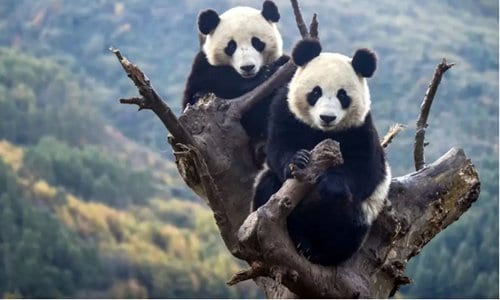
Two captive pandas strike a pose on a tree in their habitat in Southwest China’s Sichuan Province. Photo: Courtesy of the Chengdu Research Base of Giant Panda Breeding
[dropcap]T[/dropcap]he number of giant pandas living in captivity has reached 548, a record high, and the survival rate of panda cubs born in captivity reached 93 percent this year, an official at the State Forestry and Grassland Administrations (SFGA) said on Thursday.
After decades of caring for giant pandas, China’s panda experts have all but perfected creating sound conditions to raise and breed giant pandas, according to a press release the SFGA sent to the Global Times on Thursday.
The release said that 45 of 48 panda cubs born in captivity this year survived.
In the 1990s, the survival rate of captive-born cubs was only 30 percent, according to information on the website of the Chengdu Research Base of Giant Panda Breeding. Forty-three of this year’s surviving newborn giant pandas were born in China; one was born in Japan and the other in Malaysia.

Photo taken on September 28 shows giant panda cubs at Chengdu Research Base of Giant Panda Breeding. Photo: Xinhua
Li said that China will continue releasing captive-born pandas into the wild after they receive extensive trainings enabling them to adapt to living on their own in the wild. Nine captive-born pandas have been released into the wild since 2003, and another will be released this year, said Li.
In 2016, a giant panda named He Sheng was found dead two months after it had been released into the wild. It had been attacked by “unknown animals,” said the Chengdu Research Base of Giant Panda Breeding at the time. Media reported four of the released-to-the-wild pandas have not survived.
The incidents sparked heated discussions, with netizens worried the giant pandas could not survive after being released into the wild.

A giant panda twin eats birthday cake in an air-conditioned room at the Nanjing Hongshan Forest Zoo in Nanjing, capital of East China’s Jiangsu Province, on August 10. Photo: Xinhua
“Pandas are not pets. Their real home is in the wild. They may face various threats in the wild, they will adapt and live better there. Keeping them captive forever is not our purpose,” Zhang Hemin, deputy director of the Chengdu-based China Conservation and Research Center for the Giant Panda, said in the SFGA press release.
Another purpose for releasing pandas into the wild is to see if they can successfully mate on their own, Zhang explained.
In August 2017, female giant panda Cao Cao gave birth at the Hetaoping semi-wild training base in Sichuan Province. She became pregnant after being released into the wild, the Xinhua News Agency reported.
China is also working with 22 zoos and safaris from 17 countries to better protect pandas, said Li, noting that China has sent 58 pandas to other countries to help local scientists to conduct research and bring joy to local people.
National treasure

The world’s only giant panda triplets Meng Meng, Shuai Shuai and Ku Ku celebrate their fourth birthday at Chimelong Safari Park in Guangzhou, South China’s Guangdong Province on July 29. Photo: VCG
Li also said they are speeding up the creation of the Giant Panda National Park to better protect panda habitat.
During the Thursday conference, Tang Xiaoping, deputy head of the National Park Administration, said work on the national park has begun and a pilot project is underway.
According to the plan, the 27,134-square-kilometer park will cover areas in Sichuan and Northwest China’s Gansu and Shaanxi provinces. Li said the park will impose strict regulations to protect and improve the natural ecology of the vast area.
Facilities and factories that will not protect the park will be relocated from the park area. Also, human activity will be strictly limited within the area, according to another news release the SFGA sent to the Global Times on Thursday.
The park will consist of a core area that will include 67 reserves for many of the 1,864 wild-born giant pandas and 8,000 wild animals and plants, Xinhua reported in March, 2017.
[/su_spoiler]

[premium_newsticker id=”154171″]

