
Oliver Boyd-Barrett

Words, words and words
Sticks and stones can break your bones, etc., etc. Well, Putin and his government representatives do expend a lot of energy on words. And it is definitely the case that the political West in the past has badly underestimated the importance of listening to what Russian leaders have to say.But what matters at the end of the day, as always, are the deeds, and sometimes, but not always, words as indicative of potential deeds.
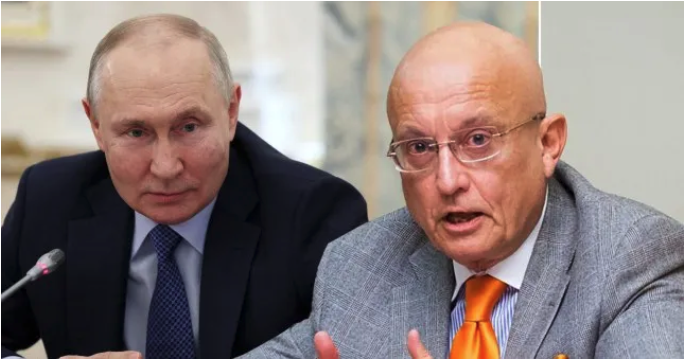
Sergei Karaganov (right) with Russian President Vladimir Putin (left)
We have heard a lot recently from Putin’s spokesman, Peskov, and others, that might lead one to expect that Russia is about to upgrade the Special Military Operation (SMO) to something else lying between an anti-terrorist operation to an all-out war. We have even heard Putin, in his recent remarks to a meeting with Russian naval commanders, to the effect that he would move more quickly against Ukraine were it not for his concern about the increased casualties that this would occasion.
We should frankly acknowledge that there has been an escalation in Russian attacks on Kiev. Most certainly, there has been a devastating impact on Odessa and other Ukrainian Black Sea ports and on shipping using those ports. I report below on a significant expansion in the size of Russian military (which anti-Russian critics like Ben Aris forecast will occasion riots). And I note that Russia does appear, for the moment, to have lost all faith in the efficacy of engaging in any kind of dialogue with the agreement-incapable, agreement-violating, negotiator-murdering USA, unless perhaps it is with the ghouls Kushner and Witkoff trying to sell Putin another “let’s build a tunnel beneath the Bering Strait” distraction, to which he still sometimes seems a bit too much vulnerable.
The Karaganov Factor
But, as Karaganov has long argued, until the West is deterred Russia has no deterrence worth the money and therefore no defense. It needs to have a deterrent that actually deters and then use it either for demonstration or substantively or both.
Putin is making a show of pulling off at least one of the gloves of restraint, but is he really? The West cannot bring itself to acknowledge Russia’s battlefield victories as serious. How can Putin make the impression he needs to make if some form of diplomacy is to be recovered and implemented?
Provocations
Putin has reportedly been under considerable pressure after so many extraordinary provocations: the terrorist incident at Crocus Hall in April 2024; Ukraine’s invasion of Krynky in October 2023; Ukraine’s invasion of Kursk in August 2024; the acceleration of the supply of Western missiles to Ukraine, together with the intelligence and navigational skills to direct them; US participation in an assassination attempt against Putin in December 2024; increased willingness of NATO members to talk openly about their preparations for war with Russia; opening of NATO airspace for the flying of Ukrainian drones against targets in Russia; opening up of NATO borders to production facilities (drawing on Chinese components) for the manufacture of drones to be sent to Ukraine for assembly - latest example being Zelenskiy’s reference, while he was in the UK talking to an odiously fawning new UK Prime Minister, Andy Burnham - apparently pretending to be just as odiously fawning as his predecessor, Keir Starmer - to Ukraine opening a major drone technology facility in the United Kingdom; Ukrainian damage to most of Russian oil refineries, closing down Russian diesel exports and requiring it to import gasoline from India and Kazakhstan and, in recent weeks, Ukrainian drone damage to Wild Berries warehouses across multiple parts of Ukraine (customers may hope to receive compensation from the state).
Nuclear Triad
Perhaps among the most important of all these provocations were the NATO-supported attacks on Russia’s nuclear triad. Ukraine has targeted the strategic bomber component of Russia’s nuclear triad via deep-penetration drone operations, most notably Operation Spider’s Web in Nune 2025, and prior coordinated base strikes. Ukrainian security services infiltrated Russian territory, hiding short-range attack drones in cargo trucks near multiple strategic airbases - including locations in the Amur region, Murmansk region (Olenya Air Bae), and Irkutsk region (Belaya Air Base). Operating via local mobile networks, the remote strikes damaged or destroyed dozens of aircraft, targeting the airborne leg of Russia’s nuclear delivery systems. Earlier coordinated drone attacks struck deep inside Russia, targeting bomber fields like Engels Air Base (Saratov region) and Ivanovo Air Base, impacting nuclear-capable heavy strategic bombers such as the Tu-95MS and Tu-22M3.
These attacks have exclusively pressured the strategic bomber fleet (the weakest and most vulnerable leg of the triad). They have not compromised Russia’s core second-strike land-based ICBMs or sea-launched ballistic missile submarines. NATO forces have provided intelligence and conventional backing to Ukraine, but alliance military forces have engaged in zero direct kinetic attacks against Russian nuclear assets to prevent catastrophic escalation - except perhaps for Ukrainian forces drone strikes against Russian strategic early-warning radar sites (such as those in Armavir and Orsk), which monitor missile launches.
Size Matters: Russian and Ukrainian Armies
Russian President Vladimir Putin has signed a decree raising the army’s authorized size to 2,426,130 personnel, with service members now numbering 1,535,000, up from 1,510,000.
The decree takes effect August 1 and ties the change to the creation of military construction units within the Russian Armed Forces.
A little more than a month earlier, Putin had signed the previous decree, which raised the army’s authorized size to 2,399,130 personnel. The reason for that increase was not specified.
It is the third change to the army’s size in the past six months, following two earlier decrees signed in March and June 2026.
Putin has now increased the army’s size six times since the start of the full-scale war between Russia and Ukraine.
Russia is increasing its armed forces through official personnel cap increases, force restructuring, and high-financial-incentive recruitment. Key steps include raising authorized end-strength numbers via presidential decrees, expanding regional military districts and commands, and relying heavily on lucrative contract enlistment bonuses. [
As we have seen, Putin yesterday signed a decree on July 27, 2026, raising total authorized armed forces strength to 2,426,130 personnel - including 1,535,000 active service members - effective August 1, 2026. He has expanded specific force allocations to incorporate specialized military construction and infrastructure units.
In addition, recent measures have divided the traditional Western Military District into two distinct regional commands: the Moscow Military District and the Leningrad Military District; formed new combined-arms and army corps units (such as the 44th Army Corps) alongside upgrading existing motorized rifle brigades directly into divisions; developed new military bases and infrastructure near northern and eastern NATO borders to permanently station newly raised formations.
Moscow is offering large federal and regional sign-on cash bonuses alongside monthly salaries that significantly exceed standard national civilian wages, maintaining a continuous influx of monthly contract volunteers (averaging roughly 30,000 to 40,000 new recruits per month) to offset frontline combat losses; enforcing legal and administrative restrictions that bar active contract soldiers from resigning or leaving service.
Russia has also benefitted from the assistance of tens of thousands of troops from its allies, notably North Korea.
In brief, Russia has far many more active troops at its disposal than does Ukraine.
Sources from the United Kingdom assess the total size of the Ukrainian armed forces as between 800,000 and 1 million active personnel, reflecting the mass mobilization and expansion required during the ongoing war. Specific components include the ground branch and overall defense structure.
So, Ukraine’s army is estimated at roughly around 800,000 to 1,000,000 active service members and mobilized personnel. The Ukrainian Ground Forces account for approximately 450,000 active personnel.
The Gulf and Red Sea Crises
Not inconceivably, Putin is still holding Russian punches, in the expectation that Trump will embroil the world in possibly its worst ever fuel crisis, signaling and endorsing the decline of US hegemony. If Trump has been listening to Netanyahu today, then surely this is more likely than ever. It is too early to know much in detail, but the two men reportedly discussed Iran’s nuclear program (there has never been an Iranian nuclear weapons program of any substance unless Trump has all but forced Iran to develop one over the past few weeks), regional conflict “management,” and intelligence sharing.
Netanyahu presented “intelligence” reports regarding a secret underground nuclear site at Pickaxe Mountain, though Trump voiced public irritation that these talking points were leaked beforehand. Pickaxe Mountain is said to be a possible location for Iranian stocks of enriched uranium. It is also said to be extremely difficult to hit. Previous Israeli “intelligence” has taken the US for a ride (1) along the fake discourse about how Iran, with no nuclear weapons, and subject to IAEA inspections, is a “nuclear threat” while Israel with hundreds of nuclear weapons and not subject to IAEA inspections, somehow is not a nuclear threat; and (2) along the argument sold to Trump by Mossad last December that a new strike on Iran in February 2026, following the failed unprovoked US-Israeli 12-day war in August last year, would lead to the country’s collapse.
There is one possible route to a return to the MOU between the US and Iran with a view to persuading Iran to reopen the Strait of Hormuz, and that would be for Israel to withdraw its troops from Lebanon and Syria and to retract some of the brutal, unparallelled violence that every day it illegally and murderously inflicts on Palestinians in Gaza and in the West Bank - without any kind of meaningful resistance from the rest of the world, apart from an occasional national restriction on the import of goods from West Bank settlers.
Netanyahu has made it clear that Israel will do none of those things. Trump could stop Israel by immediately bringing an end to the flow of US arms and other aid to Israel, along with other nations of the political West. That he wont do that is indicative of the real foreign policy of the US which is world domination through fanatical, dysfunctional proxies such as Ukraine, Israel and Taiwan, led by bought-out or totally crazed elites that would sooner see their satraps sink into hell before they stop aiding and abetting their imperial masters. This is made a tiny bit more complicated by Israel’s Epstein hold over Trump, but that is not the driver; the driver is a US foreign policy of unipolarity.
An intensification of the crises in the Gulf and the Red Sea seems highly likely. The strain on global oil supplies is already putting pressure on the US, where the government is allowing itself to dip still deeper into dwindling oil reserves and is in danger of no longer having sufficient domestic sources of diesel and aviation fuel. The credibility of Europe’s incessant sanctions war on Russia and, in particular, on Russian energy is now completely shot, as Europe scrambles for LNG supplies in competition with Asia. Russia must ultimately triumph from sky-high prices for its own oil.
Ben Aris for Intellinews (Aris) notes that while Russia’s crude output declined to the lowest in at least two and a half years in June as Ukraine attacked the nation’s oil infrastructure on an almost daily basis, its LNG production remained untouched and exports to Europe are at their highest level ever. Europe remains heavily dependent on cheap Russian imports of energy and raw materials and its business leaders try and limit or ignore sanctions as much as they can. Bloomberg has reported that Ukraine’s sustained bombardment has hit all 30 of Russia’s major oil refineries, many of them repeatedly, in more than 50 attacks in the last 100 days. Russian sources claim that some of these hits have been quickly repaired, and improved Russian air defenses are reducing Ukraine’s ability to sustain this rate of success. On the other hand, Aris quotes sources that say the damage is also becoming harder to fix:
“More Ukrainian drones are reaching their targets than ever before, increasingly striking not only primary processing units, which are relatively straightforward to repair, but complex isomerisation, cracking and hydrotreating units. Replacement components often have to be imported, lengthening repair times, while some damaged plants can maintain output only by producing lower-standard motor fuels.”
In June, Russia’s oil producers pumped an average of 8.928mn barrels a day of crude, 834,000 barrels a day below Russia’s required level for the month under an agreement with OPEC and its allies. Ukrainian attacks have pushed Russian refining runs to the lowest in more than 21 years. Crude-processing rates have averaged 3.91mn barrels a day so far this month, the lowest level since March 2005. This is what was behind the ban on most diesel exports to the end of July which, in turn, has driven prices to multiyear highs.
Despite these setbacks, Russian crude exports have jumped to a four-week average of 4.13mn b/d of seaborne crude shipments as of June 28 - the highest since Russia started its full-scale invasion of Ukraine in 2022. Ukraine has not targeted Russian LNG production, and gas exports remain unsanctioned. Were it to do so, this would cause a major energy crisis in Europe.
“Europe is in the midst of a mounting gas crisis having started this year with record low levels of gas in storage. It is importing every drop of Russian LNG it can get its hands on, despite promising to ban the import of Russian LNG from the start of next year. The imports from Russia’s Yamal LNG facility reached a record high in the first half of 2026. EU countries received 136 cargoes containing 9.97mn tons of LNG between January and June, a 16% increase year on year, according to data from commodities intelligence group Kpler. More than 97% of Yamal’s LNG deliveries during the period went to EU ports, despite Brussels’ stated desire to wean itself off Russian gas. Yamal LNG is controlled by Russia‘s Novatek (MOEX: NVTK), with China’s CNPC and France’s TotalEnergies (EPA: TTE) also holding stakes.”
Drop Site News Latest (Drop Site)
Iranian forces reportedly launched a wave of drones toward Iraq’s Kurdistan Region on Monday night, with repeated explosions and interceptions reported over Erbil. At least 6 “powerful explosions” struck the eastern region of Saudi Arabia near oil and gas facilities in eastern Saudi Arabia and drones attacked Jordan overnight.
There is diplomacy between Iran, Oman and the Gulf States concerning the Strait of Hormuz. Oman has presented Iran with a proposal for a joint regional mechanism to manage the Strait of Hormuz with voluntary user fees. Under the proposal, which reportedly has regional backing, Iran would no longer exercise sole control over the waterway. There are said to be indirect talks primarily involving Iran and Oman, and secondarily involving Qatar, Pakistan, Egypt, and U.S. envoys Steve Witkoff and Jared Kushner, reportedly remain ongoing, according to (Israel-friendly) Axios.
Shipping remains severely constrained in Hormuz and Babl-Mandab: only seven Strait of Hormuz crossings on July 27, two of these inbound and five of them outbound, all using the northern Iran-run corridor. 14 vessels entered the Red Sea through the Bab Al-Mandab and 21 exited on July 26. Inbound traffic into the strait has collapsed by nearly 70%, and outbound traffic has fallen about 28%.
Ansarallah claimed responsibility on Monday for a drone strike on Saudi Aramco’s Abqaiq crude-processing facility, the kingdom’s largest. Abqaiq stabilizes the bulk of Saudi crude before export. Saudi Aramco shut down its 400,000-barrel-per-day Jazan refinery following an Ansarallah attack, Reuters reported, citing consultancy IR. The attack reportedly damaged the refinery’s integrated gasification combined-cycle (IGCC) complex and oil tank area, with repairs expected to allow an initial restart by August 15.
The Cradle reports that Saudi crude oil loading volumes at the Red Sea port of Yanbu have plummeted by 40 percent in the past several days, with the kingdom using an Egyptian pipeline to avoid the recently imposed Yemeni blockade.
US Weapons Shortage: Where it Matters
This from Ret Admiral Cem Gürdeniz writing for Global Research :
“Prior to the conflict in Iran, open-source estimates suggested that the United States possessed approximately 1,160 SM-6, 410 SM-3, 3,100 Tomahawk missiles, and several thousand SM-2 and ESSM interceptors. A substantial proportion of these inventories is believed to have been consumed during the war. According to CNN International, the United States expended roughly half of its THAAD and Patriot interceptor inventories and approximately one-third of its Tomahawk stockpile during the campaign. The approximate unit costs of these weapons are $28.7 million for the SM-3, $15.5 million for THAAD, $5.3 million for the SM-6, $3.9 million for the Patriot PAC-3, $2.6 million for the Tomahawk, and approximately $2 million for the ESSM Block 2.
“More significant than their financial cost, however, is the time required to replace them. Given current production capacity, replenishing expended inventories is estimated to require lead times ranging from 3.5 to 5.5 years. Production bottlenecks—particularly for critical systems such as the SM-3, SM-6, and Tomahawk, which constitute the backbone of U.S. naval air and missile defense—raise serious questions regarding the sustainability of American missile inventories in a prolonged, high-intensity maritime conflict. These realities demonstrate that in any future large-scale war in the Pacific or elsewhere, ammunition stockpiles have become a strategic variable every bit as important as the number of ships, aircraft, or other combat platforms.
“This strategic reality became unmistakably clear on 25 July 2026, when U.S. President Donald Trump decided to halt offensive operations against Iran after thirteen days of intensive air strikes. According to The New York Times, the decision was influenced by several factors: the rapid depletion of Patriot interceptor stocks, the increasing vulnerability of U.S. military bases in the Gulf, the growing risk of regional escalation, and the realization that the campaign had strengthened domestic cohesion within Iran rather than producing the anticipated political outcome. In other words, Washington reduced the tempo of operations not because it had lost military superiority, but because it recognized that the cumulative costs of munitions expenditure, logistics, and industrial replacement were becoming increasingly inconsistent with its strategic objectives.
“The decision underscored a fundamental lesson of modern warfare: success in contemporary naval and air campaigns depends not only on possessing technologically advanced weapons, but also on maintaining the industrial capacity and logistical infrastructure necessary to produce, replenish, and deliver those weapons on a sustained basis. In the great-power competition of the twenty-first century, the decisive measure of military power is not simply the size of a fleet, but the resilience of the industrial, logistical, and munitions ecosystem that enables that fleet to remain in combat over time.
“The great naval wars of the twenty-first century are therefore moving beyond the platform-centric logic that dominated the Cold War. The decisive question is no longer how many aircraft carriers, destroyers, or Vertical Launch System (VLS) cells a navy possesses. Rather, the determining factors are whether a nation has the industrial capacity to replenish depleted missile inventories, the logistical capability to deliver those munitions across transoceanic theaters, and the economic resilience to sustain simultaneous operations on multiple fronts for an extended period.
“The conflicts involving the Houthis and Iran have demonstrated that possessing the world’s most powerful navy is no longer sufficient to guarantee strategic success. For China, every American SM-2, SM-3, SM-6, ESSM, and Tomahawk missile expended in West Asia represents one less missile available for a potential conflict in the Western Pacific. In this sense, the ammunition consumed in today’s West Asia battlefields is simultaneously shaping the strategic balance of tomorrow’s Pacific war.”
Nobody Wants to Negotiate Anything with Trump's America
