Print this article [bws_pdfprint display=’print’]
This work is licensed under a Creative Commons Attribution-NonCommercial 4.0 International License •
ALL CAPTIONS AND PULL QUOTES BY THE EDITORS NOT THE AUTHORS

| <• Choose your language • Elija su idioma | |
Resize text-+= |
Doctorow also looks at the political disintegration and delegitimisation of America's vassals in the EU, especially Germany, Britain and France, a process that could be accelerated by Trump's interventions, and the possible dissolution of NATO.
This work is licensed under a Creative Commons Attribution-NonCommercial 4.0 International License •
ALL CAPTIONS AND PULL QUOTES BY THE EDITORS NOT THE AUTHORS

| <• Choose your language • Elija su idioma | |
Resize text-+= |
This is the third article on Black Mountain Analysis addressing the Oreshnik phenomenon. It will discuss some theoretical possibilities in language that is understandable for non-engineers or non-scientists and try to simplify the technical aspects of a new weapon that appears to be a true game changer.
The previous two articles discussing the first use of Oreshnik and the potential attack on Zelensky’s bunker are linked here:
A recent Russian missile attack followed shortly after Ukraine got approval to use US and NATO-made weapons on Russian territory. Not even a day after Biden approved the use of ATACMS, six were launc…
This article is about the damaging effects of ammunition with a particular analysis of what the Oreshnik warhead can do to a target. The whole subject of hypersonic impact on the ground is highly tec…
Attacks on underground objects with a conventional bombs can be accessed here:
In recent days (especially end of September and beginning of October 2023) it became obvious that Russia is using more and more heavy bombs (designated as FAB-500 and FAB-1500) equipped with guidance…
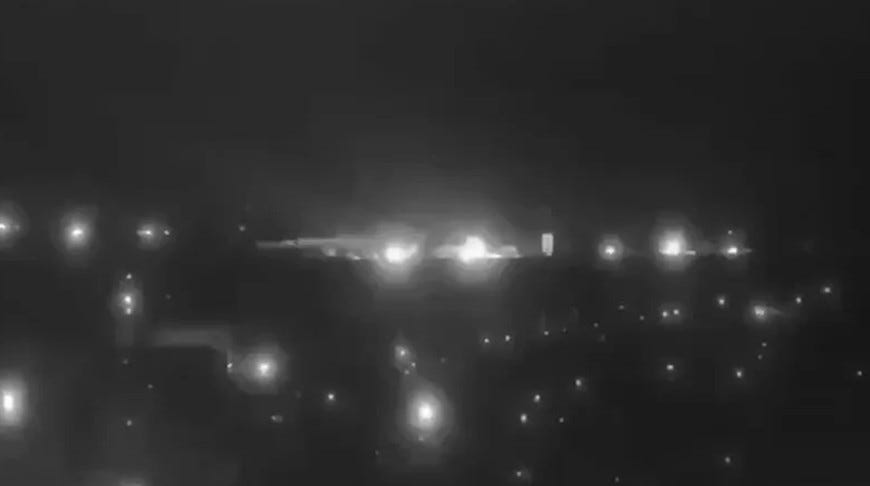
Let’s start with the arrival of the first responders to the site. According to available information, they found something very unusual about the bombing site. Besides the ruins, rubble, and debris everywhere, what leaked from the internal communications was that they observed something described as “small volcanoes filled with glowing material.” Assuming that the first responders have seen many bombing sites and participated in fire extinguishing and search and rescue operations, this description was unique and intriguing. Ukrainian SBU immediately cordoned off the whole area, and access was allowed only to those approved by the authorities. The reason was simple: attempt to deny any potential Russian observation by satellites or drones. What is interesting is that commercial satellites somehow obscure those particular areas. This prevents the OSINT approach, but the Russian military likely took site photos, satellite, and drone records. Also, the first responders in a predominantly Russian-speaking city and the Russian population are highly likely to pass HUMINT to the Russian side.
At the time of writing, there are no official records of foreigners visiting the site immediately after the attack. Still, it is highly likely that SBU and police investigation teams already shared information and collected material with their Western counterparts.
If the missile bus carries just six large warheads without submunitions, they may be dispersed some distance from each other so that the penetration into the ground might be deeper, but the overall width of the targeted area may be smaller compared to an equivalent dispersion of smaller submunitions.
As described in the article about the hypothetical attack on Zelensky’s bunker, six larger warheads may be able to penetrate closer to the underground structure, but based on the cumulative effect and the dispersion, they may not be able to cover a wider area. The same logic holds for the simultaneous attack of multiple smaller nuclear warheads on the wider but still patterned (circular or elliptical) area than with one larger warhead because combining multiple smaller warheads will yield wider destruction.
For the sake of explanation, that glowing material may be some kind of molten natural material in the form of magma (underground molten rock) or lava (molten rock above ground). It would be correct to say that they likely saw something that reminded them of lava. Anything on the surface can catch fire, but for firefighters, this is something that they don’t see every day.
As there are no public photos available, the following images illustrate how that molten material on the surface may have looked when the first responders arrived:
Considering that Dnipro is not even close to any seismic or volcanic zone, it is unknown what ammunition can create this effect.
It is definitely not nuclear but rather kinetic, and many experts agree — kinetic warheads made of a dense and very high-temperature resistant material. The next question is whether the projectile is purely inert (kinetic) or if some active component has been incorporated. Based on available information in the scientific domain, there are some merits to the argument that there may also be a unique explosive present, adding to the kinetic effect.
High density is necessary for deep penetration, and depleted uranium is among the most dense materials. However, its use would leave residual radiation, so this idea is excluded from consideration.
From the previous article about Oreshnik:
“The Russian source said that the surface temperature of the warhead is 4000 C, and to withstand this temperature, a special alloy or ceramic material was developed. The composition is top secret. It is known that Tantalum-Hafnium carbide or Hafnium carbonitride has a melting point of about 4000 C, but these materials are used just representative of the possibilities. Other components may be present if the warhead does not melt at 4000 C. Density is another unknown and can be easily higher than 16 g/cc. Depleted uranium would be the densest material available but it was definitely not used in Oreshnik. It may also be some alloy based on Wolfram (Tungsten) Vanadium base.”
Concerning high-density metals and explosives, the term Energetic Structural Material (EMS) comes to mind.
“Energetic structural materials (ESMs) are multifunctional reactive composites which are designed to have structural strength and energetic characteristics, including high energy density and low sensitivity. The application of ESMs is expected in military as kinetic penetrators, reactive fragments, reactive bullets, reactive armor and munition casings, which require mechanical properties comparable to regular metallic materials. The rate of heat release is another important consideration for designing ESMs. It requires heterogeneous reactions with fast kinetics, in time scales defined by the specific applications, ranging from minutes down to microseconds. It was found that the rate of heat release relies on the size of particles or bilayer spacing of reacting components. For the particle in nanoscale, the timescale of reaction is on the order of tens of microseconds”1.
Researching further, ESMs consist of alloys and composites using Aluminum, Zirconium, Nickel, etc. Aluminum-based ESMs have good energy release characteristics, but the most significant disadvantage is their very low density and strength, rendering them useless as hard penetrators. Even with hypersonic velocity, they would not penetrate more than a few meters before disintegrating. To achieve high penetration ability, a dense metal such as tungsten or tungsten alloy is necessary.
Adding tungsten creates energetic structural materials with high strength. This material has high stability under normal conditions and the ability to maintain structural integrity under detonation loading. What is of particular interest is that when the ESMs interact with a target object, which in Dnipro was an underground structure, chemical reactions occur between different components of the ESMs and surrounding materials, resulting in combustion or explosion reactions.
Research on shock-induced reactions in metal-based reactive materials, such as a powder mixture, appeared for the first time in the Russian literature in 1956, followed by numerous works. This has resulted in advances in solid-state chemistry under high-pressure shock loading down to microscopic scales involving defect mechanisms. A new branch of reactive materials, Structural Reactive Materials (SRM), emerged in the early 2000s. A structural reactive material comprises a mixture of micrometric or nanometric energetic metals and metal compounds condensed to maximum density. SRMs have a broad application potential, including armament systems, reactive armors, reactive protection, and energy sources for outer space uses through intermetallic reactions, for air blast through oxidation of fine SRM fragments, and for extreme environment applications where the conventional high explosives fail due to lack of high temperature or high-pressure sustenance.2
Dense metal explosives and energetics incorporate a large metallic mass fraction to maximize the dynamic effect of dense metal flow with high particle momentum flux, release high-energy reactive particles coherently to enhance the blast wave, or both.3
Dispersal from a dense metal explosive provides two main dynamic effects in a nearby structure locally: total impulse dominated by high-speed metal momentum flux and particle clustering and jetting, which deviates from the mean metal flow density and motion. Both effects will be further influenced when the particles are reactive. When reactive metal particles are involved, two multipeak energy release rules for hybrid detonation will help design new classes of dense metal explosives and energetic systems.4
To simplify a complex phenomenon, the projectile approaching with high velocity (10+ Mach) and high surface temperature creates a shockwave and interacts with the surrounding material such as dirt, soil moisture, rocks, or concrete. A chemical process forms that creates detonation. So, besides the kinetic impact, a warhead of a specific composition will also induce an explosion, multiplying the effect of the kinetic penetration. High temperature combined with a shock wave accelerates systems that contain a large quantity of micrometric or nanometric metals and metal compound particles, so detonation creates an immense temperature that can melt surrounding material to some distance.
Physically, the Oreshnik warhead (assuming it is 100+ kg) may penetrate ~40 m (depending on the soil composition). A hypersonic shockwave is trapped underground, creating immense heat and pressure that vaporizes surrounding material such as rock, dirt, and concrete. This penetration occurs so quickly that the projectile material is still compact to some level, after which a rapid (nanosecond) exothermic reaction starts, causing the immediate burning of the projectile particles and surrounding material. Tungsten and alloy components of the warhead under this temperature begin to burn. This burning creates a chemical or secondary energy release from the projectile. This happens in micro- or nanoseconds. The penetration depth ensures that most of the energy is released underground, meaning that there will be a minimal explosion effect visible on the surface. It will not be a fireball like during the explosion of conventional warheads. Plasma or electrically charged gas plume may be visible around the impact point. It may happen because of the very high temperature.
The impact at Yuzhmash may be described as extreme pressure generated underground, creating a microearthquake that damaged foundations, buildings, and underground structures. Any seismic station in the region would have been able to detect it. The combined action of longitudinal and transverse vibrations of soil particles would cause a surface seismic wave (Rayleigh wave) to be propagated along the free surface of the ground from the explosion epicenter.
After the underground overpressure subsides and the shockwave reaches the surface, everything above the impact points may collapse into the cavity below, which is filled with molten material. This collapse of the solid materials pushes the molten material up. This material will eventually solidify.
This explains what may have happened beneath Yuzhmash and what the first responders saw as a “mini volcano.”

Russia has the upper hand and is years ahead of anything similar in the West. Oreshnik missiles can reach any NATO location, and there are 40 high-priority bases whose neutralization will cripple NATO in Europe for good. Russia will soon have hundreds of Oreshnik missiles ready, and NATO has nothing (even on the drawing boards) to intercept them.
Tungsten combustion in impact-initiated WeAl composite based on W(Al) super-saturated solid solution, Kong-xun Zhao, Xiao-hong Zhang, Xiao-ran Gu, Yu Tang, Shun Li, Yi-cong Ye, Li'an Zhu, Shu-xin Bai
The Julius Meszaros Lecture: Dense Metal Explosives and Energetics: Fundamentals and Beyond. 25th International Symposium on Military Aspects of Blast and Shock (MABS25)
Effect of W on the Impact-Induced Energy Release Behavior of Al–Ni Energetic Structural Materials, Shun Li, Caimin Huang, Jin Chen, Yu Tang, and Shuxin Bai
https://www.sciencedirect.com/science/article/abs/pii/S0925838820312573
https://t.me/Slavyangrad/116233
https://x.com/cheguwera/status/1873334757171339269
https://t.me/Slavyangrad/115916
Are the Oreshnik Missile's 'Hazelnuts' Akin to the 'Rods of God'? Douglas C. Youvan
Thanks for reading Black Mountain Analysis! Subscribe for free to receive new posts and support my work.
This work is licensed under a Creative Commons Attribution-NonCommercial 4.0 International License •
ALL CAPTIONS AND PULL QUOTES BY THE EDITORS NOT THE AUTHORS
| This video has quite a story, albeit, a typical story for a film that exposes the Empire in all its perfidy. It was first posted about a decade ago, on Cyrano’s Journal, when we first encountered this resource. It was soon the object of sabotage by technical means: the page mysteriously vanished and our server went down—for almost a full week. Further attempts met the same fate, so we gave up until circumstances became favorable to our side. Lately, we decided to try again and looked for the video all over the place, to no avail. It was certainly not on YouTube, a platform notorious for its aggressive participation in imperialist censorship of free speech exposés. But, we eventually found it on YouTube, again, of all places, although after posting it here a few days, it again vanished (see the black box below). Clicking on the link provided to supposedly see it on YouTube itself, as they promise, leads nowhere. So we conducted a new wide search and located an independent depot that had preserved this film. We recoded it and sent it up to Rumble, which so far seems to still honor its promises NOT to practice censorship. Now you know. Learn from this, and if you can, download it and pass it on. Help us defeat the web of lies that keeps imperialist evil alive. |
TGP Superstation & PravdaTV
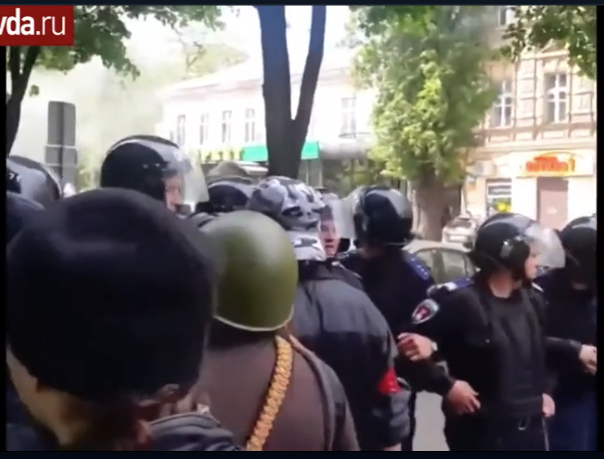
Those—especially in America—who thought fascism had been buried with Hitler are in for a big surprise. Fascism never died and is in fact popping up all over Europe, chiefly thanks to the disastrous policies pursued by most capitalist regimes and their American sponsor. The most notorious cases of a fascist revival are so far confined to Greece and the Ukraine. This program presents the views of Eastern Ukrainians and Russians exposing the brutal measures employed by Kyev to subjugate the protests and rebellions sparked by their own illegitimate actions.
Related:
2014 Odessa Clashes (Wikipedia) Since it’s Wikipedia, exercise caution.
![]()
By ANDREW KORYBKO (USA)
THIS IS A REPOST. THE ESSAY REMINDS US OF THE ROLE THAT REGIONAL NATO PUPPET STATES PLAYED AND STILL PLAY IN AMERICA’S ENCIRCLEMENT STRATEGY AGAINST RUSSIA.
Poland, the eager American servant that it has been, has now officially taken on the role of the ‘Slavic Turkey’ in relation to Ukraine. Just as Turkey has been a geopolitically convenient conduit for arms, personnel, and material support for the Syrian terrorists, so too has Poland begun to officially fulfill this role for their Ukrainian counterparts.
Prime Minister Tusk stated on 20 February, 2014 that Poland was already treating the injured insurgents from Kiev, and has actually ordered the military and interior ministry to provide hospitals to help even more. The deputy health minister has confirmed that Warsaw is in contact with the rebels in Kiev “in making plans to take in Ukrainian wounded”. This means that Poland has formally extended its covert and diplomatic reach nearly 300 miles into the interior of Ukraine, and that its intelligence services are obviously doing more in Ukraine than just ‘helping the wounded’ (terrorists). It is even more likely that Polish influence is even stronger in Lviv and Volyn Oblasts, the regions bordering Poland, and coincidentally or not, Lviv has already attempted to declare independence. The same can be said of Turkish influence deep into Syria at the height of the crisis in that country, and one must be reminded of the fact that Turkey also helped the wounded [anti-government] fighters in that country recover on its territory.
The structural similarities between Poland and Turkey in relation to Ukraine and Syria need to be examined in order to more clearly understand how the ‘Lead from Behind’ template has been applied to both case studies.

Maidan protesters in Kiev enjoy their victory in the knowledge that Washington and NATO stand behind them.
First of all, the ‘Lead from Behind’ strategy has been defined as “discreet U.S. military assistance with [others] doing the trumpeting”. It is the new strategy of warfare for theaters where the US, for whatever reasons, is reluctant to directly militarily engage itself. It relies on using regional allies/’leaders’ as proxies to further US geostrategic and geopolitical goals via asymmetrical measures while Washington pivots to Asia, where it aims to present a conventional deterrent to China. Both Poland and Turkey are the US’ puppets of choice in their respective theaters against their neighboring targeted states (Ukraine and Syria). At the least, the US provides intelligence support and the training of ‘opposition’ units, while Poland and Turkey pull the weight in directly assisting those members during their deployments in the victimized nations. In the case of Ukraine, the US utilized NGOs to infiltrate the country over a more than 10-year period and also allocated $5 billion to “help Ukraine achieve [the development of democratic institutions]”. The National Endowment for Democracy has also been pivotal in peddling the ‘Kony 2012 of Ukraine’ in order to advance their psy-op campaign against Kiev, just as ‘Syrian Danny’ was the version deployed against Damascus.
But the similarities do not end there.
Both Poland and Turkey are frontier NATO states, with Poland being described as “the largest and most important NATO frontline state in terms of military, political and economic power.” These two geostrategic states also have an overwhelming population when compared to their neighbors, as well as national inferiority complexes stemming from their lost imperial legacies (the Polish-Lithuanian Commonwealth and the Ottoman Empire). They share a significant land border with the states targeted for a ‘democratic transition’, as well as important cultural and political connections with those societies (as a result of the aforementioned imperial legacies) prior to the unleashing of the respective crises. This gives them significant intangible benefits over the future battlefield, both in state, non-state, and informational activities.
[dropcap]P[/dropcap]oland and Turkey also host important American military installations. Turkey houses the US Air Force at Incirlik and an anti-missile defense radar in the east, while Poland provides the US with the Lask Air Force Base and an anti-missile defense outpost in the northeast near Kaliningrad. In regards to the development of the insurgents’ mission, the Ukrainian Fascists are taking on disturbingly similar characteristics to the Jihadists in Syria. In 2011, random sniper fire (attributed to the ‘rebels’) was targeting civilians in Damascus, just as the same has begun to occur in Kiev, even targeting a reporter from RT. The Lviv request for independence can be seen as following the declaration of autonomy of Syria’s Kurds, as both areas abut the border of the proxy state interfering in the affairs of its neighbor. In a similar fashion, both insurgent groups have taken over border control posts connected to their patron state, and this move obviously increases the ease with which Ankara and Warsaw can funnel arms, personnel, and materials to their subversive spawn. When the borders cannot be held by the insurgents, they resort to ransacking government depots and stealing arms from captured government forces and occupied buildings. The Syrian fighters have a history of hostage taking and brutal executions, and their Ukrainian comrades have followed their lead by capturing over 60 police officers in Kiev.
It has thus clearly been demonstratively shown via the aforementioned examples that the destabilizations of both Ukraine and Syria are modelled off of a patterned approach. The US utilizes proxy states with injured imperial legacies in order to advance its ‘Lead from Behind’ strategy, targeting pivotal geostrategic areas where the US prefers to maintain a plausible deniability over its role and is reluctant to get too directly involved. One can also discern a larger trend developing – the use of extreme macro-regional ideological movements to support long-term destabilization. In the Middle East, extreme Islam is the method of choice for application and export, whereas in Ukraine, it is increasingly appearing as though extreme far-right (in some applications, even Neo-Nazi) group fit the ‘Wahhabi role’ for Europe. Ukraine could quite possibly become a training ground for other European far-right militants, or the ones currently in Ukraine can go on to teach the ‘tools of their trade’ to the highest bidder in other European states. Just as Turkey is supporting the extreme Islamists in Syria via its support for the fighters there, Poland can be said to be flirting with extreme far-right nationalists in Ukraine through its statements of support for the violent opposition and its recent decision to evacuate and help the wounded insurgents (not even counting the unreported level of covert involvement already ongoing). And just as the extreme Islamists got out of the control of their handlers and now endanger the entire Middle East, the risk remains that the extreme far-right nationalists may become uncontrollable in Ukraine as well and come to endanger the entire EU. When comparing Poland to Turkey and Ukraine to Syria, it is proven that the Arab Spring has come to Europe in more ways than meet the eye.
Note to Commenters
Due to severe hacking attacks in the recent past that brought our site down for up to 11 days with considerable loss of circulation, we exercise extreme caution in the comments we publish, as the comment box has been one of the main arteries to inject malicious code. Because of that comments may not appear immediately, but rest assured that if you are a legitimate commenter your opinion will be published within 24 hours. If your comment fails to appear, and you wish to reach us directly, send us a mail at: editor@greanvillepost.com
We apologize for this inconvenience.
Nauseated by the
vile corporate media?
Had enough of their lies, escapism,
omissions and relentless manipulation?
A DISPATCH FROM RT.COM

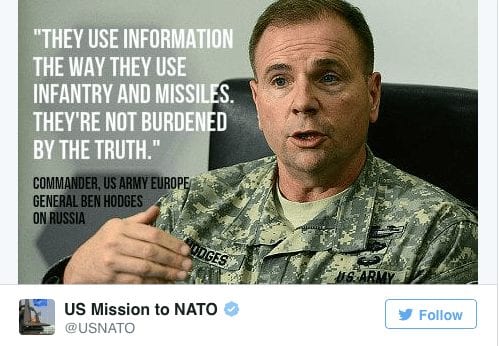
US forces in southern Afghanistan Operations Director General Frederick ‘Ben’ Hodges.(AFP Photo / Ed Jones)
[dropcap]U[/dropcap]S army commander in Europe says Russia is a “real threat” urging NATO to stay united. The alliance is not interested in a “fair fight with anyone” and wants to have “overmatch in all systems,” Lieutenant-General Frederick “Ben” Hodges believes.
“There is a Russian threat,” Hodges told the Telegraph, maintaining that Russia is involved in ongoing conflict in eastern Ukraine. A key objective for NATO is not to let Russia outreach it in terms of capabilities, the general said.
“We’re not interested in a fair fight with anyone,” General Hodges stated. “We want to have overmatch in all systems. I don’t think that we’ve fallen behind but Russia has closed the gap in certain capabilities. We don’t want them to close that gap,” he revealed.
“The best insurance we have against a showdown is that NATO stands together,” he said, pointing to recent moves by traditionally neutral Sweden and Finland to cooperate more closely on defense with NATO.
[pullquote]The US military doesn’t like an even playing field. They prefer overwhelming power or nothing. Sometimes they are irritated that the enemy should even have the audacity to shoot back. This attitude was seen frequently among pilots flying over Vietnam. Gen. Hodges is at least honest about it. [/pullquote]
Moscow has expressed “special concern” over Finnish and Swedish moves towards the alliance viewing it as a threat aimed against Russia.
“Contrary to past years, Northern European military cooperation is now positioning itself against Russia. This can undermine positive constructive cooperation,” Russia’s Foreign Ministry said in a statement.

Laugh if you like, but Gen Hodges‘ beliefs mirror perfectly the utmost untruths peddled by the official US propaganda playbook, including the idea that it is the Russians, and not the Americans, who specialize in the Big Lie.
Hodges also said US expects its allies to contribute financially to the security umbrella provided by the NATO alliance, as its member states have been failing to allocate 2 percent of every member nation’s GDP to NATO budget.
“I think the question for each country to ask is: are they security consumers or security providers?” the general demanded. “Do they bring capabilities the alliance needs?”
However, the general does not believe that the world is on the brink of another Cold War, saying that “the only thing that is similar now is that Russia and NATO have different views about what the security environment in Europe should be.”
“I don’t think it’s the same as the Cold War,” he said, recalling “gigantic forces” and “large numbers of nuclear weapons” implemented in Europe a quarter of a century ago. “That [Cold War] was a different situation.”
“We did very specific things then that are no longer relevant. We don’t need 300,000 soldiers in Europe. Nobody can afford that anymore,” General Hodges acknowledged.
However, there was a sharp increase in the intensity of the training of NATO troops near the borders of Russia last year, Russian General Staff reported.
“In 2014, the intensity of NATO’s operational and combat training activities has grown by 80 percent,”said Lieutenant General Andrey Kartapolov, head of the Main Operation Directorate of General Staff.