
Oliver Boyd-Barrett

Balmy Days for Hormuz?
Just to be clear: as of the time of writing this early in the afternoon of June 13, California time, we don’t have anything sure, yet, on an Iran peace deal. We have to allow for the possibility that there may be some development, perhaps as early as tomorrow, Sunday - as Trump has said - or, as Iranian Foreign Minister and Pakistan mediators are indicating, something during the upcoming week.
Four main things we need to keep in mind.
(1) As of now, there are major considerations that have been clearly flagged by Iran as red lines that will prevent a deal if they are not resolved - one of the most intractable of these is Israel’s Zionist struggle for a greater Israel at the cost of hundreds of thousands of lives of Palestinians in Gaza and the West Bank, Lebanese Shia (and Christians), residents of southern Syria and whose ambitions appear to stretch from Turkey to Egypt to secessionist “Somaliland”. If this does not come to an end at the very least in the form of a credible ceasefire and consequent negotiations, then I do not think any lasting deal with the US is possible.
(2) Even to this minute, public statements from the US, Pakistan and even Iran to the effect that some kind of deal is imminent are belied by clear indications of continuing, vast gulfs between the different parties as to how they understand the “deal,” as indicated yesterday when Trump accused Iran of giving the public an entirely false impression of what the deal is that these parties claim to be “close” to. Oh, and by the way, don’t expect to know what is in the deal if an when there is an announcement that there is a deal. Publication of the details is something that may come. And don’t expect to know for sure that anything has been signed just because someone somewhere says that something has been signed.
(3) So much doubt, just over a Memorandum of Understanding (MOU)! In other words, just a piece of paper that has no legal authority whatsoever and can be broken at any moment.
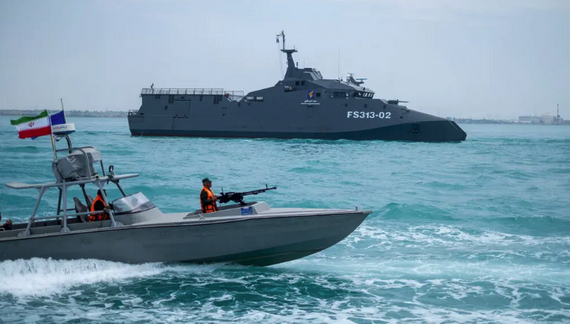
Protected by tunnels, Iran's "mosquito fleet" of well armed speedy boats can easily disrupt shipping in the Persian Gulf. Regular heavier vessels are tactically less important in the current era of drones and missiles.

People forget, and the Western press rarely mentions, that Iran is largely an autarkic nation (like Russia) due to America's massive sanctions. With a well-educated population and sophisticated manufacturing capabilities, Iran can manufacture its own missiles and certainly navy vessels, as shown in the picture.
(4) For as long as this framework holds (and I don’t see how it can possibly hold for long) then we can reasonably expect that there will be continuing negotiations in whose every paragraph, every line, there will lie countless tripwires. Yet we may hope that it will last for 60 days of extended “ceasefire,” which will take the pressure off the US temporarily, and further calm oil markets for a period, perhaps even giving the world an opportunity to re-stock oil reserves (though I don’t think much re-stocking is possible in the space of 60 days, even if the real period of calm will last another month or so even after the 60 days, given the amount of oil that will by then be at sea).
The US, Trump, are behaving like desperate people. This could be subterfuge, but I suspect there is something to be desperate about. I am inclined to think that rumors are true to the effect that Washington has been engaged in ruthless market manipulation of whatever kind works to keep oil prices below the $100 a barrel mark. I would not be surprised if the rumor is true that the US has actually been paying Iran the $2 million per tanker for each of the tankers that the US claims, through ever so subtle and courageous navigation guidance, it has helped slip the Iranian closure of Hormuz. So far, so good. It could be worse, and in the space of 60 days who knows what could happen that might transform the situation for good or for bad. I will also not be surprised, I should add, if rumors prove true to the effect that the US, or elements in the US, are actually planning not a peace deal but a further escalation that will propel oil prices to stratospheric levels and bring about a recession, or a depression, that will prove very difficult for China and the BRICS to survive. I don’t say I believe that such a strategy will work, but I can well imagine, especially after Scott Bessent’s war on the rial, that such a strategy might appeal to elements of the US Deep State.
Ukraine
Dual Narratives
An incessant duality in Ukraine persists between (1) a narrative of major Russian territorial breakthroughs in the north (Chernihiv, Sumy, Kharkiv), the approaching fall to Russia of Lyman and Kostyantynivka in the Donbass (better enabling Russian designs to take down the neighboring cities of Kramatorsk and Slavyansk), stuttering Russian advances west of Pokrovsk towards Dnipropetrovsk, stalling or reversing Russian advances in Zaporizhzhia and (2) a narrative of surprising Ukrainian resilience overall, strong and unexpected ability of “Ukrainian” drones - made in China and assembled in Europe, launched from Ukraine or from the Baltic States or Finland - to wreak sufficient havoc on energy, military and residential targets across mainland Russia as to unnerve Russia (inciting Putin to boast yesterday before a Russian military audience of the rapid innovations Russia is achieving in drone technology, and the expected completion of the new Russian version of Starlink, for which, Putin says, Russia now badly needs satellites).
The single most important Ukrainian accomplishment at this time is the gasoline shortage in Crimea, and the pressure of Ukrainian drones on each of the three major crossing points from Crimea into Kherson (possibly countered by a Russian hit earlier today on a drone or similar facility on the edge of the city of Kherson). Among other things these have caused major slowdowns of truck traffic at the border crossings, rendering supply trucks very vulnerable to Ukrainian attacks.
European “Demands”
European leaders (specifically the ambassadors of the UK, France, and Germany) met with Deputy Foreign Minister Mikhail Galuzin in Moscow. European capitals directly delivered a set of strict conditions for ending the war in Ukraine - so entirely counter were they to legitimate Russian security interests and in violation of often repeated Russian conditions for the ending of the war that should be considered either utterly unserious, or that these leaders are so cocooned in the webs of unreality spun by their own governments and media for far too long that they mirror one another’s lunatic behavior, or that Ukraine’s relatively minor achievements in Crimea and Zaporizhzhia will cause Russia to roll over and beg to be tickled.
While the US and Israeli militaries are not the same, they are deeply intertwined through shared intelligence, joint operations, and vast technological partnerships. Israel maintains its own independent chain of command, operational autonomy, and sovereign defense choices. While the US military occasionally stores equipment in Israel, the US does not station a standing army inside the country as a matter of permanent combat deployment.
While the US remains Israel’s primary arms supplier, the relationship is currently shifting from a traditional donor-recipient dynamic to an unprecedented level of institutional and military-industrial integration.
The US Congress is advancing legislation (such as Section 224 of the 2027 National Defense Authorization Act) to irreversibly entrench Israel within the US defense industrial base. If fully enacted, this framework will deepen co-production of weapons and joint ventures in artificial intelligence, quantum computing, and cyber technology; implement network integration and data fusion between both militaries, and transition Israel away from annual US taxpayer-funded financial aid and toward a model of equal defense-trade partnership—a transition backed by Israeli leadership.
Operationally, the two militaries function in high sync, collaborating through joint exercises (like Juniper Oak) and a close, shared strategic vision for countering mutual adversaries in the Middle East. Israel was shifted from the US European Command (EUCOM) into the US Central Command (CENTCOM) to streamline joint regional operations and integrate regional air defense networks. Israel fights largely with US-sourced, advanced military hardware, while the US incorporates Israeli-designed systems—such as SkyHunter medium-range interceptors—into its own operational supply chains.
US Secrets are Israel’s Secrets
The Pentagon’s Defense Intelligence Agency (DIA) has officially raised Israel’s counterintelligence threat assessment to “critical,” its highest internal level, following reports that Israeli intelligence agencies are aggressively spying on top U.S. leadership. The intelligence collection efforts—described by one senior U.S. official as “unhinged” - specifically targeted high-ranking American officials to intercept internal deliberations regarding the ongoing conflict and ceasefire negotiations with Iran.
This is hardly new news. The most notable instances of Israeli espionage on US soil involve intelligence agents and American informants passing military, political, and classified defense data to Israel. The most famous and damaging cases include
Jonathan Pollard: An American-born civilian intelligence analyst for the U.S. Navy who provided thousands of classified documents to Israel in the 1980s. Arrested in 1985, he was sentenced to life in prison, paroled in 2015, and allowed to immigrate to Israel in 2020.
Ben-Ami Kadish: An 85-year-old former civilian engineer for the U.S. Army who pleaded guilty in 2008 to being an unregistered Israeli agent. He admitted to passing classified documents regarding U.S. fighter jets and missile systems to the same handler used by Jonathan Pollard.
A former Department of Defense analyst who pleaded guilty in 2006 to passing classified Pentagon information regarding U.S. policy on Iran to AIPAC officials. The Department of Justice prosecuted the case as a major breach of national security.
Now we are being told that despite the close bilateral alliance between the U.S. and Israel, American counterintelligence agencies have continued to rank Israeli espionage as highly active on U.S. soil.
FBI and U.S. intelligence officials have occasionally reported on clandestine monitoring or eavesdropping efforts targeting American officials, though both countries officially deny mutual espionage.
According to intelligence reports published by The New York Times and NBC News, the primary targets of the stepped-up Israeli electronic surveillance and eavesdropping campaign include: Steve Witkoff: President Donald Trump’s top negotiator and special envoy leading the diplomatic peace talks with Tehran; Elbridge A. Colby, the Pentagon’s top policy official (Undersecretary of Defense for Policy); and Michael P. DiMino IV, a senior Middle East policy official and one of Colby’s main deputies.
These are said to be vulnerable because they frequently travel on private aircraft, use personal cell phones for sensitive matters, and occasionally decline standard U.S. Embassy security details while abroad. The first two are so pro-Israel one really has to wonder why Israel would need to spy on them and why Israel would not have much more pressing targets.
The DIA’s reclassification elevates Israel’s threat tier above several adversarial nations. While allied nations routinely track each other’s broad geopolitical intentions, U.S. national security officials maintain that Israel has “crossed a red line” by attempting to bug physical U.S. government offices, vehicles, and the private electronic communications of senior negotiators.
Kushner and Israel in Albania
Jared Kushner is leading a €1.4 billion luxury development project to transform Albania’s largely unspoiled Sazan Island and the Zvërnec coastline into exclusive eco-resorts. His interest stems from his private equity firm, Affinity Partners, which focuses heavily on ventures across the US, Israel, and the Gulf region.
The development targets Sazan Island, a former communist-era military base, and the Zvërnec coastline near Vlora. The area is known for sensitive natural habitats, including migratory bird species, flamingos, and sea turtles. Kushner and his wife, Ivanka Trump, unveiled a plan for high-end hotels, villas, and a marina aimed at wealthy international tourists. Kushner’s firm is heavily backed by foreign funds, including billions of dollars from Saudi Arabia’s Public Investment Fund.
The involvement of the Rothschild family has served as the catalyst that connected Kushner and Albania’s prime minister, Edi Rama. Jared Kushner has recounted how, during a 2021 vacation after leaving the White House, he was sailing the Adriatic Sea on a boat owned by financier Nat Rothschild. While on Rothschild’s yacht, Rothschild introduced Kushner to Sazan Island and arranged for Prime Minister Rama to board the vessel for a dinner meeting. This meeting served as the foundation for the luxury project. It was later advanced when Kushner and Rama reconnected at the World Economic Forum in Davos. While the introduction happened via Nat Rothschild’s social and financial network, the actual funding for the €1.4 billion to €4 billion development is driven by Kushner’s firm, alongside backing from Qatari investors and Saudi Arabia’s Public Investment Fund
In short, while the Albanian investments do not appear to involve direct Israeli state funding, Kushner’s broader business and political ties tie the project to the region. Kushner’s investment firm was explicitly designed to foster business ties between Israel and the Arab world, growing out of his work on the Abraham Accords during the Trump administration. Kushner maintains extensive business and political connections in Israel and the Middle East, which has framed the Albanian project as part of his broader geopolitical focus.
The project has faced immense pushback and protests from environmentalists, locals, and civic groups who argue the development will threaten the local ecosystem, dispossess citizens of their land, and fail to create affordable jobs.
Edi Rama has claimed that some of the backlash is tied to geopolitics. He suggested that Kushner’s ties to Israel, as well as Albania’s hosting of Iranian opposition groups, have made the development a target for foreign interference and cyber campaigns originating from the Middle East.
The Gulf ON, the Gulf OFF, the Gulf ON, the Gulf OFF x 1000s
Trump’s De-Scheduling is Meaningless
The US and Iran have engaged in escalating tit-for-tat exchanges over the Strait of Hormuz following the downing of a US Apache helicopter by Iranian forces. This downing was not a credible pretext for Trump’s subsequent escalation (and now aborted at least for five minutes). The Apache may have collided with an Iranian surveillance drone and, if so - assuming this event is not entirely fabricated in order to promote the sale of US robot rescue vessels - this would have occurred in Iranian air space over Iranian waters in the Strait of Hormuz.
While the unprovoked and illegal US and Israeli hostilities against the sovereign nation of Iran, a nation which is the main regional obstacle to Israel’s Zionist imperialism, have pushed the region toward a wider conflict, U.S. President Donald Trump has, within an hour of my writing this around midday on June 11, called off strikes that were apparently scheduled for later today, citing imminent progress on a negotiated peace deal.
Peace, No Way
There is no evidence whatsoever of such a peace deal, and the existence of any such peace deal would be very surprising, given that there are no actual negotiations - only messages that are being exchanged via the mediation, we are told, of Pakistan, and given, also, that one of the important conditions that it is clear would have to be resolved if there was to be a settlement - Israel’s invasion of Lebanon - is nowhere near happening. The fictional character of most Trumpian Truth Social pronouncements nonetheless still seems to function perfectly fine for manipulating stock markets and oil prices - the which are all apparently controlled by certified idiots or malfunctioning AI algorithms. Maybe that is why Trump is today appointing a former SEC chair, Jay Clayton, to the diminishing post of Director of National Intelligence, recently vacated by the feckless former anti-war radical, Tulsi Gabbard.
Recent Exchanges of Fire
Here are the major developments from the last 12 hours:
U.S. Central Command (CENTCOM) launched heavy, so-called “self-defense” strikes (why does the US need to defend itself thousands of miles from the US and from anything that is threatening US national security, given that the US has plenty of oil of its own?) against multiple Iranian targets, hitting military surveillance, radar, and air defense sites along the Strait of Hormuz and within southern Iran. Last night, there were 49 Tomahawk strikes, reportedly (not much video evidence and details of targets or strike rates, etc., are minimal or nonexistent) of which at least one struck a target in Karaj, northern Iran. Sixteen towns are reported to have seen explosions, concentrating around Tehran, the capital, Bandar Abbas on the Strait of Hormuz and Kharg Island to the north. There have been further strikes today as of 5:50pm local time.
The US continues to claim, dubiously, that it maintains a strict naval blockade of the Strait of Hormuz. U.S. Trump has also threatened to seize control of vital Iranian oil export facilities, such as Kharg Island - a move that, were it to occur, would subject US military forces in full combat gear to the intense heat of the Gulf such that many would risk death within ten hours of exposure.
To help things along in the direction of catastrophe, and in place of agreeing to Iran’s insistence that it be paid reparations for the illegal US attacks on its territory, Treasury Secretary Scott Bessent (the guy who initiated the most recent war with an attack on the Iranian currency) has provocatively stated that frozen Iranian funds could be used to cover damage to U.S. allies.
Three of the US airstrikes disabled foreign-flagged oil tankers (which the US claims were carrying Iranian oil) crewed by Indian seafarers in the Gulf of Oman, resulting in the deaths of three Indian mariners. The fatalities mark the first merchant sailor deaths since the United States initiated its naval blockade on Iran-linked shipping on April 13.
CENTCOM defended the strikes, stating that the vessels were operating in violation of the US naval blockade of Iran (which has no legality whatsoever, being an act of wanton piracy, similar to US imperialist and murderous aggression against Venezuela and Cuba) and attempting to transport Iranian oil or dock at Iranian ports. According to CENTCOM statements, American forces fired precision munitions and Hellfire missiles directly into the ships’ engine rooms only after the crews repeatedly ignored maritime directions from US naval assets.
US Attacks India: After All, They’re Not White Either
The Indian government summoned the U.S. Deputy Chief of Mission in New Delhi to lodge a “strong protest” and explicitly condemned the strikes. The Ministry of External Affairs spokesperson Randhir Jaiswal stated to reporters that “these attacks must cease and end”. India’s Foreign Ministry clarified that none of the targeted vessels are Indian-owned. The mariners were working aboard foreign-flagged merchant ships operating in an active conflict zone. India’s Ministry of Ports, Shipping, and Waterways is collaborating with the Royal Navy of Oman to repatriate the surviving crew members and retrieve the remains of the three deceased sailors.
The International Maritime Organization (IMO) has condemned the attacks for endangering civilian seafarers and has demanded a full, transparent investigation into the incidents.
In response to the recent US strikes on its assets and territories, Iran launched retaliatory missile and drone attacks against U.S. allied nations hosting American forces, forcing temporary military and airspace lockdowns in Kuwait, Bahrain, and Jordan. More specifically, explosions were reported at the Mwaffaq Salti airbase in Jordan, the Ahmed Al Jaber Airbase in Kuwait, the headquarters of the US 5th Fleet in Bahrein, the Sheikh Isa airbase in Bahrein and in multiple other locations. Iran claimed to have fully closed the Strait of Hormuz to vessel traffic, threatening to target any ships approaching the vital maritime corridor. Many of the details appeared in my post yesterday.
From Pathetic Navies to the Supply of Tungsten and Why They Matter
Pathetic UK Dependence on the US in Starmer’s Last Days
In interview with Judge Napolitano today, former British diplomat Ian Proud adds to the wonder reminding us (and there has been a stream of corroborating accounts) of the pathetic state of the UK’s military forces whose army, at 73,790 regular full-time personnel, is exceptionally modest for a former ruler of the world. Its once-great navy (remember Nelson at Trafalgar, piercing the might of Napoleonic glory with a far smaller force?) today comprises 62,160 active personnel and 62 commissioned ships. However, due to ongoing maintenance and refits, its deployable “functioning” frontline surface fleet comprises merely two aircraft carriers (and I am not sure that even they are up to it), six destroyers and and about eight frigates. As we speak, there are no actually functioning attack submarines.
In interview with Judge Napolitano today, former British diplomat Ian Proud adds to the wonder reminding us (and there has been a stream of corroborating accounts) of the pathetic state of the UK’s military forces whose army, at 73,790 regular full-time personnel, is exceptionally modest for a former ruler of the world. Its once-great navy (remember Nelson at Trafalgar, piercing the might of Napoleonic glory with a far smaller force?) today comprises 62,160 active personnel and 62 commissioned ships. However, due to ongoing maintenance and refits, its deployable “functioning” frontline surface fleet comprises merely two aircraft carriers (and I am not sure that even they are up to it), six destroyers and and about eight frigates. As we speak, there are no actually functioning attack submarines.
Britain's air force (RAF) consists of approximately 35,300 active personnel and 3,001 reserves. In terms of equipment, the RAF fields around 670 total aircraft, including about 151 combat aircraft. But only 40% to 50% of the Royal Air Force's aircraft are immediately functioning and available for frontline operations today. I won’t even bother to compare this with Russian forces, limiting myself to the comment that, for a country that makes so much thunderous noise about Russia and that over the past two hundred years has been the principal source, other than the US, of anti-Russian and Russia phobic propaganda, British is a noise stream of hot air that would count for nothing in battle. And much the same is true of other European countries whose sick militaries, if strung together on a beanpole, would make up one very sick and uncoordinated bigger military.
Britain’s nuclear capability is operationally independent but structurally and technically dependent on the United States. While the British Prime Minister has the sole authority to launch the weapons, the UK relies on the US for the supply, maintenance, and testing of its Trident missile systems. The UK does not manufacture its own submarine-launched ballistic missiles. Instead, it leases a pool of US-built Trident II D5 missiles from the US Navy, which are stored at the Naval Submarine Base Kings Bay in Georgia. British submarines must return to US facilities for maintenance, missile overhauls, and test firings, as the UK lacks the domestic infrastructure to perform these services. The UK’s warheads are built in Britain, but they are designed in close cooperation with the US and rely on American-supplied components and aeroshells. The UK’s deterrent depends on US-provided satellite and weather data, meaning its capacity to deploy the missiles would be degraded without American navigational infrastructure.
The notion that the UK is going to be the savior of fascist Ukraine does not seem sound in this context. Britain is offering to work with Ukraine so as to produce an equivalent to US patriot air defense systems (a development that may not be welcome to the US). The chances of this coming to fruition in timely fashion are remote in the extreme.
China Makes the Drones that Ukraine Uses to Attack Russia
In his broadcast today from Pskov, Alexander Mercouris shares information imparted to him by a fellow conferee (from Beijing) to the effect that most of the drones that “Ukraine” fires into Russia are assembled (in Ukraine, the US, Europe, wherever) from Chinese parts. China’s excuse for this astonishing inability to extend some really useful help to its most important ally is that, were it to come down hard and deregulate this trade, its manufacturers of drones would go bankrupt. But at least we can be reassured by China’s tougher stance on the supply of rare earths, including Tungsten, to Western purchasers.
China holds a near-monopoly on the global rare earth elements (REEs) supply chain, controlling over 91% of refining capacity and 94% of permanent magnet production. By leveraging this dominance and the intellectual property developed over decades, Beijing can restrict global access to critical minerals used in electric vehicles, consumer electronics, and military defense systems.
Weaponizing China’s Rare Earths
China utilizes a mix of export controls, licensing mandates, and intellectual property (IP) protection to maintain its strategic advantage. China requires exporters to obtain special governmental approval to ship rare earth elements and permanent magnets. Companies must thoroughly document their end-users and the intended use of the materials. Regulations dictate that any product manufactured outside of China containing Chinese-origin rare earths at 0.1% or more of the product’s value requires a Chinese export license to be shipped internationally. China has banned the export of rare earth extraction and separation technologies. Furthermore, Chinese nationals are barred from working on rare earth exploration or manufacturing projects overseas without explicit authorization from Beijing.
Because heavy rare earths and permanent magnets are integral to modern defense tech (like fighter jets, submarines, and radar systems), China’s restrictions pose significant challenges to Western supply chains. In response to trade tensions, nations have repeatedly been forced to navigate complex licensing processes and shipment delays, occasionally resulting in temporary manufacturing shutdowns.
The United States and European nations are attempting to build alternative, non-Chinese supply chains and processing facilities, but establishing independent mining and processing infrastructure requires years of effort.
The Tungsten Factor
Of particular significance is tungsten, an irreplaceable critical mineral that stands at the absolute intersection of national security and global industrial necessity. As of 2026, tungsten is considered a primary supply-chain bottleneck for Western nations. China controls over 80% of global tungsten production. By contrast, the United States has had no active domestic tungsten mining for over a decade.
The role of tungsten stems from a combination of extreme, unmatched physical properties and a highly volatile, concentrated geopolitical supply chain. Tungsten holds several unique physical and chemical records that make it functionally impossible to substitute in high-stress applications. It has the highest melting point of all known metals. It retains its structural integrity under temperatures that would melt or deform steel and titanium. When synthesized into tungsten carbide, it is the hardest element on the periodic table after diamond. It is highly resistant to wear, scratches, and friction. With a density of 19.25 g/cm³, it is roughly 1.7 times denser than lead and sits on par with gold and uranium. This allows it to pack massive kinetic mass into highly compact spaces.
Because of its density and heat tolerance, tungsten is the foundational material for modern kinetic warfare and advanced aerospace. Tungsten serves as the core “penetrator” inside anti-tank rounds and high-speed missile projectiles. It cuts through heavy military armor purely through kinetic force without relying on toxic depleted uranium. It is utilized to build rocket nozzles, missile bodies, re-entry vehicle shielding, and jet engine components that must endure continuous, explosive thermal exposure. Heavy reliance on tungsten exists for critical defense hardware supplied to active conflict zones, including Patriot missile batteries and THAAD air defense systems.
Beyond the battlefield, tungsten acts as an invisible force underpinning global manufacturing, infrastructure, and technology - as in machine tooling, drill bits, and cutting blades used in the automotive, mining, and oil industries rely on tungsten carbide. Without it, metal-on-metal manufacturing lines would wear out almost instantly. It is used as a foundational material for electrical contacts, thin-film transistors in modern displays, and integrated circuits inside mobile phones and consumer goods. Tungsten is increasingly used in the manufacturing of electric vehicles (EVs), next-generation batteries, and solar infrastructure.
Compounding the problem of China’s dominance in this field, are strict U.S. national security laws—such as the REEShore Act—mandate a total prohibition on using Chinese-origin tungsten in military equipment. Because establishing alternative mines and domestic processing plants takes years, Western rearmament plans face severe near-term market squeezes and price spikes whenever export restrictions tighten.
On the Battlefields
Yes, Lyman is falling (after how many months or, rather, years of trying?), again, to Russia and yes, Kostiantynivka has almost completely fallen to Russia after a comparable period of time, opening a much clear path for Russia to turn its full attention on Slavyansk and Kramatorsk - all good evidence of continuing Russian territorial gains in the Donbass, the main priority of the Russian SMO. And in the north, Russia has made substantial gains in Chernihiv, Sumy (where last night Russian drones were attacking the city of Konotop) and, especially, Kharkiv, all of which constitutes a medium-term threat to Kiev.
But on the other side of the ledger we have to enter the catastrophic gasoline shortages in Crimea, the impact of Ukraine’s shelling of the bridge near Chongar between Crimea and Kherson (leaving only two other routes of which at least one is highly vulnerable to Ukrainian drones), the continuing threat of a Ukrainian marine invasion of the Kinburn spit. Then there is the continuing escalation of Ukrainian drone attacks on significant energy and military and other facilities deep inside Russia such that Ukraine is now sometimes sending far more drones into Russia (500 over the past 24 hours) than Russia is firing into Ukraine (even if more of the Russian drones hit their targets - given the poor state of Ukrainian air defense and the relative absence of Patriot launchers and missiles, supplies of which have essentially run out - and possibly do more damage per hit, though not enough, it would seem, to stop Ukraine increasing the number of drones that it launches)
The situation in Crimea is increasingly grave for Russia. Last night Ukrainian drones struck another oil refinery in the Krasnodar area of Crimea. What was once intended to be an untouchable, strategic stronghold has become a highly vulnerable liability marked by severe logistical bottlenecks, fuel shortages, and a collapsing defensive perimeter. The Kerch Strait bridge and remaining railway ferries are under constant threat from Ukrainian drones and missiles, rendering these routes highly unreliable, although Russia has road and rail links across the mainland that have long since rendered these routes less important than they once were. Long-range strikes on oil terminals and depots have led to strict fuel rationing, with civilian and military fuel access severely restricted.
With maritime and bridge transport compromised, Russia’s only remaining supply lines are land routes (like the M14, M17, and M18 highways), which are also experiencing “logistical lockdown” due to relentless drone and artillery targeting. Ukraine has systematically dismantled key radar and air defense systems in Crimea over an extended period. The Black Sea Fleet has been forced into a major retreat to safer ports, further stripping the peninsula of its historical defensive and offensive capabilities. Russian forces are also withdrawing from strategic positions like the Kinburn Spit, opening the door for Ukraine to establish new footholds (three attempts so far, though none successful, yet) and directly pressure the occupied south. The extensive economic and military damage has resulted in panic, with many attempting to leave the peninsula due to a lack of confidence in the situation normalizing.
Russian forces are currently moving on Kostyantinivka via the northwest of the city, while south of the city they are in the process of consolidating control over Dovha Balka and, further west, Rozkishne, suggesting that quite soon Russia will establish control over a continuous territory from Toretske and Solivka in the west, through Mykolapillia, to Dovha Balka and Rozkishne in the east.
This will considerably shorten the distance that Russia has to cover to get to the settlements of Druzhkivske and Oleksilovo Druzhkivka, which lie immediately south of Kramatorsk, on the way to finally taking control of all of the Donbass.
To the north, Russian forces are rapidly closing the gap in the territory they control along the river Volcha, from Vovchansk in the west to Russian-controlled Budarky and Pischane in the east, having today taken Okhrmivka in the direction of Mala Vovcha. In the northwest of Kharkiv oblast, Russian forces continue moving on Kozacha Lopan and Nova Kozacha, suggesting an ultimate goal of seizing Kharkiv city itself, the second largest city of Ukraine.
