
Julian Macfarlane
 Russia advances; the West retreats into madness
 As Russian forces in the Ukraine continue their advances, cauldronizing the last remnants of Kievan occupation forces in Liman and Konstantinovka in preparation for taking the Slavyangrad - Kramatorsk agglomeration, and with Russian airpower strikes on all fronts, it would seem that the SVO is entering a decisive phase. Kiev is getting desperate with more and more terrorist strikes. Kiev will not give up easily. And the West is increasingly deranged. ]
The Silovik myth
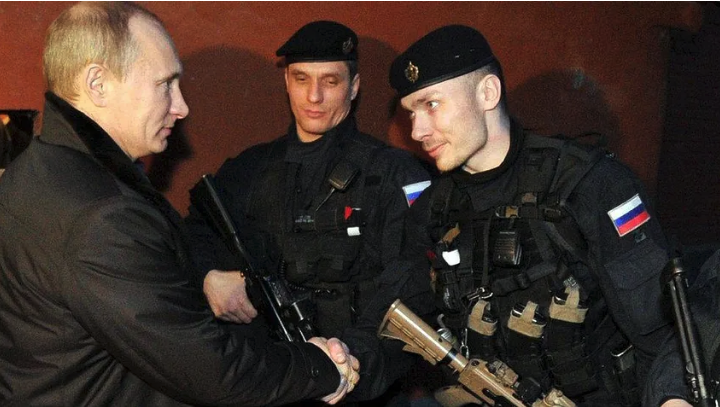
There are constant references to Putin’s KGB background, with the KGB understood as the USSR’s Gestapo. Putin is the ultimate silovik.
This word, “silovik” tells us much about the centuries old phobic response of Europe and the Anglosphere to Russian civilization and its values. And indeed Putin IS the “ultimate Silovik” have reinvented the concept of public service in the context of a renewed Russia.
For him, “Siloviki” are public servants who have dedicated their lives to serving Mother Russia. They represent service and sacrifice And the Russian public agrees. No world leader, other than Xi, is as popular with his people as Putinm One can keep in mind, that, if the Russian people, don’t support him, they won’t vote for him.
Of course, as Western academics will tell you, the siloviki were associated with the KGB in the context of the USSR, post Stalin.
Yet to understand the full meaning of what this kind of public service means you must also understand why Putin sought to join the KGB as a young man, despite the discouragement of family, friends, teachers — and the KGB itself! (That’s in a separate post for coffeebuyers. You can click on the link later.)
In my last post, we talked about honesty - an important idea in any country with complex hierarchies—and not something seen much in Washington DC. .
The honest man
Who would say that of any Western politician?
Nor is Putin’s association with the KGB and a its successor agencies a problem for Russians.
It may be hard for Western readers to grasp this, for lack of historical context.
The KGB was the successor to Stalin’s’ NKVD which was a massive organization including secret police, the regular police, the penal system and border and internal troops.
American Threat
The Soviet Union at this time was under constant threat from Western intelligence agencies, which were overthrowing governments around the world, Greece, Iran, etc.
The Soviet espionage networks at Los Alamos were organized and directed by the NKVD (People’s Commissariat for Internal Affairs) under the code name ENORMOZ. Soviet intelligence officers operating out of the New York consulate recruited scientists and set up a system to funnel research to Moscow.
The majority of these scientists were Jewish, including Ethel Rosenberg who was not a scientist. The only non-Jew was Klaus Fuchs who was German. Only the Rosenbergs were executed although records show Ethel Rosenberg was innocent of anything but marrying a spy.

She deserves exoneration, of course — but it will probably never happen. .
Why you don’t know?
The point is that the USSR had good reason to be afraid of American intentions. Its initial intelligence after WWII was thanks to the…
KVD / NKGB: foreign intelligence services
MGB: (Ministry of State Security), which handled collection of early U.S. war plans like Operation Fleetwood and Operation Charioteer.
GRU: which intercepted a large portion of Pentagon tactical planning.
These plans were partially revealed in the 70s, then more fully with the opening of Soviet archives in the 90s. which helped dispel Russian illusions about American benevolence.
It also revealed how much Russia owed its siloviki.
It also helped that the KGB which replaced the NKVD organizations had a much better image.
Beginning in the Khrushchev and Brezhnev eras, aware of the NKVD’s reputation, the USSR promoted “Chekist fiction” in literature and film (such as Yulian Semyonov’s Seventeen Moments of Spring).

These stories portrayed KGB officers as brilliant, incorruptible patriots, deeply devoted to the state rather than blindly serving a political party.
Whether or not ordinary people believed this, as you will see, the KGB did— and tried to live up to the new image, as I explain in the follow-up article on the coffee buyer’s site.
The KGB represented order and the rule of law (Soviet Style) And principles and integrity at the same time...
But with the economic and social chaos of the 80s and the geopolitical humiliations that broke the Soviet Union apart, the KGB foundered and was replaced by the FSB, created by Boris Yeltsin and the FSR and GRU.
The FSB handles domestic counterintelligence.

The SVR is the foreign intelligence branch.

The GRU handles military intelligence and offshore operations.

So, Yeltsin basically broke the KGB into three organizations. Putin was given the job of making them work. And he did, imposing on them the values he had hoped for in the old KGB.
Russia Under Threat
The Chechen War, which has been set up by the CIA and MI6 was raging with major terrorist attacks in Russia. Naturally, the Western media portrayed the Chechens as “freedom fighters”, although the rhetoric lost momentum after the Boston Bombing.

Budyonnovsk Hospital Hostage Crisis (June 1995): Militants led by Shamil Basayev seized a hospital in southern Russia, taking over 1,500 hostages. The siege resulted in the deaths of 129 civilians and hostages.
Kizlyar-Pervomayskoye Hostage Crisis (January 1996): Fighters attacked a military airbase and a hospital in Kizlyar, taking thousands of hostages and retreating to the village of Pervomayskoye, leaving dozens dead.
Moscow Theater Siege (October 2002): Chechen militants seized the Dubrovka Theater in Moscow, holding approximately 850 people hostage. Russian special forces stormed the building using gas, resulting in the deaths of 40 attackers and at least 129 hostages.
Beslan School Siege (September 2004): Attackers occupied School Number One in Beslan, North Ossetia, holding over 1,000 people hostage. The three-day siege ended in a violent chaotic rescue operation, leaving 334 people dead, including 186 children.
Russian Apartment Bombings (September 1999): A series of coordinated bombings targeted apartment blocks in Buynaksk, Moscow, and Volgodonsk, killing nearly 300 people.

Moscow Metro Bombings (February 2004): A suicide bombing on a crowded Moscow metro train during morning rush hour killed 41 people and wounded over 100.
Domodedovo Aircraft Bombings (August 2004): Two Russian passenger planes were blown up by female suicide bombers within minutes of each other, resulting in 90 deaths.
Yessentuki Train Bombing (December 2003): A suicide bombing on a commuter train near the Yessentuki station in southern Russia killed 46 people and injured 160.

That’s about 600 civilians – not counting Chechens. By comparison about 500 to 1000 Russian civilians have died as a result of Ukranian terrorism since 2022 – not counting those who died after 2014.
In Russia, the Russian intelligence agencies are credited with reducing casualties , but often criticized for being too liberal in their approach.
But today, Chechnya is thriving and very pro-Russian.

But the Russian public is tired of Western interference and increasingly vocal in demanding more extreme measures !
The responsibility of the siloviki is to protect not just the “state” but its people. Also to lead, not to be led by special interests. In the US the government is “led” by the wealthy. The Epstein Class does not serve — it is served. This is one reason why Putin’s anti-corruption efforts are so popular. “Don’t lie, don’t steal, don’t cheat”. It’s pretty simple.

Michael Hudson • Radhika Desai
GEOPOLITICAL ECONOMY
 |  |
Radhika Desai:
Hello and welcome to the 74th Geopolitical Economy Hour. The conversation that illuminates the fast-changing political economy and geopolitical economy of our times from a socialist and anti-imperialist point of view. The point of view, that is, of the world’s majority. I’m Radhika Desai and you’re watching Radhika Desai, Geopolitical Economist. Please like, subscribe, and share this video. Subscribe to the YouTube channel, and if you can, please donate. You can do this through our Patreon or by becoming a paid subscriber on our Substack or a member here on YouTube. Your support helps us to produce high-quality content for this channel and to keep it free.
Paid members and subscribers on Patreon, YouTube, and Substack will also be able to participate in an exclusive question and answer session with me later this month on the 27th of June. We will invite you to pose any geopolitical economic question that has been dogging you. Our range, as you know, is wide from de-dollarization to trade, from American capitalism to Chinese socialism and beyond. We will hold such paid subscribers’ question and answer sessions regularly at the end of each month. These special events will be my way of expressing gratitude to those viewers who not only watch my content but also materially support and help me and my team to produce independent socialist and anti-imperialist material. More information will follow closer to the 27th of June.
Now on to the subject of the day: What else is there to talk about this week than Trump’s announcement of the agreement that is supposed to end the Iran war? On the one hand, it seems firmer than before with an MOU signed electronically in the last few hours and Iran reporting that its ships were sailing past the US naval blockade. On the other hand, it’s only an MOU. The text has not been released and it’s not at all clear that the United States is going to be able to keep its part of the bargain if it involves, as it likely does, the cessation of Israel’s bombardment of Lebanon, reparations, and an end to Iran’s nuclear program. There also are many other obstacles to peace. So, the current lull may well be all it may have achieved, a 60-day extension of the so-called ceasefire. And so, with me to discuss all this is, of course, our regular guest, Professor Michael Hudson. Welcome, Michael.
Michael Hudson:
Thanks, Radhika. It’s a great time to have our discussion in view of how quickly the whole world is being transformed by Iran’s achievement. It’s Tuesday morning now. Stock markets up, oil prices down, everybody’s happy.
Radhika Desai:
Well, exactly. But how long can this happiness last? This is the open question. Because even if this agreement sticks, which is highly unlikely, the harms the Iran war has already done are probably irrevocable on a lot of different fronts. And it is on these harms that I think we should be focusing. We can divide them into a number of different categories. There are harms to the world economy. There are harms to the US economy. There are harms to the US financial system and the dollar system which rests on the US financial system. There are harms to Trump’s base and the Republicans’ midterm election prospects. There are harms to the US ability to project its power in the West Asian region. Harms to the US’s international position and many, many other categories. Michael, please start us off with reflections on any of these harms that are uppermost in your mind.
Michael Hudson:
Well, Radhika, you sound very pessimistic, almost like Schadenfreude when it comes to the United States. Now, I share your views concerning the disastrous and negative impacts that Trump’s reckless war in Iran has created. And even if the memorandum of understanding is signed, the physical oil trade is not going to be able to start for a few months. And that means that oil prices are going to go way up as a result. And I think we’ve discussed before, I believe that the effects of this war are going to be a world depression on the scale of the 1930s. And that’s going to cause many industries to have to stop producing because they can’t make a profit at the high oil prices that are here. They’re not going to be able to avoid laying off their labor force. There will be unemployment. They’re not going to be able to pay the debts that they’d expected to pay out of the normal course of their business.
So, there’s going to be a financial backlash and a political backlash, but I’d rather begin by saying, look at all the positive aspects of all this. And you’re right to point out the fact that this disruption is going to cause all of the things we’ve spoken about, but this can have a positive outcome. It’s going to set in motion discussions about how to end the whole US-centered order so that the United States foreign policy never again will be able to control other countries by causing the kind of chaos that they’re causing now by imposing sanctions, because other countries are going to protect themselves by creating a decoupling from the US economy. After all, that’s what we’ve been speaking about for the last two years. All that’s going to have a positive outcome.

And every major war always has transformed political relations just as they’ve transformed financial relations. And I think, you know, I’d like to talk about the transformations at work just for a minute. And I think most of the harms that you’ve mentioned relate to the United States, and I don’t see the United States participating in this creation of a new kind of world order. It’s going to do what it can to fight against it. So you’re right, the financial system is already so highly leveraged that it’s going to be probably the major victim of all of this world depression, just as it was a major victim in 1929 after the collapse of the World War I settlements that led to the Great Depression.
Yes, there’s going to be the whole presence of the US in West Asia is going to be ended to me. Yes, everything that you’ve said that’s negative for the US is a positive from the point of view of the rest of the world. In fact, this US inability to defeat Iran has so shocked the United States and also shocked the rest of the world as the fact that it’s really just a paper tiger all along. It doesn’t have the military power ever to invade another country again. Imagine, nobody had expected it to lose to Iran except the Iranians who’d been preparing this for 20 years, and that’s made them an enormously strong power and it’s shown the whole world that it doesn’t have to be this way. They don’t have to let the United States have military bases in their regions. Now having a military base is an invitation to be bombed by the rest of the world trying to protect itself from the United States trying to do to other countries what it’s been doing to Iran all of this time.
Radhika Desai:
Yeah. I mean, let me first of all just clarify one, well no, let me actually first of all pick up on something very interesting that you said, because it ties in with so much of the work that I’ve been doing. You said that the Iran war has revealed that US power was a paper tiger all along. And that’s exactly the argument that I’ve been making since 2013 when my book, Geopolitical Economy, was published in which I argue that, as I used to say when I went around on my various book launches, you may have heard people argue that the United States is hegemonic. You may have heard other people argue that the United States was once hegemonic but it’s now declining. But I bet you you’ve never heard anyone argue that the United States was never hegemonic. And this is the argument of my book. And so, I think absolutely, I completely agree with you that this Iran war will have everybody talking about exactly how US power was always exaggerated, etc. So that’s the first point.
Secondly, I mean, I think that in terms of tone, I completely agree on the one hand that all the points that you are making, that the harms are to US power and so on, but for the whole world, from the point of view of the whole world, there is much that is positive in this. Although there’s a very interesting twist because the IMF and the World Bank, which recently downgraded the growth prospects of the world, are still showing the US economy as growing. That is to say, whereas the rest of the world economy will take shocks, etc. Now, in part, this is of course because the United States is relatively self-sufficient in oil, but that does not mean that this will not have many other harms. And of course, you and I know, and we’ve talked about the fact that the way in which the GDP of the United States is calculated significantly overestimates US GDP anyway. So in that sense, I completely agree with you, and I also agree with you, by the way, that the United States is not going to participate in the construction of the new order. You want to say something? Go ahead.
Michael Hudson: No, I just want you to talk a little slowly.
Radhika Desai:
A little slowly. Okay. So I completely agree that the United States is not going to participate in the construction of this new order, but the rest of the world certainly has been taking notes. And I think that the biggest effect of this will be to underline that the United States is really not in a position to ensure the stability of the world economy. In fact, it is now the source of all the chaos and uncertainty which is being inflicted upon the world.
The erratic behavior of the Trump administration, not just in the case of the Iran war, but going back over a year, to all those tariffs that were unleashed and then stopped, and all the back and forth on tariffs and so on, and every other type of unpredictable action that the United States has undertaken. We are now seeing the G7 meeting, and in that, I’m sure Trump will start a new drama around constructing a peace around Ukraine. He’s been having meetings with Zelenskyy and that will probably impose or inflict more uncertainty on the world. So, I think the uncertainty that has been injected into the world economy is one of the biggest harms and it is going to disrupt a lot.

But of course, the birth of anything new is difficult, and so these are the birth pangs, I would say, of a new world order which will definitely be a very post-United States world order. Maybe I’ll just say one other thing before I hand it back to you. You pointed out that there will certainly be various harms to the world economy, but one of the things that we are yet to fully understand, and I think we’ll understand this probably in the fall near harvest season and so on, is that there’s going to be a huge agricultural crisis. Because compared to the oil crisis of the 1970s, which was certainly a very serious shock to the world economy, in the intervening 50 odd years, the world’s agriculture has become far more dependent on oil and oil-based products. It has become more energy-intensive. It’s become reliant on fertilizers that come out of petrochemicals and so on. And all of this means that world agriculture and world food security will be in very deep crisis. And hopefully, there will be lessons learned about food self-sufficiency that come out of it, lessons learned about better agricultural practices that come out of it that are not so reliant on energy and so on. But I just wanted to get that one in. But yeah, please go ahead.
Michael Hudson:
Well, you’re right. The important thing is that this is all about oil. And again, as we’ve been discussing, we can tie it all together now. For the last hundred years, the United States foreign policy has been based on the strategy that it can control the whole world’s oil trade. And by sanctioning Russia in 2022, by closing off Iran after 1979, by seizing Venezuela’s oil, by conquering Iraq, Syria, destroying Libya, the United States was able to close off all other sources of oil that it didn’t control. And the national security strategy of last year spilled it out. Oil is the way that we can control the world.
It didn’t quite put it in these words, but I think you and I have discussed. The US said, “Well, we can turn off the oil to any country that doesn’t follow our policy, that doesn’t accept the same sanctions against Russia and ultimately China and Iran that we’ve been promoting. So, if we can control oil, we can control other countries’ energy, agriculture, chemical industry, everything with it. And we can threaten to cause chaos in other countries.” And as again the national security strategy said, we can’t do what we did after World War II when we had all the power. We had all the industrial power because there wasn’t any fighting to destroy American industry as there was in Europe. We had the financial power. We had three-quarters of the world’s monetary gold in 1945 and increased that to 80% by the time the Korean War broke out. America had the leading technology, and it was able to dictate all of the terms of peace.
Well, everything changed after 1950. It did not win the Korean War. It did not win the Afghan war. It didn’t win the Iraq war or the Syrian war or Libyan war. All it could do was destroy the countries that it went to war with. And that’s what it tried to do in Iran. And while our main talk today is about what is going to happen, I think we have to say what didn’t happen that was expected as recently as last weekend. You had the war hawks in the United States hope to impose crushing reparations on Iran that would devastate it just as Germany was devastated after World War I. And you had Treasury Secretary Scott Bessent explain on June 11th, just a week ago. I want to read what he said:
“The Iranian regime will lose the zero-sum game it is playing. Any damage it inflicts on our allies in the Gulf,” and Israel obviously, “will be paid out with funds extracted from Iranian accounts. Any tolls paid to Persian Gulf strait authority will be offset by funds extracted from their accounts. Every attack Iran launches will only deepen the economic and financial consequences it faces.”
And Trump said what he was going to do: “We are going to seize Iran’s oil. Half of all of the proceeds—we’re going to do to Iran what we did in Venezuela.” That was Trump’s plan. All of the proceeds of the oil that America seized would be paid into a US account. Trump said half of the money in this account will be paid to the United States and the other to the victims of Iran’s attacks. Obviously, that meant Israel primarily with maybe a little bit left over for Saudi Arabia and the Emirates. And again, over the weekend, he said he wants 20% of OPEC’s oil export proceeds to be payment to the US to act as a peacekeeper protecting the Near East. All of this was nakedly expressed for the whole world, saying, “This is the future that we have planned for you. What are you going to do about it?” What can you do to protect yourself, as if there’s nothing you can do? I can’t imagine in history when there’s been such a black and white conflict of interpretations about what happened.
So, I agree with you that I don’t see how the memorandum terms are going to be able to sustain, but it doesn’t matter. The United States has not won in Iran and cannot win any more than it failed to win in Korea, Afghanistan, etc. The military and apparently even the investment community knows that there’s no way that the United States can mount a new attack. The war is over. That’s the important thing. And now that it’s over, the ball is in the court of the global majority. What are they going to do with it?
Radhika Desai:
Okay, so I completely agree with you and the war is over in one very clear sense. Essentially after waiting for weeks, maybe even a month or two for some kind of face-saving off-ramp that Trump wanted, this memorandum or this agreement, whatever it is, from what we can tell without having read it, is really Trump’s admission that he is going to have to take defeat and try to put lipstick on it and make it look like victory because that’s what he has to do. This is really Trump’s acceptance of defeat and that, I agree with you, is a positive thing.
But let me comment on a couple of other things that you were saying, and they’re really quite interesting. So, one of them is that Scott Bessent, whose statement you read out, I think is a very interesting statement because what does it tell you? It tells you that the United States thinks that just controlling the world’s financial system is as good as controlling the world’s economy, but it isn’t. Or rather, controlling the dollar financial system is as good as controlling the world economy, but it isn’t. Let me give you just two examples to illustrate this with two things.
Number one, the Venezuela model is always very much in the air. The idea seems to be that the United States has acquired control over Venezuela’s oil. No, it hasn’t. It has acquired control over what Venezuela earns from the piddly 1 million barrels a day that it is currently able to produce because the United States controls the financial pipelines. Fine, you know, you own the financial plumbing, you can stop it. But you may own the financial plumbing, but that does not include the production that puts the incomes into the plumbing in the first place, which you can then skim off. So, the United States is not able to expand the oil production in Venezuela. None of the oil majors want to go to Venezuela to invest in there, etc. Indeed, they told Trump in no uncertain terms in that amazing televised meeting he had with them that Venezuela is uninvestable. Unless the United States shows its capability to actually control the territory and the population, which it cannot, US oil majors will not invest there. Do you think that US oil majors will be allowed to go into Iran now after what happened with Mossad and so on? I mean, the population will be up in arms, there will be no oil major that’s going to go in there. So, these are just two very interesting illustrations that the delusion of the United States about its ability to control what happens in the world just by controlling the world financial system—without control over production, there is no point in controlling the financial system.
Secondly, of course, the world is creating a new financial architecture as we speak. Just two days ago, Iran announced the expansion of the mBridge system, which by the way includes Saudi Arabia and the UAE, the two closest allies of the US in the West Asian region. So that’s one set of things I wanted to say.
I have another set of things I want to say which also concern oil. I think that of course you are quite right that the United States has sought in the past to control over the world’s oil. However, every time the United States has exerted this control, the world has found a way around it to diminish this control. So, for example, think about the 1970s and the US refusal to allow OPEC oil surpluses to be recycled through some IMF-organized facility, as West European countries and Japan were asking for, and ensuring that they would be deposited in American financial institutions in dollar deposits and so on. We know that story. So that was part of it, but what was the result of that big increase in the price of oil and US control? The world learned to produce highly efficient cars. All those six and eight-cylinder American gas guzzlers went out with the 1970s and in came all the fuel-efficient cars.
So, the US is not in control over the financial system. Plus, people highly misunderstand, and I think you and I, Michael, talked about this a couple of shows ago, people misunderstand the role of oil in the dollar system. It’s not that the oil trade is denominated in dollars, although it helps, but it’s not because today international financial transactions are so far in excess of any trade taking place that it is insignificant. What matters is the price of oil, because as the price of oil rises, it puts pressure on the dollar. It creates inflation. It undermines the value of the dollar because all commodity prices move in the opposite direction to the dollar. So, oil prices rise, the value of the dollar declines. Similarly with gold and many other commodities. So this is the key issue, and if the price of oil is high, as it seems to promise to remain to be for reasons that you mentioned—which is even if the war stops tomorrow, and we are not certain that it will, bringing the flow of oil back to its pre-war levels is going to take months if not years. So, the high oil prices will continue, but this is the exact particular way in which oil prices play a role, and of course, that is connected with the stability of the financial system, but I’ll come back to that later.
Michael Hudson:
I think that’s the most productive discussion we can have because the financial system has been left out of the whole discussion. Let’s look back at what happened after World War II when, as I said, the United States controlled most of the monetary gold and it was in a position to dictate what kind of a world economy and above all what kind of financial system the world was going to have. As we’ve discussed, there was a debate between Keynes and the Americans as to what this would be. Keynes wanted to protect the debtors, thinking of England primarily, while the United States wanted a creditor system and it wanted a hard money system based on gold because it had the gold. That’s what the victors of wars usually wanted. Any war that’s resulted in reparations to the victor has given it a lot of gold, and of course, it wants to promote the gold standard.

And that worked until 1950 started the new trend of America’s foreign military spending that was responsible for the entire US balance of payments deficit after 1950, as we’ve discussed. Well, by 1971, this spending, first in Korea then in all the rest of the world, culminating in the Vietnam war, forced the US off gold in 1971. And at the time, everyone thought, “Oh, this is a disaster for the plans that the United States had ruled the world financially through its control of gold.” Well, it turned out that once countries no longer were adding to their monetary reserves by gold, what did they do? All they had was to keep their savings in the form of loans to the US government by buying US Treasury securities.
So ever since 1971 to today, the United States has had this free lunch, its exorbitant privilege of spending money and running up debts. All these dollars that it spends on military and also for takeovers of foreign industry end up in local banks, which turn it over to the central banks that recycle it to the United States. All of that’s now ended. The United States has begun confiscating other countries’ money and its allies have confiscated money. Russia’s 300 billion dollars seized by the Europeans, America’s confiscation of Venezuela’s gold supply by telling the Bank of England simply to turn it over to a political candidate backed by the United States, and recently the United States’ confiscation of Iran’s attempt to avoid the US stealing its dollars—200 billion dollars of its US and foreign deposits—by trying to buy stablecoins, and the US confiscated its stablecoins.
So, this has ended the whole free lunch that the United States economy had ever since 1971 to run up a foreign debt that it had no intention of ever repaying or no ability to repay. Now what are foreign countries going to do? How will they ever take payments as they move out of US Treasury securities, and what will they move into? Well, ironically, one of the things they’re moving into is the few things that governments for hundreds of years have been able to agree upon. Gold will be one measure of this store of value. The balance will be either holding each other’s currencies or what you and I have spoken about: the creation of some new kind of international fund or bank that will coordinate the settlement of balance of payments surpluses and deficits among the global majority countries. This is what has to be worked out.
There have been discussions of a BRICS bank. I don’t think it’ll be a BRICS bank because the BRICS are not a unified political unit so far and able to create such a bank. It’ll be some kind of international banking arrangement as an alternative to the International Monetary Fund with a completely different operating philosophy that the United States will not be a member of and will not have veto power in like the IMF, but it will be dominated by China, Russia, and Iran because they’re the great powers. So, the question is what kind of arrangements are they going to have? That’s been unspoken because I think they’re having to, in a way, reinvent the wheel, and you and I have discussed that. But there is so little understanding of not only the character of money but the character of international monetary credits and debts that it’s almost become unthinkable because it’s not the kind of subject that’s talked about in economics curricula.
Radhika Desai:
Well, a couple of reactions to that, maybe three. I would say number one, and again, Michael, you and I have discussed this and agreed on this, the idea of the US exorbitant privilege has always been exaggerated. The United States is not free to print as much money as it likes for reasons that Robert Triffin talked about ages ago, and that pressure—that is to say, the bigger the US deficits, the greater the pressure on the US dollar—continues to operate. You’ll remember that in the run-up to the 2020 election, the big bestseller was Stephanie Kelton’s The Deficit Myth, which said basically there was no limit to how much money could be printed and that it would not cause inflation, and so on. In reality, as you know, when Biden brought in his Inflation Reduction Act, which was his big industrial strategy, etc., he had to raise taxes. He would have loved not to raise taxes, but he had to raise taxes because there is no exorbitant privilege. The US Treasury market is already in trouble. It is being supported by the Federal Reserve to a massive extent. So, one should be careful.
The second is that the US treasury standard—actually, US Treasuries are not the main thing that support the US dollar. It is the US financial system. In fact, I think we should coin a new expression. We should talk not about the US Treasury standard, we should talk about the dollar-denominated bubble standard, because that’s what is bringing money into the US financial system, counteracting the downward pressure that US deficits place on the US dollar. The question then becomes, how long will this money keep flowing in? Right now, it’s flowing in because of the huge AI bubble that has been inflating. But we are now seeing new developments. People are raising very serious questions about the viability of this project of creating artificial general intelligence. Practically everybody is saying that this market is in bubble territory. The earnings of the companies that are going to make these billions and even trillions of dollars of investment are hugely in doubt. So, all of these uncertainties are around, and it’s not at all certain that money will keep flowing into the US market.
The second really interesting thing about this is that a lot of this money was coming from the Gulf countries and a lot of this money is also coming from Western Europe. Now the United States’ relationship with both of these parts of the world is in question, and of course, both Western Europe and the Gulf countries will now have new uses for their money. They are not going to leave it idle or engage in speculation in the American financial system. So, all of these are going to create new pressures for the dollar system.
But one final point I’ll end on a positive note. You know as far as the construction of alternatives is concerned, one has to remember one very important thing: the overwhelming bulk of the money sloshing around the world, the overwhelming bulk of the international transactions that are taking place, have nothing to do with trade or investment. They are vastly in excess. If trade and investment is this much, the financial excess is way—most of this financial excess is not necessary for the smooth functioning of the world economy. In fact, it’s actually harmful to it. So, if we were constructing payment systems simply to finance trade and productive investment, I think the arrangements that will have to be made will be far more modest in comparison with the financial infrastructure that supports what I call the bubble standard.
Michael Hudson:
Well, you talk about the financial system, but I think I want to focus on something that is left out of account by most people because it’s so technical. It’s the Federal Reserve and the balance sheet. Bessant has been complaining with a really brilliant essay in the magazine International Economy that the Federal Reserve has simply been financing all of the increase in government debt resulting from Trump’s tax cuts. The Federal Reserve has been monetizing all of this deficit by essentially buying huge amounts of bonds from the banks to provide the banks with enough money to carry the Ponzi scheme of debt leveraging that the United States has turned into.
And we were going to talk originally today about the new Federal Reserve head, Warsh, and Warsh is in complete agreement with Bessant saying we’ve got to wind down the Federal Reserve balance sheet that is essentially just printed US debt. Not like the greenbacks in the Civil War. When the government printed money in the Civil War, it spent it into the economy into real goods and services to fight the war. But now when the Federal Reserve creates money, it’s not for spending into the economy. It’s to lend to banks. And they don’t spend money into the economy of production and consumption. They spend it on financial securities and loans against real estate, stocks, and bonds.
Well, now that Trump’s appointees to the Treasury and the Fed say we’ve got to stop the Federal Reserve’s financing of US debt, we’ve got to go back to hard money, well, what’s that going to do? All of these bonds that now the Federal Reserve is essentially not buying back, all of this is going to raise interest rates. It’ll be very hard for people to get a mortgage loan. Interest rates are going to remain very high. There are going to be a lot of debt defaults, especially by private equity companies.
The whole US economy is so highly debt leveraged that the result of this Iran war is going to be just the opposite of what happened in World War II. In World War II, Americans and other countries all emerged from the war with abundant savings because consumers didn’t have much to buy during the war. What could they do? They bought savings bonds or they saved the money because there weren’t many consumer goods around. Same thing with corporations. Everything was really for the war. Well, the United States emerged with money and the whole global south, from India to South America, had accumulated huge reserves from what they had sold to the allies during the war.
But this time that’s not the case. You have the global south debt-strapped, the United States economy debt-strapped, the European economy debt-strapped. And to undertake a war at a time when the economy was already at the breaking point was just madness. And this means that this time around, instead of there being a post-war recovery after there’s no more fighting in Iran, you’re going to have the post-war depression that we’ve been talking about. Everything that has happened as a result of past wars is now being reversed by all of this. And there’s no historical perspective that the media or the government or it seems anyone else is really talking about to say what makes this war so different from all other wars.
Radhika Desai:
Well, I think that of course there are many huge differences between the Second World War and this current war. I mean first of all simply the level of mobilization is completely absent. I mean what made the American economy and many other economies boom during the Second World War was all the need to supply Europe with the weapons and the war material that it needed. The level of mobilization here is not at all the same.
I mean there are others, you know, I recently did a short video on why we are not in World War II because we are not in a world war. World Wars happened in imperialist times when a small number of imperial powers, if they went to war with one another, they would drag the whole world into it. Today most of the world is not participating in this war. They are suffering from its economic consequences but they are not participating in this war.
You mentioned Warsh. You know, I wonder—and let’s make sure to talk about Warsh in a later show. Maybe, you know, we’ll know after we have a better idea of what he does, but from my own reading, my understanding is that he’s quite capable of supporting either an easy money policy or a tight money policy. So, you know, he’s a bit of a two-faced guy basically. So, yes, he’s been making a lot of noises about reducing the size of the US Federal Reserve balance sheet, but I have no doubt that he will find lots of reasons eventually not to undertake this. The reason is very simple.
Since the US economy—sorry, the US dollar—in order to retain its world role relies on so much money coming into the dollar system, and all that money comes into the dollar system primarily because the dollar systematically generates these bubbles. So, we have this what I call the bubble standard. So, this bubble standard creates a very difficult dilemma for the US because, you know, until a few years ago, until about 21-22, the previous couple of decades had been decades of relatively—I say relatively—low inflation. Now we are no longer there. We’re no longer in a period of low inflation.

Now the Federal Reserve—I mean there are many ways of dealing with inflation, many many good ways of dealing with inflation, but the Federal Reserve will permit itself only one way of dealing with inflation, and that’s a very bad way of dealing with inflation , namely tightening monetary policy, increasing interest rates, restricting money supply, etc., which, as you know, the economist Robert Solow called “burning your house down to roast a pig”. You know, there are more efficient and controlled ways of roasting a pig.
So, and this is what Paul Volcker did back in the late 1970s and early 1980s. That tightening of monetary policy induced a prolonged recession on the United States. Eventually, it restored the value of the dollar but it was at great expense, at the great cost of a recession. Today, however, the chairpeople of the Federal Reserve can no longer afford to do that because if they raise interest rates much higher than they already are, this could trigger a huge collapse of financial markets—the bubble-driven financial markets that have rested on easy monetary policy for such a long time. And by the way, they will do so at a time when all these companies, you know, SpaceX and others, are going to demand a lot more liquidity because of their IPOs and all of that.
So, to make a long story short, the Federal Reserve is basically caught on the horns of a dilemma. If it tries to deal with inflation by increasing interest rates, it will prick the bubble that will collapse the dollar system. If it does not do that, the dollar system will slowly decline anyway because inflation will continuously erode the value of the dollar. And the Federal Reserve being seen not to act to do anything about it will only reinforce doubts about the dollar’s credibility.
Michael Hudson:
I’m so glad you raised the craziness of the idea of raising interest rates to stop the price inflation that’s being caused by rising oil prices. We’ve been speaking so much trying to understand economic reality that we haven’t been discussing the unreality that is guiding the central bankers throughout the world. And it’s the junk economics of an anti-labor ideology. The automatic knee-jerk reaction of prices going up is it must be labor’s fault because whatever is wrong with the economy is always labor’s fault —that we’re not exploiting it sufficiently and wages are going up, reducing the value of our claims on labor, and we want our claims to rise relative to labor, not for labor’s rising wages that make it not have to go so deeply into debt.
And Paul Volcker made this very clear when he raised interest rates to 20% way back that brought down the Carter administration in the end of 1980. He carried around him this list of wages in the construction industry. He said when inflation goes up it’s always because there’s too much employment. The job of the Federal Reserve on paper was to promote full employment, but it’s really to promote unemployment. What used to be called the reserve army of the unemployed—we need to keep enough unemployment to keep prices down.
So, this is such a knee-jerk reaction saying, “Well, prices are going up because of oil. How do we prevent prices from rising? Let’s raise interest rates and cause unemployment”. Well, the problem is, as we’ve just been discussing, there’s going to be mass unemployment in the United States and all over the world as a result of the high energy prices leading to the closing down of industry, bankruptcies of companies, farmers, consumers that are over-indebted. What are you going to base your policy on—reality or your ideology? Ideology wins every time. The class war wins every time because look at who’s appointing the heads of the Federal Reserve: people whose job is to do what the job of central banks is, to support the commercial banking system, the finance system, not the economy at large.
If it was the economy at large, of course they’d want to spend money into the economy into industry into consumption, to subsidize the consumers to make them able to pay the higher electric rates, the gas rates, to enable truckers to afford the higher cost of diesel and right down the line. That’s not what they’re doing. They’re pumping money into the economy to keep all of these debt-leveraged private capital companies afloat. And one hopes that one of the upshots of this coming financial clash will be that people finally re-look at what is the character of monetary policy and how do we really want central banks to be controlling the money supply on behalf of the commercial banking system, or do we want money and credit to be a public utility—which is what has made China so amazingly efficient in not having an independent financial class to make money financially, but to make money by tangible capital investment in production and infrastructure.
Radhika Desai:
This is so true. I mean, let me again say two slightly different things but in response to the very good remarks that you made, Michael. So, the first is that the politics of monetary policy have long been controversial. In one sense, I see this entire mania about Bitcoin and cryptocurrencies as expressing a very widespread popular questioning of monetary policy. So, there’s definitely that has been going on. Although, of course, crypto is the wrong route to take out of that dilemma, nevertheless, the mania, the enthusiasm around crypto is in large part because of people realizing that there is a politics to monetary policy and it is weighted against the interests of ordinary people.
Secondly, I think that now we are entering a new phase. I think that people are beginning to understand that crypto is not the way out and therefore there will be a more open and I think more direct questioning of the politics of monetary policy. And that this is happening is to me underlined by the fact that recently there was an article in the Financial Times which says that this is the end of central bank independence. We are looking at the end of central bank independence.

So, if you decode—I mean, central bank independence sounds very nice, you know, we should have independent central banks. No, what independent central banks really mean is central banks that are in the pockets of big financial interests. If you want central banks that are in the pockets of the people, so to speak, or that work in the interests of ordinary people, they have to be controlled by democratically elected governments that are actually accountable to ordinary people. So, I think that this article lamenting the end of independence of central banks is also essentially saying that the myth of central bank independence can no longer be sustained.
That in itself is a good thing. Central banks were never independent. Central banks always had a politics around them. So, it’s time we recognized them and oriented the politics to the interest of ordinary people. And I think this discussion should take place.
But let me make another very different type of remark, but it is very closely related to what you’re saying because you’re right. Throughout the neoliberal era, which began roughly 1980. Paul Volcker and his unemployment-generating monetary policies were the opening act of all this. And just two years previously, Congress had passed this act which gave the Federal Reserve its dual mandate—that is, it should work for price stability as well as for high levels of employment. But no sooner was this act passed than Paul Volcker demonstrated that he didn’t care a wit about it by imposing on the US economy the highest levels of unemployment that had been seen since the Great Depression.
So, you got that. Anyway, I think that this anti-people policy is now being exposed for what it is, and I think that people are reacting. And Trump on the one hand, though he got elected by appealing to these very people who were disillusioned by existing policy, has in office pursued the exact same interests as all his predecessors, namely the interests of a narrow corporate elite. And it is in order to undo the damage that this was causing for his popular approval ratings that he has been launching these wars. But now these wars are boomeranging. Trump’s main objective, which was to somehow have a victory which would restore his approval ratings, has entirely eluded him.
Coming back to the costs of the Iran war, another big cost the Iran war is going to impose is on Trump and his Republican party with a view to the midterm elections. It’s not surprising that they have extended the ceasefire another two months, and who knows, probably they will keep doing that at least until the November midterms. But I think this is going to be another really important turning point for the United States. What will the future financial system look like?
Michael Hudson:
That sounds logical to me. That seems to be what is in store, and all we can do is hope that we can play a role in the discussion that’s going to come out of this for an alternative. And I suspect that the next show we do is going to be on what will this monetary policy of countries be? Obviously, as you say, they want to avoid being tied to the dollar, but cryptocurrency isn’t the way out. Stablecoins are invested in US Treasury securities. That just means we’re opening the market for the world’s criminal class—for the drug dealers, for the criminals and arms merchants all to hide their money from governments to buy secret holdings of keeping their money safe in government bonds.
Well, Iran tried to use these crypto coins by saying, “All right, we’re going to have to play the same game that criminals do to keep our savings free from US oversight and so that we can take payments for our oil in stablecoins”. Well, the US government turned out to be able to grab crypto. The only crypto that the US permits are for the number one class that Trump is supporting: the world’s drug dealers. He’s very careful to give pardons to all of the leading drug magnates. They’re our guys; we call that private enterprise. When you make a billion dollars, it’s not a crime anymore; it’s a financial success, and you join the club. And essentially, that’s who Trump had organized for.
Ever since the Vietnam War, the United States created the whole network of offshore banking centers to get the criminal capital. And as I’ve said before, I was a witness to this and read the State Department documents where they said we want to be the new Switzerland. The highest-paying industry is crime. They’re also the most liquid industry because they don’t want to invest in something visible like real estate that governments can grab. They want secret money. Let’s finance our wars by making America the new Switzerland, the new haven for the world’s criminal class. And these are the class that Trump’s “get out of jail free” card and pardons have been addressed to.
Radhika Desai:
Michael, you made such a good point. Let me mention very briefly because we should be concluding our conversation, but let me mention very briefly that I read an article—a very interesting one in the London Review of Books—reviewing two different books that were all pointing to the same reality. Here we all are increasingly using digital payment systems. So, you know, most of us hardly ever carry any cash; the cash economy is going out. However, central banks are printing more cash than ever. So where is it? And they’re printing it in high-denomination notes. So, the implication was that there is a lot of cash being held by these criminal agents.
Anyway, I think definitely I agree with you that unless something happens that requires us to pay attention to that, we should do our next show on Warsh, on the Federal Reserve, and generally on the kinds of monetary policies that are currently being followed but which are wrong and that should be followed in the interests of ordinary people and in the interest of productive activity, sustainability, etc. So, definitely we should do that.
Michael Hudson:

I just want to make an exclamation point to that. Trump’s creation of a $250 note—let’s make it easier for all of these foreigners in other countries that want to keep their money in the mattress where the government can’t find it. With $100 bills, you can imagine a suitcase full of $100 bills. Now you only need a suitcase about one-third the size to have a million dollars in the same amount of currency.
Exactly. I want to say one funny thing about that. Trump did not involve the Treasury or the Bureau of Engraving in any of this. So, my suspicion is he wants to supply these $250 bills just the way they are without any of the safeguards of the special paper, the special coding, and someone with a Xerox machine or photocopier is going to go out and begin printing these, putting them into ATMs, and oh, it’ll be a bonanza. Anybody can make a $250 bill.
Radhika Desai:
I love that. I must look that up; I didn’t know that. Anyway, Michael, thanks for—thanks indeed, exactly. Gangster capitalism of the best kind.
So, thanks, Michael, and thanks to everyone for listening. I hope you liked this show. If you did, please like, subscribe to the channel, share widely, donate if you can. And until next time, this is Radhika Desai and Michael Hudson saying goodbye.
Michael Hudson:
Yeah, and also myself at Michael-hudson.com and my Patreon account that I have and a Substack account.
Radhika Desai:
Wonderful. Thanks, Michael, and see you next time.
Oliver Boyd-Barrett
 OLIVER BOYD-BARRETT
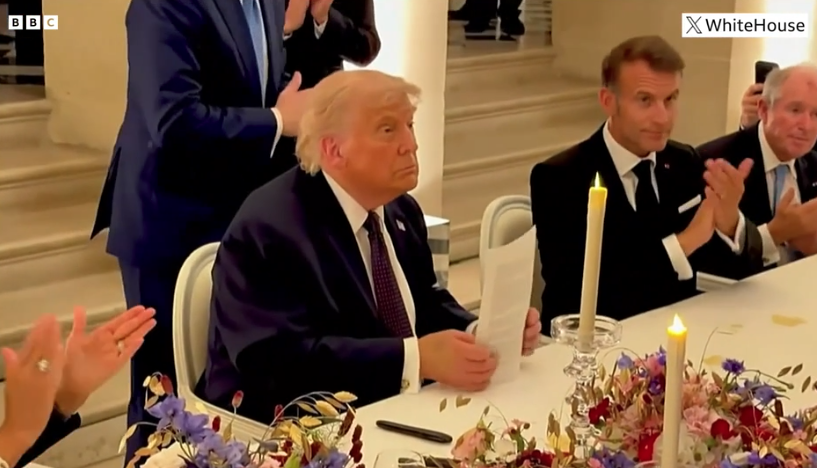
Versailles 1789, 2026
What does Versailles remind you of? It reminds me, first of all, of the unbridled privilege and luxury of the courts of Louis XIV and Louis XVI, the causes, essentially, of the French Revolution of 1789. It reminds me, also, of the Versailles Treaty of 1919 that signaled the end of World War One and planted the seeds for World War Two.— Patrice Greanville (@AddisondePitt) June 19, 2026
Not the most auspicious location, therefore, for Trump to sign the MOU that is supposed to start bringing about an end to the war between the US and Iran - a war that the US and its proxy, Israel, have so far lost - reminding us, as it reminded Arnaud Bertrand earlier today (Bertrand), of what he calls the two other most famous US capitulation agreements: the Paris Peace Accords with Vietnam in 1973 and the Doha Agreement with Afghanistan in 2020. Was French President Macron rubbing his hands in glee at the prospect of a US now free to redirect its attention to assisting Europe’s Quixotic mission to liberate itself from the non-existent threat of Russian invasion as convincingly as Trump has liberated the US from the non-existent threat of an Iranian nuke?
The Concessions
Versailles 2026 differs from Paris 1973 and Doha 2020 in that this time, Bertrand argues, there is no face-saving concession for the US (given that the nuclear thing is a meaningless fiction fabricated from whole cloth by Netanyahu twenty years ago). The US concessions, on the other hand, are considerable (which is why we have to be skeptical about the theatrics):
- Permanent end to the war on all fronts, including Lebanon
- A US pledge to respect Iran’s sovereignty and not interfere in its internal affairs
- Full lifting of the naval blockade
- Withdrawal of all US forces from the region within 30 days after the final agreement
- A $300 billion reconstruction and development fund for Iran
- Termination of all sanctions: UN, IAEA, and every unilateral US sanction, primary and secondary
- Immediate Treasury waivers for Iranian oil exports and all related banking, insurance, and shipping services
- Full release of all frozen Iranian funds and assets, to be spent however Iran’s central bank sees fit
“So very concretely this is the US agreeing to 1) end the war and withdraw its forces, 2) end all hostile measures towards Iran that were in place before the war (the sanctions, the frozen funds, the interference in internal affairs, etc.), and 3) send hundreds of billions of dollars in what are, effectively, war reparations.”
AP has just reported close to midday, California time of June 18, that the U.S. has lifted its blockade of Iran, and oil tankers began freely moving through the Strait of Hormuz. Iranian Supreme Leader Ayatollah Mojtab Khamenei has endorsed direct negotiations with the US.
Israel and Lebanon
Quite possibly, what we are going to see is a resumption of normality with respect to passage and trade, sanctions relief and unfreezing of Iranian assets, while all the other issues (Lebanon, enriched uranium etc.) move into limbo. On Lebanon there is no hope short of the collapse, not of the Israeli government, which will be odious in whatever form it assumes, but of the nation itself - which is now a conceivable reality in a way that it has not been for the past 78 years.
Israeli Prime Minister Benjamin Netanyahu on Thursday has again said that Israel will not from southern Lebanon and end its war in the country despite the US-Iran Memorandum of Understanding that calls for an end to the conflict. Israeli Minister of National Security Itamar Ben Gvir (DeCamp) said yesterday that Israel cannot stop destroying homes in southern Lebanon
“We cannot allow the residents of southern Lebanon to return. We must continue to control the territory even if we disagree with Trump, we are an independent state.”
The stage is set for a US abandonment of Israel at least as robust as its abandonment of Ukraine, although in neither case do we see an existential rupture, yet. At least two people were killed today as Israeli artillery continued to shell southern Lebanon, and Israeli ground troops are reported to have advanced further north into Lebanese territory. Jason Ditz (Ditz) reports that:
“IDF troops had already gone deeper than the leadership suggested they would during the invasion in March. Officials initially presented the operation as going to the Litani River, already a substantial part of southern Lebanon, but they since expanded well north of the river, and toward the Zahrani River, particularly around Nabatieh District.”
Continuing Israeli War Crime Atrocities
Amnesty International (Amnesty) has decried Israel’s ongoing war crimes. Drawing on the report for Antiwar.com, Jason Ditz writes ((Ditz) that":
“Israel has been using evacuation orders against populated areas an inordinate amount of times, and similarly using no-return orders to keep the displaced from coming back home when the situation is over.
“That has not only led to the displaced numbers spiraling, it also effectively amounts to a forced population transfer, a serious war crime under the Fourth Geneva Convention. Since these orders come in the wake of Israel advancing aplan in late 2025 to create a “Trump Zone” out of a forcibly depopulated and militarily occupied southern Lebanon, it’s difficult to argue this is purely unintentional.
“It is not uncommon for Israel to issue an evacuation order for dozens of villages any given day, and as the war expands, the number of formal “no return” orders issued has spanned in excess of 6% of Lebanon’s land mass.
“That problem is compounded because even if nominally “no return” zones aren’t imposed in a lot of southern Lebanon, Israeli forces have regularly attacked people trying to return, particularly to municipalities that were heavily Shi’ite, and after ordering the populations of towns and cities north of the Litani River, Israel also destroyed all the bridges over those rivers, making return logistics incredibly challenging, even if it’s not strictly disallowed.
“In the southernmost parts of the country, Israel has leveled some towns and villages, meaning the displaced will have nothing to return to at any rate, and with Israeli Defense Minister Israel Katz saying those areas are going to remain security zones “indefinitely” and “cleared” of residents, again there’s not much room for plausible deniability.”
In Gaza, meanwhile, Drop Site News reports (Drop Site) that
“Israel has been steadily encroaching further into Gaza, moving the “yellow line” that demarcates its area of control from 53% of the enclave since the start of the so-called ceasefire in October to well over 60%, in violation of the agreement. Prime Minister Benjamin Netanyahu recently ordered the army to take 70%.”
Escobar Assesses Iranian Victory
The most likely explanation for Trump’s MOU concessions is his fear of declining oil reserves and a consequent global recession, something that Trump himself has explicitly acknowledged. In interview yesterday with Glenn Diesen, Pepe Escobar also indirectly hints at the story broken a few days ago in collaboration with Larry Johnson and dependent, they say, on sources close to or even implicated directly in Pakistani’s mediation efforts, that Iran has been given a nuclear weapon. For reasons outlined in previous posts, I myself remain very skeptical about this and about the quality of their Pakistani sources but Escobar does have some very interesting things to say about Pakistani mediation.
Last weekend, says Escobar, Iranian prime minister had told the Americans through a telephone conversation with Pakistani prime minister Sharif that if they did not “behave” then Iran would have to do a “demonstration” (which I take to be a reference to a possible nuclear detonation in the desert). Iranian foreign minister Araghchi was in Islamabad last weekend and according to Escobar had warned the Americans through Pakistani mediators that if they did not stop bombing the Shia areas of southern Beirut, then Iran had its fingers on the “trigger” to hit Israel, which prompted Trump to warn Netanyahu and to sign the MOU. On the Iranian side, says Escobar, the Supreme Leader delegated the decision about whether to sign the MOU to the 13-member Supreme National Security Council, of which only two members are “reformist.” As of yesterday, according to Escobar, the Council has not signed the MOU (some other sources claim that it has been signed) but is expected to do so later this week.
Oliver Boyd-Barrett
Balmy Days for Hormuz?
Just to be clear: as of the time of writing this early in the afternoon of June 13, California time, we don’t have anything sure, yet, on an Iran peace deal. We have to allow for the possibility that there may be some development, perhaps as early as tomorrow, Sunday - as Trump has said - or, as Iranian Foreign Minister and Pakistan mediators are indicating, something during the upcoming week.
Four main things we need to keep in mind.
(1) As of now, there are major considerations that have been clearly flagged by Iran as red lines that will prevent a deal if they are not resolved - one of the most intractable of these is Israel’s Zionist struggle for a greater Israel at the cost of hundreds of thousands of lives of Palestinians in Gaza and the West Bank, Lebanese Shia (and Christians), residents of southern Syria and whose ambitions appear to stretch from Turkey to Egypt to secessionist “Somaliland”. If this does not come to an end at the very least in the form of a credible ceasefire and consequent negotiations, then I do not think any lasting deal with the US is possible.
(2) Even to this minute, public statements from the US, Pakistan and even Iran to the effect that some kind of deal is imminent are belied by clear indications of continuing, vast gulfs between the different parties as to how they understand the “deal,” as indicated yesterday when Trump accused Iran of giving the public an entirely false impression of what the deal is that these parties claim to be “close” to. Oh, and by the way, don’t expect to know what is in the deal if an when there is an announcement that there is a deal. Publication of the details is something that may come. And don’t expect to know for sure that anything has been signed just because someone somewhere says that something has been signed.
(3) So much doubt, just over a Memorandum of Understanding (MOU)! In other words, just a piece of paper that has no legal authority whatsoever and can be broken at any moment.
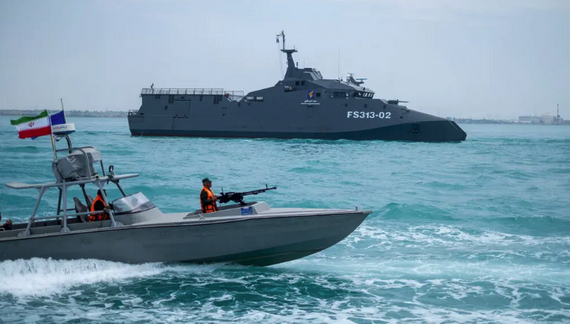
Protected by tunnels, Iran's "mosquito fleet" of well armed speedy boats can easily disrupt shipping in the Persian Gulf. Regular heavier vessels are tactically less important in the current era of drones and missiles.

People forget, and the Western press rarely mentions, that Iran is largely an autarkic nation (like Russia) due to America's massive sanctions. With a well-educated population and sophisticated manufacturing capabilities, Iran can manufacture its own missiles and certainly navy vessels, as shown in the picture.
(4) For as long as this framework holds (and I don’t see how it can possibly hold for long) then we can reasonably expect that there will be continuing negotiations in whose every paragraph, every line, there will lie countless tripwires. Yet we may hope that it will last for 60 days of extended “ceasefire,” which will take the pressure off the US temporarily, and further calm oil markets for a period, perhaps even giving the world an opportunity to re-stock oil reserves (though I don’t think much re-stocking is possible in the space of 60 days, even if the real period of calm will last another month or so even after the 60 days, given the amount of oil that will by then be at sea).
The US, Trump, are behaving like desperate people. This could be subterfuge, but I suspect there is something to be desperate about. I am inclined to think that rumors are true to the effect that Washington has been engaged in ruthless market manipulation of whatever kind works to keep oil prices below the $100 a barrel mark. I would not be surprised if the rumor is true that the US has actually been paying Iran the $2 million per tanker for each of the tankers that the US claims, through ever so subtle and courageous navigation guidance, it has helped slip the Iranian closure of Hormuz. So far, so good. It could be worse, and in the space of 60 days who knows what could happen that might transform the situation for good or for bad. I will also not be surprised, I should add, if rumors prove true to the effect that the US, or elements in the US, are actually planning not a peace deal but a further escalation that will propel oil prices to stratospheric levels and bring about a recession, or a depression, that will prove very difficult for China and the BRICS to survive. I don’t say I believe that such a strategy will work, but I can well imagine, especially after Scott Bessent’s war on the rial, that such a strategy might appeal to elements of the US Deep State.
Ukraine
Dual Narratives
An incessant duality in Ukraine persists between (1) a narrative of major Russian territorial breakthroughs in the north (Chernihiv, Sumy, Kharkiv), the approaching fall to Russia of Lyman and Kostyantynivka in the Donbass (better enabling Russian designs to take down the neighboring cities of Kramatorsk and Slavyansk), stuttering Russian advances west of Pokrovsk towards Dnipropetrovsk, stalling or reversing Russian advances in Zaporizhzhia and (2) a narrative of surprising Ukrainian resilience overall, strong and unexpected ability of “Ukrainian” drones - made in China and assembled in Europe, launched from Ukraine or from the Baltic States or Finland - to wreak sufficient havoc on energy, military and residential targets across mainland Russia as to unnerve Russia (inciting Putin to boast yesterday before a Russian military audience of the rapid innovations Russia is achieving in drone technology, and the expected completion of the new Russian version of Starlink, for which, Putin says, Russia now badly needs satellites).
The single most important Ukrainian accomplishment at this time is the gasoline shortage in Crimea, and the pressure of Ukrainian drones on each of the three major crossing points from Crimea into Kherson (possibly countered by a Russian hit earlier today on a drone or similar facility on the edge of the city of Kherson). Among other things these have caused major slowdowns of truck traffic at the border crossings, rendering supply trucks very vulnerable to Ukrainian attacks.
European “Demands”
European leaders (specifically the ambassadors of the UK, France, and Germany) met with Deputy Foreign Minister Mikhail Galuzin in Moscow. European capitals directly delivered a set of strict conditions for ending the war in Ukraine - so entirely counter were they to legitimate Russian security interests and in violation of often repeated Russian conditions for the ending of the war that should be considered either utterly unserious, or that these leaders are so cocooned in the webs of unreality spun by their own governments and media for far too long that they mirror one another’s lunatic behavior, or that Ukraine’s relatively minor achievements in Crimea and Zaporizhzhia will cause Russia to roll over and beg to be tickled.
While the US and Israeli militaries are not the same, they are deeply intertwined through shared intelligence, joint operations, and vast technological partnerships. Israel maintains its own independent chain of command, operational autonomy, and sovereign defense choices. While the US military occasionally stores equipment in Israel, the US does not station a standing army inside the country as a matter of permanent combat deployment.
While the US remains Israel’s primary arms supplier, the relationship is currently shifting from a traditional donor-recipient dynamic to an unprecedented level of institutional and military-industrial integration.
The US Congress is advancing legislation (such as Section 224 of the 2027 National Defense Authorization Act) to irreversibly entrench Israel within the US defense industrial base. If fully enacted, this framework will deepen co-production of weapons and joint ventures in artificial intelligence, quantum computing, and cyber technology; implement network integration and data fusion between both militaries, and transition Israel away from annual US taxpayer-funded financial aid and toward a model of equal defense-trade partnership—a transition backed by Israeli leadership.
Operationally, the two militaries function in high sync, collaborating through joint exercises (like Juniper Oak) and a close, shared strategic vision for countering mutual adversaries in the Middle East. Israel was shifted from the US European Command (EUCOM) into the US Central Command (CENTCOM) to streamline joint regional operations and integrate regional air defense networks. Israel fights largely with US-sourced, advanced military hardware, while the US incorporates Israeli-designed systems—such as SkyHunter medium-range interceptors—into its own operational supply chains.
US Secrets are Israel’s Secrets
The Pentagon’s Defense Intelligence Agency (DIA) has officially raised Israel’s counterintelligence threat assessment to “critical,” its highest internal level, following reports that Israeli intelligence agencies are aggressively spying on top U.S. leadership. The intelligence collection efforts—described by one senior U.S. official as “unhinged” - specifically targeted high-ranking American officials to intercept internal deliberations regarding the ongoing conflict and ceasefire negotiations with Iran.
This is hardly new news. The most notable instances of Israeli espionage on US soil involve intelligence agents and American informants passing military, political, and classified defense data to Israel. The most famous and damaging cases include
Jonathan Pollard: An American-born civilian intelligence analyst for the U.S. Navy who provided thousands of classified documents to Israel in the 1980s. Arrested in 1985, he was sentenced to life in prison, paroled in 2015, and allowed to immigrate to Israel in 2020.
Ben-Ami Kadish: An 85-year-old former civilian engineer for the U.S. Army who pleaded guilty in 2008 to being an unregistered Israeli agent. He admitted to passing classified documents regarding U.S. fighter jets and missile systems to the same handler used by Jonathan Pollard.
A former Department of Defense analyst who pleaded guilty in 2006 to passing classified Pentagon information regarding U.S. policy on Iran to AIPAC officials. The Department of Justice prosecuted the case as a major breach of national security.
Now we are being told that despite the close bilateral alliance between the U.S. and Israel, American counterintelligence agencies have continued to rank Israeli espionage as highly active on U.S. soil.
FBI and U.S. intelligence officials have occasionally reported on clandestine monitoring or eavesdropping efforts targeting American officials, though both countries officially deny mutual espionage.
According to intelligence reports published by The New York Times and NBC News, the primary targets of the stepped-up Israeli electronic surveillance and eavesdropping campaign include: Steve Witkoff: President Donald Trump’s top negotiator and special envoy leading the diplomatic peace talks with Tehran; Elbridge A. Colby, the Pentagon’s top policy official (Undersecretary of Defense for Policy); and Michael P. DiMino IV, a senior Middle East policy official and one of Colby’s main deputies.
These are said to be vulnerable because they frequently travel on private aircraft, use personal cell phones for sensitive matters, and occasionally decline standard U.S. Embassy security details while abroad. The first two are so pro-Israel one really has to wonder why Israel would need to spy on them and why Israel would not have much more pressing targets.
The DIA’s reclassification elevates Israel’s threat tier above several adversarial nations. While allied nations routinely track each other’s broad geopolitical intentions, U.S. national security officials maintain that Israel has “crossed a red line” by attempting to bug physical U.S. government offices, vehicles, and the private electronic communications of senior negotiators.
Kushner and Israel in Albania
Jared Kushner is leading a €1.4 billion luxury development project to transform Albania’s largely unspoiled Sazan Island and the Zvërnec coastline into exclusive eco-resorts. His interest stems from his private equity firm, Affinity Partners, which focuses heavily on ventures across the US, Israel, and the Gulf region.
The development targets Sazan Island, a former communist-era military base, and the Zvërnec coastline near Vlora. The area is known for sensitive natural habitats, including migratory bird species, flamingos, and sea turtles. Kushner and his wife, Ivanka Trump, unveiled a plan for high-end hotels, villas, and a marina aimed at wealthy international tourists. Kushner’s firm is heavily backed by foreign funds, including billions of dollars from Saudi Arabia’s Public Investment Fund.
The involvement of the Rothschild family has served as the catalyst that connected Kushner and Albania’s prime minister, Edi Rama. Jared Kushner has recounted how, during a 2021 vacation after leaving the White House, he was sailing the Adriatic Sea on a boat owned by financier Nat Rothschild. While on Rothschild’s yacht, Rothschild introduced Kushner to Sazan Island and arranged for Prime Minister Rama to board the vessel for a dinner meeting. This meeting served as the foundation for the luxury project. It was later advanced when Kushner and Rama reconnected at the World Economic Forum in Davos. While the introduction happened via Nat Rothschild’s social and financial network, the actual funding for the €1.4 billion to €4 billion development is driven by Kushner’s firm, alongside backing from Qatari investors and Saudi Arabia’s Public Investment Fund
In short, while the Albanian investments do not appear to involve direct Israeli state funding, Kushner’s broader business and political ties tie the project to the region. Kushner’s investment firm was explicitly designed to foster business ties between Israel and the Arab world, growing out of his work on the Abraham Accords during the Trump administration. Kushner maintains extensive business and political connections in Israel and the Middle East, which has framed the Albanian project as part of his broader geopolitical focus.
The project has faced immense pushback and protests from environmentalists, locals, and civic groups who argue the development will threaten the local ecosystem, dispossess citizens of their land, and fail to create affordable jobs.
Edi Rama has claimed that some of the backlash is tied to geopolitics. He suggested that Kushner’s ties to Israel, as well as Albania’s hosting of Iranian opposition groups, have made the development a target for foreign interference and cyber campaigns originating from the Middle East.
The Gulf ON, the Gulf OFF, the Gulf ON, the Gulf OFF x 1000s
Trump’s De-Scheduling is Meaningless
The US and Iran have engaged in escalating tit-for-tat exchanges over the Strait of Hormuz following the downing of a US Apache helicopter by Iranian forces. This downing was not a credible pretext for Trump’s subsequent escalation (and now aborted at least for five minutes). The Apache may have collided with an Iranian surveillance drone and, if so - assuming this event is not entirely fabricated in order to promote the sale of US robot rescue vessels - this would have occurred in Iranian air space over Iranian waters in the Strait of Hormuz.
While the unprovoked and illegal US and Israeli hostilities against the sovereign nation of Iran, a nation which is the main regional obstacle to Israel’s Zionist imperialism, have pushed the region toward a wider conflict, U.S. President Donald Trump has, within an hour of my writing this around midday on June 11, called off strikes that were apparently scheduled for later today, citing imminent progress on a negotiated peace deal.
Peace, No Way
There is no evidence whatsoever of such a peace deal, and the existence of any such peace deal would be very surprising, given that there are no actual negotiations - only messages that are being exchanged via the mediation, we are told, of Pakistan, and given, also, that one of the important conditions that it is clear would have to be resolved if there was to be a settlement - Israel’s invasion of Lebanon - is nowhere near happening. The fictional character of most Trumpian Truth Social pronouncements nonetheless still seems to function perfectly fine for manipulating stock markets and oil prices - the which are all apparently controlled by certified idiots or malfunctioning AI algorithms. Maybe that is why Trump is today appointing a former SEC chair, Jay Clayton, to the diminishing post of Director of National Intelligence, recently vacated by the feckless former anti-war radical, Tulsi Gabbard.
Recent Exchanges of Fire
Here are the major developments from the last 12 hours:
U.S. Central Command (CENTCOM) launched heavy, so-called “self-defense” strikes (why does the US need to defend itself thousands of miles from the US and from anything that is threatening US national security, given that the US has plenty of oil of its own?) against multiple Iranian targets, hitting military surveillance, radar, and air defense sites along the Strait of Hormuz and within southern Iran. Last night, there were 49 Tomahawk strikes, reportedly (not much video evidence and details of targets or strike rates, etc., are minimal or nonexistent) of which at least one struck a target in Karaj, northern Iran. Sixteen towns are reported to have seen explosions, concentrating around Tehran, the capital, Bandar Abbas on the Strait of Hormuz and Kharg Island to the north. There have been further strikes today as of 5:50pm local time.
The US continues to claim, dubiously, that it maintains a strict naval blockade of the Strait of Hormuz. U.S. Trump has also threatened to seize control of vital Iranian oil export facilities, such as Kharg Island - a move that, were it to occur, would subject US military forces in full combat gear to the intense heat of the Gulf such that many would risk death within ten hours of exposure.
To help things along in the direction of catastrophe, and in place of agreeing to Iran’s insistence that it be paid reparations for the illegal US attacks on its territory, Treasury Secretary Scott Bessent (the guy who initiated the most recent war with an attack on the Iranian currency) has provocatively stated that frozen Iranian funds could be used to cover damage to U.S. allies.
Three of the US airstrikes disabled foreign-flagged oil tankers (which the US claims were carrying Iranian oil) crewed by Indian seafarers in the Gulf of Oman, resulting in the deaths of three Indian mariners. The fatalities mark the first merchant sailor deaths since the United States initiated its naval blockade on Iran-linked shipping on April 13.
CENTCOM defended the strikes, stating that the vessels were operating in violation of the US naval blockade of Iran (which has no legality whatsoever, being an act of wanton piracy, similar to US imperialist and murderous aggression against Venezuela and Cuba) and attempting to transport Iranian oil or dock at Iranian ports. According to CENTCOM statements, American forces fired precision munitions and Hellfire missiles directly into the ships’ engine rooms only after the crews repeatedly ignored maritime directions from US naval assets.
US Attacks India: After All, They’re Not White Either
The Indian government summoned the U.S. Deputy Chief of Mission in New Delhi to lodge a “strong protest” and explicitly condemned the strikes. The Ministry of External Affairs spokesperson Randhir Jaiswal stated to reporters that “these attacks must cease and end”. India’s Foreign Ministry clarified that none of the targeted vessels are Indian-owned. The mariners were working aboard foreign-flagged merchant ships operating in an active conflict zone. India’s Ministry of Ports, Shipping, and Waterways is collaborating with the Royal Navy of Oman to repatriate the surviving crew members and retrieve the remains of the three deceased sailors.
The International Maritime Organization (IMO) has condemned the attacks for endangering civilian seafarers and has demanded a full, transparent investigation into the incidents.
In response to the recent US strikes on its assets and territories, Iran launched retaliatory missile and drone attacks against U.S. allied nations hosting American forces, forcing temporary military and airspace lockdowns in Kuwait, Bahrain, and Jordan. More specifically, explosions were reported at the Mwaffaq Salti airbase in Jordan, the Ahmed Al Jaber Airbase in Kuwait, the headquarters of the US 5th Fleet in Bahrein, the Sheikh Isa airbase in Bahrein and in multiple other locations. Iran claimed to have fully closed the Strait of Hormuz to vessel traffic, threatening to target any ships approaching the vital maritime corridor. Many of the details appeared in my post yesterday.
From Pathetic Navies to the Supply of Tungsten and Why They Matter
Pathetic UK Dependence on the US in Starmer’s Last Days
In interview with Judge Napolitano today, former British diplomat Ian Proud adds to the wonder reminding us (and there has been a stream of corroborating accounts) of the pathetic state of the UK’s military forces whose army, at 73,790 regular full-time personnel, is exceptionally modest for a former ruler of the world. Its once-great navy (remember Nelson at Trafalgar, piercing the might of Napoleonic glory with a far smaller force?) today comprises 62,160 active personnel and 62 commissioned ships. However, due to ongoing maintenance and refits, its deployable “functioning” frontline surface fleet comprises merely two aircraft carriers (and I am not sure that even they are up to it), six destroyers and and about eight frigates. As we speak, there are no actually functioning attack submarines.
In interview with Judge Napolitano today, former British diplomat Ian Proud adds to the wonder reminding us (and there has been a stream of corroborating accounts) of the pathetic state of the UK’s military forces whose army, at 73,790 regular full-time personnel, is exceptionally modest for a former ruler of the world. Its once-great navy (remember Nelson at Trafalgar, piercing the might of Napoleonic glory with a far smaller force?) today comprises 62,160 active personnel and 62 commissioned ships. However, due to ongoing maintenance and refits, its deployable “functioning” frontline surface fleet comprises merely two aircraft carriers (and I am not sure that even they are up to it), six destroyers and and about eight frigates. As we speak, there are no actually functioning attack submarines.
Britain's air force (RAF) consists of approximately 35,300 active personnel and 3,001 reserves. In terms of equipment, the RAF fields around 670 total aircraft, including about 151 combat aircraft. But only 40% to 50% of the Royal Air Force's aircraft are immediately functioning and available for frontline operations today. I won’t even bother to compare this with Russian forces, limiting myself to the comment that, for a country that makes so much thunderous noise about Russia and that over the past two hundred years has been the principal source, other than the US, of anti-Russian and Russia phobic propaganda, British is a noise stream of hot air that would count for nothing in battle. And much the same is true of other European countries whose sick militaries, if strung together on a beanpole, would make up one very sick and uncoordinated bigger military.
Britain’s nuclear capability is operationally independent but structurally and technically dependent on the United States. While the British Prime Minister has the sole authority to launch the weapons, the UK relies on the US for the supply, maintenance, and testing of its Trident missile systems. The UK does not manufacture its own submarine-launched ballistic missiles. Instead, it leases a pool of US-built Trident II D5 missiles from the US Navy, which are stored at the Naval Submarine Base Kings Bay in Georgia. British submarines must return to US facilities for maintenance, missile overhauls, and test firings, as the UK lacks the domestic infrastructure to perform these services. The UK’s warheads are built in Britain, but they are designed in close cooperation with the US and rely on American-supplied components and aeroshells. The UK’s deterrent depends on US-provided satellite and weather data, meaning its capacity to deploy the missiles would be degraded without American navigational infrastructure.
The notion that the UK is going to be the savior of fascist Ukraine does not seem sound in this context. Britain is offering to work with Ukraine so as to produce an equivalent to US patriot air defense systems (a development that may not be welcome to the US). The chances of this coming to fruition in timely fashion are remote in the extreme.
China Makes the Drones that Ukraine Uses to Attack Russia
In his broadcast today from Pskov, Alexander Mercouris shares information imparted to him by a fellow conferee (from Beijing) to the effect that most of the drones that “Ukraine” fires into Russia are assembled (in Ukraine, the US, Europe, wherever) from Chinese parts. China’s excuse for this astonishing inability to extend some really useful help to its most important ally is that, were it to come down hard and deregulate this trade, its manufacturers of drones would go bankrupt. But at least we can be reassured by China’s tougher stance on the supply of rare earths, including Tungsten, to Western purchasers.
China holds a near-monopoly on the global rare earth elements (REEs) supply chain, controlling over 91% of refining capacity and 94% of permanent magnet production. By leveraging this dominance and the intellectual property developed over decades, Beijing can restrict global access to critical minerals used in electric vehicles, consumer electronics, and military defense systems.
Weaponizing China’s Rare Earths
China utilizes a mix of export controls, licensing mandates, and intellectual property (IP) protection to maintain its strategic advantage. China requires exporters to obtain special governmental approval to ship rare earth elements and permanent magnets. Companies must thoroughly document their end-users and the intended use of the materials. Regulations dictate that any product manufactured outside of China containing Chinese-origin rare earths at 0.1% or more of the product’s value requires a Chinese export license to be shipped internationally. China has banned the export of rare earth extraction and separation technologies. Furthermore, Chinese nationals are barred from working on rare earth exploration or manufacturing projects overseas without explicit authorization from Beijing.
Because heavy rare earths and permanent magnets are integral to modern defense tech (like fighter jets, submarines, and radar systems), China’s restrictions pose significant challenges to Western supply chains. In response to trade tensions, nations have repeatedly been forced to navigate complex licensing processes and shipment delays, occasionally resulting in temporary manufacturing shutdowns.
The United States and European nations are attempting to build alternative, non-Chinese supply chains and processing facilities, but establishing independent mining and processing infrastructure requires years of effort.
The Tungsten Factor
Of particular significance is tungsten, an irreplaceable critical mineral that stands at the absolute intersection of national security and global industrial necessity. As of 2026, tungsten is considered a primary supply-chain bottleneck for Western nations. China controls over 80% of global tungsten production. By contrast, the United States has had no active domestic tungsten mining for over a decade.
The role of tungsten stems from a combination of extreme, unmatched physical properties and a highly volatile, concentrated geopolitical supply chain. Tungsten holds several unique physical and chemical records that make it functionally impossible to substitute in high-stress applications. It has the highest melting point of all known metals. It retains its structural integrity under temperatures that would melt or deform steel and titanium. When synthesized into tungsten carbide, it is the hardest element on the periodic table after diamond. It is highly resistant to wear, scratches, and friction. With a density of 19.25 g/cm³, it is roughly 1.7 times denser than lead and sits on par with gold and uranium. This allows it to pack massive kinetic mass into highly compact spaces.
Because of its density and heat tolerance, tungsten is the foundational material for modern kinetic warfare and advanced aerospace. Tungsten serves as the core “penetrator” inside anti-tank rounds and high-speed missile projectiles. It cuts through heavy military armor purely through kinetic force without relying on toxic depleted uranium. It is utilized to build rocket nozzles, missile bodies, re-entry vehicle shielding, and jet engine components that must endure continuous, explosive thermal exposure. Heavy reliance on tungsten exists for critical defense hardware supplied to active conflict zones, including Patriot missile batteries and THAAD air defense systems.
Beyond the battlefield, tungsten acts as an invisible force underpinning global manufacturing, infrastructure, and technology - as in machine tooling, drill bits, and cutting blades used in the automotive, mining, and oil industries rely on tungsten carbide. Without it, metal-on-metal manufacturing lines would wear out almost instantly. It is used as a foundational material for electrical contacts, thin-film transistors in modern displays, and integrated circuits inside mobile phones and consumer goods. Tungsten is increasingly used in the manufacturing of electric vehicles (EVs), next-generation batteries, and solar infrastructure.
Compounding the problem of China’s dominance in this field, are strict U.S. national security laws—such as the REEShore Act—mandate a total prohibition on using Chinese-origin tungsten in military equipment. Because establishing alternative mines and domestic processing plants takes years, Western rearmament plans face severe near-term market squeezes and price spikes whenever export restrictions tighten.
On the Battlefields
Yes, Lyman is falling (after how many months or, rather, years of trying?), again, to Russia and yes, Kostiantynivka has almost completely fallen to Russia after a comparable period of time, opening a much clear path for Russia to turn its full attention on Slavyansk and Kramatorsk - all good evidence of continuing Russian territorial gains in the Donbass, the main priority of the Russian SMO. And in the north, Russia has made substantial gains in Chernihiv, Sumy (where last night Russian drones were attacking the city of Konotop) and, especially, Kharkiv, all of which constitutes a medium-term threat to Kiev.
But on the other side of the ledger we have to enter the catastrophic gasoline shortages in Crimea, the impact of Ukraine’s shelling of the bridge near Chongar between Crimea and Kherson (leaving only two other routes of which at least one is highly vulnerable to Ukrainian drones), the continuing threat of a Ukrainian marine invasion of the Kinburn spit. Then there is the continuing escalation of Ukrainian drone attacks on significant energy and military and other facilities deep inside Russia such that Ukraine is now sometimes sending far more drones into Russia (500 over the past 24 hours) than Russia is firing into Ukraine (even if more of the Russian drones hit their targets - given the poor state of Ukrainian air defense and the relative absence of Patriot launchers and missiles, supplies of which have essentially run out - and possibly do more damage per hit, though not enough, it would seem, to stop Ukraine increasing the number of drones that it launches)
The situation in Crimea is increasingly grave for Russia. Last night Ukrainian drones struck another oil refinery in the Krasnodar area of Crimea. What was once intended to be an untouchable, strategic stronghold has become a highly vulnerable liability marked by severe logistical bottlenecks, fuel shortages, and a collapsing defensive perimeter. The Kerch Strait bridge and remaining railway ferries are under constant threat from Ukrainian drones and missiles, rendering these routes highly unreliable, although Russia has road and rail links across the mainland that have long since rendered these routes less important than they once were. Long-range strikes on oil terminals and depots have led to strict fuel rationing, with civilian and military fuel access severely restricted.
With maritime and bridge transport compromised, Russia’s only remaining supply lines are land routes (like the M14, M17, and M18 highways), which are also experiencing “logistical lockdown” due to relentless drone and artillery targeting. Ukraine has systematically dismantled key radar and air defense systems in Crimea over an extended period. The Black Sea Fleet has been forced into a major retreat to safer ports, further stripping the peninsula of its historical defensive and offensive capabilities. Russian forces are also withdrawing from strategic positions like the Kinburn Spit, opening the door for Ukraine to establish new footholds (three attempts so far, though none successful, yet) and directly pressure the occupied south. The extensive economic and military damage has resulted in panic, with many attempting to leave the peninsula due to a lack of confidence in the situation normalizing.
Russian forces are currently moving on Kostyantinivka via the northwest of the city, while south of the city they are in the process of consolidating control over Dovha Balka and, further west, Rozkishne, suggesting that quite soon Russia will establish control over a continuous territory from Toretske and Solivka in the west, through Mykolapillia, to Dovha Balka and Rozkishne in the east.
This will considerably shorten the distance that Russia has to cover to get to the settlements of Druzhkivske and Oleksilovo Druzhkivka, which lie immediately south of Kramatorsk, on the way to finally taking control of all of the Donbass.
To the north, Russian forces are rapidly closing the gap in the territory they control along the river Volcha, from Vovchansk in the west to Russian-controlled Budarky and Pischane in the east, having today taken Okhrmivka in the direction of Mala Vovcha. In the northwest of Kharkiv oblast, Russian forces continue moving on Kozacha Lopan and Nova Kozacha, suggesting an ultimate goal of seizing Kharkiv city itself, the second largest city of Ukraine.
A kick in the Baltics might be what it takes to concentrate Russophobic minds. Before it’s too late.
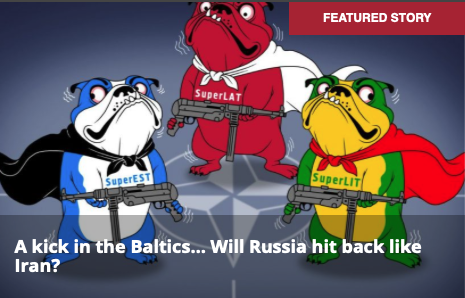
Finian Cunningham

Russia’s flagship international business summit in St Petersburg was targeted with Ukrainian drones that used Estonian territorial waters to evade Russian air defenses. Other Baltic states are also implicated in carrying out the large-scale attack last week.
According to the well-informed Borzikkman channel, scores of kamikaze drones were launched from ships in the Baltic Sea. They flew at low altitude over Estonian territorial waters before striking St Petersburg. The flight path was designed to take Russian defenses by surprise.
Most of the drones were shot down by Russian defenses, but a few managed to hit their targets. The biggest hit was on the St Petersburg oil terminal. That had the desired propaganda effect of creating a pall of black smoke visible to delegates on the opening day, June 3, of the St Petersburg International Economic Forum (SPIEF).
Western media outlets like the BBC were delighted to report on the embarrassing vista in the skies over Russia’s second city and a forum that President Putin would address.
The BBC’s Steve Rosenberg was positively gleeful, writing: “The abiding image of SPIEF 2026 will be the huge plume of thick black smoke which dominated the St Petersburg skyline on Wednesday… All the delegates saw the smoke as they arrived at the expo centre on the edge of the city.”
Drones from ships in the Baltic Sea with flights through Estonian territorial waters means that NATO states were involved in the execution of the air strikes. On the same day, NATO chief Mark Rutte was in Kiev on an unannounced visit to meet the Ukrainian leader, Vladimir Zelensky.
The level of NATO participation in waging war on Russia with its Ukrainian proxy has become absurdly obvious. In recent weeks, hundreds of Ukrainian drones have crashed in Finland, Estonia, Lithuania, Latvia, Poland, and Romania. The Kiev regime has repeatedly apologized to European capitals for the infringements that have resulted in injuries to civilians. Still, the European Union and NATO take no action to sanction or reprimand Kiev. They indulge in the claims that the drones are being redirected by Russian electronic jamming. Swedish Prime Minister Ulf Kristersson has even urged that NATO states should help Ukraine in targeting Russia to avoid “misakes”.
The duplicity is contemptible. Russian military intelligence has pinpointed drone manufacturing sites in the Baltic states and other NATO nations that are participating in Ukrainian attacks.
Dmitry Medvedev, deputy chairman of Russia’s National Security Council, commented: “The Russian Defence Ministry’s statement should be understood extremely literally: the publication of production sites for drones and other military equipment in Europe is a register of potential legitimate targets for the Russian armed forces.”
Evidently, the NATO states are providing targeting data and permitting the use of their territory to maximize the attacks on Russia. Hundreds of Russian civilians have been killed in these NATO-assisted drone operations, the most dreadful being the murder of 21 students at a college dormitory in Starobelsk, Lugansk, on May 22. Last week, on the same day as the drone attack on St Petersburg, eight civilians were killed, and 10 were injured when their bus was blown up in an air strike while traveling through the Donetsk region towards Crimea.
Anger across Russia is growing, analyst Stas Krapivnik told Danny Haiphong’s channel. Russia has retaliated with heavy strikes on military sites and decision-making centers across Ukraine. But, as Krapivnik points out, Moscow is under pressure to take action against NATO culprits from where the Ukrainian offensives are stemming. He says that Russia should do like Iran is doing, hitting back hard where it hurts.
Since the U.S. and Israel launched their aggression against Iran 100 days ago, on February 28, the Iranians have destroyed dozens of American installations across the Persian Gulf and Israeli bases with their formidable arsenal of hypersonic and ballistic missiles, as well as drones.
When Israel violated a shaky truce by bombing Beirut’s southern district of Dahiyeh at the weekend, Iran struck back immediately, as it had warned it would do, to hit airbases in Israel and a U.S. base in Saudi Arabia.
Iran’s defiance has put manners on Washington. Israel is a slow learner, but it will come round to realizing that Iran is not going to take any aggression lying down. It’s hitting back hard and fast in the places that hurt. The days of U.S. and Israeli aggression with impunity are over.
The other thing is that Tehran has called Trump’s bluff about his “madman threats” to escalate the war and obliterate Iran. The Iranians have demonstrated to Washington and the Israelis that the aggressors have much more to lose if they persist in their belligerence.
Russia might want to take note, as Krapivnik, Borzikkman, Sergey Karaganov, and other analysts have advised. The EU and NATO are acting with impunity and a delusional sense that they can escalate attacks on Russia, killing civilians and damaging Russia’s economy, all because of some cynical charade that Ukraine is alone in carrying out the attacks.
Of course, the risk is that if Russian hypersonics were to take out a NATO drone-launching ship in the Baltic Sea, then that would trigger the U.S.-led military alliance’s joint defense commitments. In that case, we are potentially in a situation of World War Three.
But hold on a moment. Are we not already in that situation, given that, despite the charade, NATO states are directly involved in attacking Russia, its capital, Moscow, and St Petersburg, and killing hundreds of civilians?
The NATO and EU leaders are so imbued with Russophobia and arrogance that they are beyond rational thinking. The only language they understand is direct threat and force. Unless they pay a price, the deranged Russophobic leaders will keep escalating as they are doing.
Iran has shown a viable self-defense policy. The enemy is hit hard for daring to aggress against the Iranian people.
A kick in the Baltics might be what it takes to concentrate Russophobic minds. Before it’s too late.