Friday, July 3 2026 - Welcome • Bienvenidos • Bienvenu
Europe Continues Self-Harming
Why the US Lost More Than a War Against Iran | Radhika...
IMPERIALISM: DECADENT & DOOMED W/JOTI BRAR EP 58 – EU GOVERNMENTS FIGHT...
The REAL reason the US fears China
Alexander Mercouris: A New Putin? From Diplomacy to War
PATRIOT MISSILES FAIL MISERABLY, Here’s the Video Evidence /MIT Prof Ted Postol
Class War Is Bipartisan
Trump Turns from TACO to TITS
The Horrors of Early Dickensian Capitalism
End of Empire: A Report to America
  • HOME
  • ESSENTIAL
  • MYTH-FREE HISTORY WITH JACQUES PAUWELS
  • MUST VIDEO
  • BLOWBACK
  • NATURE
The Greanville Post
Money for Crimes? Oh. YEA. Money for the people? Hell NO. That's American democracy for you.
  • HOME
  • ESSENTIAL
  • MYTH-FREE HISTORY WITH JACQUES PAUWELS
  • MUST VIDEO
  • BLOWBACK
  • NATURE
Home SOCIAL PSYCHOLOGY
Category:

SOCIAL PSYCHOLOGY

CITIZENS' MEDIA

THE SCIENCE OF SUPERSTITION

by Bergeracpas Published: October 1, 2023
written by Bergeracpas 21 minutes read
Please make sure these dispatches reach as many readers as possible. Share with kin, friends and workmates and ask them to do likewise.

Bruce Lerro


 Home / Perspectives / The Science of Superstition
THE SCIENCE OF SUPERSTITION
Its Social and Psychological Foundations Part I
BY BRUCE LERRO / PERSPECTIVES / 27 SEP 2023


Orientation

Examples of Superstitious Behavior

Stuart Vyse is a psychologist and the author of one of the books I’ll be referencing called Believing in Magic: The Psychology of Superstition. In that book he used his students as guinea pigs for his research on superstition. Before taking one of his exams Vyse found the following superstitions for good outcomes among his students. These included if they:

  • Used a lucky pen, piece of jewelry or clothing – 62%
  • Wore sloppy clothes – 28%
  • Dressed up – 33%
  • Touched a lucky object – 36%
  • Sat in a particular seat – 54%
  • Listened to special music or particular song – 38%
  • Eaten a particular food – 26%
  • Avoided particular person, place and action – 23%
  • Performed a lucky action or sequence of actions – 31%
  • Wore a particular kind of perfume – 13%

Given that Stuart teaches courses on statistics, these students need all the help they can muster!

The scope of superstition

Gustav Jahoda proposed four categories of superstition that provide a valuable framework in our search to understand superstition:.

  1. as part of a cosmology or coherent world-view such as the magic of tribal societies;
  2. as experiences with the paranormal such as ESP, communicating with the dead, ghosts and haunted houses;
  3. as socially shared superstitions such as black cats that can bring bad luck. Not walking under a ladder or not doing anything significant on Friday the 13thand;
  4. as personal superstitions that include lucky shirts, hats, and numbers.

We will be mostly concerned with the third and fourth categories in this article.

What is superstition?

Superstitious behavior and thoughts are most likely to emerges under three conditions:

  • when there is significant uncertainty which promotes fear;
  • the reward in very important; and
  • the cost of the superstition is minimal.

Yet not all superstition is based on fear. For example, gambling, driving fast, skydiving and taking drugs are all instances in which people choose uncertainty for the high that is brought.

Science divides the natural world into three dimensions: the physical world of material objects, the biological world of life and the psychological world of human intentions. These are all distinct from each other. What religion, the paranormal and the superstitious all have in common is the fusion of inanimate, animate and psychological. What this means is the belief that rocks can come alive or that caterpillars can have intentions. In addition, minds can communicate with minds, unmediated by brains and bodies. Superstitions are beliefs and behaviors which defy natural law (fusing ontological categories) while making a supposed invisible connection between natural events. Its purpose is to:

  • either quell uncertainty;
  • bring good luck; and
  • create a temporary high (sensation-seeking).

Sir James Frazer’s principle of superstition as it relates to magic is more precise in what this hidden order is like. Frazer described two important principles of sympathetic magic:

  • Homeopathy magic is based on the law of similarity, that like produces like. In voodoo, a burning an effigy will weaken the person burned in effigy.
  • Law of contagion – where there is a lastingconnection between things that were once in contact.

Superstitious judgmental biases

Control, or the illusion of it, is very important in superstition. For example, gambling participants think they have a better chance of winning if they roll the dice and if they choose the number. In superstitious thinking illusionary correlations play an important role in the maintenance of many superstitions. For example, too much attention is paid to times when:

  • the superstition was tried and the outcome worked or;
  • when the superstition was not tried and the outcome failed.

It is ignored in times when:

  • the superstition was not tried and the outcome succeeded; or
  • when the superstition was tried but the outcome failed.

Further, the number one reason people given to believe in superstition is from personal experience. However,  these same people do not understand the inherent weaknesses in how people interpret events. For example, scientific research shows we underestimate the likelihood of how often weird stuff happens. They are more common than we think.  The second bias is to overestimate the likelihood of events that are rare, like being killed in a plane crash. If you go to a different party each week with at least 23 people each, on average two people will have the same birthday half the time. We are not equipped to think about likelihood very accurately because the science of probability is only about 300 years old. It’s too recent to be part of our evolutionary heritage. Instead, we interpret these coincidences as if something supernatural were involved.

Questions about the relationship between religion, superstition, the paranormal and psychopathology

Is it possible to be religious and not superstitious? Is it possible to be an atheist and still be superstitious? Can you believe in paranormal (ESP, telepathy) and not be superstitious? Can you be superstitious and not believe in the paranormal? Are all irrationalities superstitious? The answer is no. Some irrationalities are not always superstitious, such as murder or schizophrenia. Further, some superstitions, given the level of intensity, the dangers involved and the unpredictability of the outcome might make superstitions a rational strategy! Is there any relationship between the kind of work you do and superstition? How much of superstition is governed by age? Are there certain ages in children when they are more superstitious than others? Is there a superstitious personality?  Are superstitions people abnormal? Are superstitions indicative of a psychological disorder? Should we be concerned about our mental health if we are superstitious?

Where we are headed

This article is divided into two parts. In Part I, I start with a socio-culture of superstition. I identify the social demographics of groups most likely to be superstitious, including their occupations. Further, I identify how superstitious behaviors are learned, focusing on associative (Pavlov) and operant conditioning (Skinner). We discuss attachment to places and to objects and the reasons for these attachments. I close part I by showing why it is easier for people to believe in creationism rather than evolution.

After summarizing part one of this article, the heart of Part II is to discuss how the mind develops in children. We examine children’s superstitious thinking in the light of recent criticisms of Piaget.  We talk about how some of Piaget’s findings have been replaced by psychological essentialism.  Next, I show how our social theory of mind invites superstitious thinking. Our ability to form social relationships leads to speculation about meanings and intentions which leads to superstitious mind-reading. Towards the end of Part II of this 2-piece article, it may seem like a no-brainer to announce that superstitious behavior is irrational. However, there are some extreme conditions in which thinking superstitiously is rational. Further, I ask whether superstitious thinking is pathological.  Whether superstitious thinking is irrational or pathological, I’d like to know if it is dangerous. As I pointed out in an earlier article, superstition is the product of an ancient mind. Experiencing the world in a non-superstitious way is a product of the reflective mind and only gathers force in the scientific revolution of the 17th century.

My claim

My claim in this article is that superstitious thinking and behaving is built into the mind by our biological inheritance and we cannot get rid of it completely. While more modern societies can minimize its impact through science and its institutions, there are limits in how far it can go. For this article I will be referring to two books. The first in Believing in Magic by Stuart Vyse and the second is by Bruce Hood, The Science of Superstition.

Qualifications

This article is about the origins of supernatural beliefs, why they are so common and why they are be so hard to get rid of. This piece is not about ghosts and ghouls or anything paranormal. Rather it is about the supernatural thinking and behavior in everyday activity. Lastly, this article is about the science behind our superstitions not whether these beliefs and behaviors are or are not true.

The Sociology of Superstition

Culture is a necessary but not sufficient condition for superstition

Superstition depends partly on the proportion of social life that is secular and how much is sacred. Of course, in tribal societies where there is little secular culture developed, parents will pass on cultural superstitious traditions. However, in his book The Science of Superstition Bruce Hood points out that children, even when raised in a strong secular culture such as Russia (when it was the Soviet Union) or the Scandinavian countries, children are still superstitious. Even atheists are still vulnerable to good luck charms, knocking on wood and crossing fingers no matter how much of a rationalist they may be.

How are work and leisure related to superstition?

Which social groups are superstitious considering demographics of occupation, gender, age, and education? Traditionally superstitious occupational groups include sports figures, gamblers, sailors, soldiers, miners, financial investors and college students.

Professional athletes and actors are the most famous superstitious people and there is more to superstition in team sports than individual sports like track. In baseball, the most capricious parts of the game are batting and pitching and are the most suspectable to superstition. Female athletes think that dressing well is especially important to success.

Some gamblers certainly have rules like these: the number of rolls is connected with the velocity of the throw; a soft touch brings low numbers and; a hard throw brings a high one. If you want to talk to the dice, slow the pace down. Some superstitions are aimed at maintenance of a successful hot streak; other superstitions are designed to break a batting slump with a hit.

Demographics

Gender studies show that women are more superstitious and have a greater belief in the paranormal than do men. I think this has to do with women having less control over their lives and needing some method of making their world seem more predictable. Vyse tells us that in childhood and early adolescence boys and girls do not differ in their locus of control. In college, however, women begin to show a greater external locus of control than men. People in the soft sciences are more likely to be superstitious than people in the hard sciences. The latter probably use the scientific method as part of their work more frequently.

People with an external locus of control are more superstitious. If a person feels their life is unpredictable, they are going to be drawn to superstitious techniques for making them more predictable. This means working class people are more likely to be susceptible than upper middle-class people. Hypnotic suggestibility studies found that those who were higher in suggestibility were more likely to have psychic experience, such as seeing angels or extraterrestrials. In terms of the big five of personality theory, superstitious behavior is connected to higher levels of neuroticism, depression, anxiety, low self-esteem and low ego strength. They have difficulty responding constructively to stressful or challenging events. People with low ambiguity tolerance and living in high stress area are especially superstitious.

How is Superstition Acquired?

Association and conditioning

As Ford says, we are not born knocking on wood. Superstition is acquired. We become followers of astrology. How it is acquired depends on events coming together in time, place and with people, something psychologists call “contiguity”. Pavlov developed seven laws of association. Associations are events that happen right before the stimulus and the behavior and are for the most part unconscious. The first law of association is temporal continuity of association. In a weak association more time will pass between the association and the stimulus. A stronger linkage between association and stimulus occurs if association happens right before the behavior. The second law is the intensity of the association. A weak association goes with drab colors, monotone sounds or neutral smells. Strong intensity is associated more with vivid sights, sounds and smells. The third law is the frequency of the association. The more frequent and consistent the association the more likely the behavior will be repeated. The more infrequent or erratic the association the less chance the behavior will have of continuing. This is one reason why therapists like to insist that their meetings be on the same day of the week, hopefully at the same time and in the same place.

The fourth law of association is the resemblance between the association and the behavior. The closer the resemblance association is the greater the chance the association will be linked to the stimulus. So if you are trying to build a habit of going running it’s not a good idea to play Brahma Lullaby right before getting out of bed to run. Speedy music is best for speedy activities. The fifth law of association is the sequencing between association and stimulus. It is always best to create an association right before the behavior, not right after it. The sixth association has to do with duration. Associations which last a long time right before the behavior will create a deeper impression than if the duration is too fast. Lastly, we have the quality of the association itself. If the association is very enjoyable that will make it more likely to be repeated. If it is enjoyable in itself, it is more likely to make the connection with the behavior intrinsic.

What is the connection between these laws and superstition? After all, Pavlov was a scientist. The most significant thing is that these associations are made unconsciously by people who haven’t a clue about Pavlov’s laws. That means the associations are operating behind the person’s back. The success between the association and behavior is interpreted superstitiously, as some kind of occult connection when there is really a scientific explanation.

Consequential conditioning

The same process of unconscious assimilation happens right after the behavior with the consequences. BF Skinner argued that a consequence that follows the behavior can either strengthen the behavior or weaken it. A consequence that increases the behavior is a reinforcement. The consequence that weakens the behavior is called a punishment. Skinner further divided reinforcers into positive and negative. Conversely, he divided punishment into positive and negative. Again, people’s behavior is not consciously connected to consequences so successes and failures seem to happen in a haphazard way. The successes and failures seem to come out of nowhere and so there is a search for some hidden set of rules that explains them. Hence, we have superstitious beliefs and behaviors. The development of pathological obsessions, compulsions and phobias can all be explained by both associational and consequential conditions. Magical and religious rituals can be similarly explained.

When Does a Routine Become a Superstition?

People like to have routines to ground their lives in things they can control. So, if every morning I turn on the lights, start my computer, wash up, put my clothes on, go into the kitchen and start to have breakfast there is comfort in knowing I do everything in the same order. Then I might read my email, have breakfast and go for my walk. So practically, if I went for my walk before I looked at my email and then had my breakfast and then checked my email it really is not that important. This routine would become superstitious when the order became compulsive. I might feel that the rest of my day would be ruined if I did things out of order. I might feel instead of the routine being mindful, it became mindless, like muttering hymns in church as a little kid with no understanding of what the words meant. However, I did it because God would punish me if I didn’t.

Attachment to Places

In his book The Science of Superstition, Bruce Hood points out that houses associated with notorious murders are difficult to resell. Could you buy or even rent a house where a murder was once committed? Are you a person who would cross the street to avoid standing on the same spot where the evil took place?  Why would mature adults will pay good money for personal items that once belonged to famous people? Why do fans go crazy when they get to physically touch their sports heroes or rock stars?

There are principles of superstition that underly these reservations. We intuitively feel that the integrity of something good can be more easily spoiled by contact with something bad rather than the reverse. Why do we treat evil as contagious more so than good? Why do we refuse to touch evil items? Bruce Hood quotes Rozin saying  that adults endorse each of these reasons to varying degrees because:

  • we do not want to be seen undertaking an action that the majority of people would avoid;
  • an item associated with a killer is negative and wearing it produces associations with the act of killing;
  • it is imagined there is a physical contamination of the clothing; and
  • we believe there is a spiritual contamination of the clothing.

Attachment to Objects

In an old store author Bruce Hood visited, the objects were so evocative that if he closed his eyes he could smell decades pass him by. The shop had a wonderful aroma of the past, laced with tobacco. Objects are a tangible, physical link with the past that can instantly transport us back to earlier days. Objects define who we think we are. We treat objects as an extension of ourselves. We think some invisible property in them makes them what they are. Old chairs seem to know something about the past. How far can this be carried? When will it turn into a superstition?

What is a fetish? A fetish is a belief that an object has supernatural powers. They are attributing to physical objects invisible properties. Certainly, furniture has a history in its faded fabric and scratched legs. They remind us of events or people, but many people go further. They claim that the objects are haunted by dead relatives.

Evolutionary Mind Structure

What humans do most naturally and spontaneously at the most basic level is to look for patterns. We imagine hidden faces and causes as part of watching for patterns. Further we see things in wholes, not parts. Gestalt psychologists have shown that the mind fills in the missing edges of shapes that in real life are only partly formed. The completed shapes do not really exist. Our brains have created something out of nothing because the completed shapes are generalizations about shapes that help us to survive. In part we see faces in the clouds or on Mars because we are not used to working with coincidence and the possibility that things happen randomly and by chance. If you are like most people, if Vyse asked you to generate a random series of numbers, you might happily announce you could do it. In coin flips, you are much more likely to alternate fourteen flips with either heads or tails.  But chance is just as likely to generate streaksof heads or streaks of tales. Because our minds are designed to see the world as organized we often detect pattern that are not really present. Because what causes events in the world is something we cannot witness since they happen in scales of time and space that are too large for us, our minds have evolved to infer the existence cause of things we can’t see. This is because any cause, even sinister ones, is better than being ruled by chance.

Humans’ Lack of Imagination About Slow Creativity

Darwin’s theory of natural selection is hard to understand because it operates at time scales well beyond the lifetime of an individual. This makes it difficult for people to accept. When we see the diversity of life forms in our day it is hard to believe that such complexity could arrive spontaneously with no designer over long periods of time. As individuals with relatively short life-spans, we don’t have the experience of immense passages of time and so we cannot observe evolution at work. Furthermore, we are not naturally inclined to imagine a theory that is non-purposive and non -directive. This is because so many of our actions are driven by plans and purposes. We can’t imagine nature without it.

Why is it so hard for people to become scientific in their thinking? Science is full of ideas that seem bizarre simply because:

  1. a) we are not used to them and
  2. b) they are hard to wrap our heads around and require specialized knowledge like a class in scientific methodology and statistics. It is easier to imagine ghosts than a light wave made of up photons

On the other hand, monotheistic intuitions for creationism include:

  • the world is governed by non-random events or patterns in the world;
  • events are caused by intention;
  • complexity cannot happen spontaneously but must be a product of someone’s plan to design things for a purpose; and
  • All living things are fundamentally different because of some invisible property inside them (essences)

No wonder monotheistic religion continues to be  adhered to in spite of Darwinian evolution!

The Roots of Mind-Body Dualism

Epistemologically, the mind seems to have no real direct connection in the physical world. That is why some consider mind-body dualism irrefutable evidence for why there must be supernatural powers operating in the world. Hood cautions us that once we commit to the independent existence of mind and body, there is no limit to what the mind can do. If the mind is separate from the body it is not constrained by the same laws that govern the physical world.

Coming Attractions of Part II

As a result of his research among children and adolescents, Piaget developed a cogent and elaborate system for understanding child development. He certainly explained superstition well. But recently many of his findings have to be adjusted as a result of collaborations between psychologists and stage magicians. Current research in child development tells us that much of superstition results from the fusion of the physical, biological and psychological worlds. Piaget would haves certainly agreed with this, using  his own terminology. However, thanks to the work of Susan Gelman, we learn that children are psychological essentialists. In part II we will find out what that means, not only for children but also for adults.

The human mind is lost in the world of other people long before the mind becomes self-reflective.  A child learns very soon that other human beings have minds which have intentions and give meaning which is different from the child. The mind of the adult has intentions which are hidden from them. But in order to become mind-readers, children must face up to the fact that minds appear to be separate from bodies. How might this be related to the emergence of superstition? Ghosts are often associated with the superstitions but what evolutionary adaptative function might ghosts serve?

Which psychopathology is most consistently connected with superstition: paranoia, neurosis or schizophrenia? Is superstitious thinking and behavior the cause or the consequence of psychopathology?

What are the conditions under which superstitious thoughts or behavior are rational? What does how much uncertainty there is in a situation and what are the stakes have to do with rationality? How much does the amount of time and the cost in time and energy play a factor? How  does knowledge of science, problem-solving skills and decision-making capacities connect to being rational yet still being superstitious?

It is a common stereotype to say that tribal people are more superstitious than people who live in industrial capitalist or socialist societies. Putting aside the imperialistic and monotheistic use these claims can be put to, this claim is true for bioevolutionary reasons. Comparing the ancestral mind to the deliberative mind pulls together most, if not all the facets of superstitious thinking and behavior in this article.


About the author
Bruce Lerro has taught for 25 years as an adjunct college professor of psychology at Golden Gate University, Dominican University and Diablo Valley College. He has applied a Vygotskian socio-historical perspective to his four books: From Earth-Spirits to Sky-Gods: the Socio-ecological Origins of Monotheism, Individualism and Hyper-Abstract Reasoning Power in Eden: The Emergence of Gender Hierarchies in the Ancient World Co-Authored with Christopher Chase-Dunn Social Change: Globalization from the Stone Age to the Present and Lucifer's Labyrinth: Individualism, Hyper-Abstract Thinking and the Process of Becoming Civilized He is also a representational artist specializing in pen-and-ink drawings. Bruce is a libertarian communist and lives in Olympia WA.

Print this article [bws_pdfprint display='print']


Unfortunately, most people take this site for granted.
DONATIONS HAVE ALMOST DRIED UP... 
PLEASE send what you can today!
JUST USE THE BUTTON BELOW


[premium_newsticker id=”211406″]

This work is licensed under a Creative Commons Attribution-NonCommercial 4.0 International License


ALL CAPTIONS AND PULL QUOTES BY THE EDITORS NOT THE AUTHORS


Read it in your language • Lealo en su idioma • Lisez-le dans votre langue • Lies es in Deiner Sprache • Прочитайте это на вашем языке • 用你的语言阅读


black-horizontal

Keep truth and free speech alive by supporting this site.
Donate using the button below, or by scanning our QR code.

Published: October 1, 2023 0 comments
0 FacebookTwitterPinterestEmail
CAPITALISM & SOCIALISM

RULING CLASS FEARS OF THE DAY OF RECKONING: HISTORICAL CAUSES FOR THE BIASES AGAINST CROWDS

by Bergeracpas Published: June 21, 2021
written by Bergeracpas 27 minutes read

HELP ENLIGHTEN YOUR FELLOWS. BE SURE TO PASS THIS ON. SURVIVAL DEPENDS ON IT.


BY BRUCE LERRO / PERSPECTIVES


 Orientation

As I was looking at images to place at the beginning of this article, I was struck by how many images and quotes there were of Le Bon. It is pretty amazing for someone whose first work was published in 1895 and whose last works are still around 100 years old. It is especially strange given how unscientific his methods were and how recent empirical studies of crowds like David Miller’s Introduction to Collective Behavior and Collective Action contradicts virtually everything Le Bon claimed. Why is Le Bon’s work still circulating despite lack of scientific rigor? Why have the last fifty years of research on crowds that have a solid scientific basis been ignored?

Purpose of this article

The purpose of this article is to:

  • Expose the propagandist roots and branches of our biases against crowds while showing some of the scientific evidence that supports the actual behavior of crowds.
  • To outline what historical events occurred that supported the prejudice against crowds.
  • Propose that it is ruling-class fears of crowds that fuels the perpetuation of unscientific theories about crowds.
  • Propose that ruling class fears that working-class people mobilized into crowds will seize their resources, destroy their property and enslave them.

Crowds vs Masses

Crowds are large collections of people who meet at the same place at the same time and are large enough that it is difficult to have a central conversation. A loudspeaker, microphone or some external device is necessary to have a single central discussion.  There are different kinds of crowds. There are casual crowds like those that meet by chance at the scene of an accident or a fire. They may congregate to watch a building go up or be torn down. A second kind of crowd is long lines that form to buy tickets to ball games or musical concerts.

An audience is a more formal crowd with a more deliberate focus. Examples are attending a musical concert or a sporting event. Lastly, there are unconventional crowds that can lead to riots, lynchings, protests and demonstrations. Mass behavior involves large numbers of people who are spatially dispersed but participate in common activities like fads or fashions.  Mass behavior involves the use of radio (Orson Wells, War of the Worlds) television, movies which often lead to rumors or urban legends.

Questionnaire on Crowds

In order to understand the purposes of this article, I ask that you spend about 25 to 30 minutes answering the following true-false questions. For the answer to be true, it simply means most of the time, not all the time.  For the answer to be false, it just means it rarely happens, not never happens. Follow your answer with a one-sentence justification. Feel free to draw from your experience as well as what you’ve read. It is important to answer quickly and spontaneously and not dwell on the answers. One purpose of the questionnaire is to see if you think there are any significant differences between how people in crowds behave (collective behavior) as opposed to how small groups or individuals behave.

Here are the True – False questions:

  • Most crowds consist of strangers, rather than family, friends or acquaintances.
  • The percentage of violent behavior is higher in crowds than in small groups such as a musical band or a baseball team.
  • The behavior of crowds is more likely to be unanimous than the behavior of small groups.
  • Crowds of people are more likely to engage in unusual or extraordinary behaviors than either groups or individuals.
  • The behavior of individuals and small groups is more likely to be rational than the behavior of a crowd, which is more likely to be
  • There are certain kinds of personalities that are drawn to crowds that you could predict would join a crowd if you knew enough about their personalities.
  • There is a disproportionately higher number of working-class people in crowds compared to other social classes.
  • Compared to people without legal convictions, there is a higher percentage of criminals in crowds.
  • Individuals and small groups that are more likely to deliberate and plan their actions are less likely to be spontaneous.
  • You could predict that most individuals are more likely to lose their personal identity in a crowd rather than alone or in small groups.
  • Emotions are more likely to spread by contagions in a crowd rather than in a small group.
  • Groups are easier to disperse than crowds because people in crowds want to linger longer.
  • There has been more research done on crowds than on groups because the behavior in crowds has greater social impact.
  • People conform less to norms in crowds than they do in groups or as individuals.
  • Most violence in crowds is caused by the participants in the crowd rather than the police.
  • There is a higher degree of unpredictability of behavior in crowds than there is in small groups or within an individual.
  • The goals of a crowd are more extreme and unconventional than the goals of groups or individuals.
  • Riots are equally likely to happen regardless of the season of the year.
  • The most typical reaction to a natural disaster or emotional shock is panic – that is, uncontrolled individualistic flight as opposed to a rational, deliberate response.
  • There is a correlation between which people will engage in a protest and their political beliefs before the protests.
  • The most likely group to join a movement is the group who has absolute deprivation of resources as opposed to relative deprivation or no deprivation.

 The last three questions are about mass behavior, not crowd behavior:

  • Fads are less predictable than fashions.
  • Rumors begin mostly because people lose their ability to investigate before coming to a conclusion.
  • Fashions exist in all societies – tribal and industrial – as well as industrial.

Myths vs Facts About Crowds

In their book, Social Psychology, Delamater Myers and Collett, citing the research of Carl Couch, Clark McPhail, David Schweingruber and Ronald Wohlstein argued that there are seven basic myths about crowds. They are:

  • Irrationality
  • Emotionality
  • Suggestibility – mindless behavior
  • Destructiveness
  • Spontaneity
  • Anonymity
  • Unanimity of purpose

Through these seven myths we are likely to see why all the answers in relation to crowds to the True-False questions are false. The only true answers are the first two questions about masses. Rather than explaining why every single question on crowds are false, I will speak generally and then answer a few questions specifically.

Are crowds wholes that are less than the sum of their parts?

One of the great underlying beliefs about crowds is that terrible things happen in a crowd that somehow would not happen in a small group and especially at an individual level.  Individuals are seen as rational, non-violent and prudent, but once the individual is surrounded by enough other individuals, things turn sour. The belief is that while individuals and groups may have differences with each other, those differences melt away in a crowd as individual members turn into a group hive. In fact, differences between individuals and small groups are maintained in crowds. To cite one example, in riots, crowds rarely act in unison. Some throw rocks and break windows. Others climb telephone poles and smash statues. Others disapprove and try to talk the others out of armed conflict. Still others are altruistic and help protesters who have been injured by cops.

Who is orderly and disorderly in crowds?


Chilean women, shot by the police in the eyes, participate in a mass protest in the capital. Aiming rubber bullets at the eyes is a technique of intimidation taught by Israeli teams to Chile's police. They also recommend shooting rubber or real bullets on the legs, especially knees, of demonstrators, an act that often cripples the victims for life. Such techniques have long been used on Palestinians.

Since the Yellow Vests began protesting in France in 2018, more than 24 demonstrators have lost an eye to snipers in the French police. This new approach to "crowd control" has ignited even more determination among the Gilets Jaunes to continue their just struggle. Most people who have stopped to talk to Gilet Jaunes have been impressed by the clarity of their responses to questions regarding their motivations.

Speaking of cops, research on mass psychology has shown that most of the time, contrary to Le Bon, riots are started by the police, not the crowd. Furthermore, crowds assemble and disassemble at ballgames and concerts without any police necessary. Once gathered crowds do not stick together like honey. They easily disperse and really do not need the police to do so. I have been to many a Yankee and Knicks game in which the crowd, anywhere from 15 thousand to 30 thousand people leave the game, peacefully get on the train and talk about the ballgame. There is no need for police because nothing controversial happens. For conservatives like Le Bon, they cannot imagine that crowds regulate themselves. For them crowds are filled with animalistic, hedonistic barbarians who need the police to whip them into order.

Are working-class people more likely to be disorderly?

There is some truth to the fact that a higher percentage of working-class people will be in crowds. This has more to do with the reality that middle-class or upper-middle class people can afford to take a taxi to a ball game or a concert instead of taking the train. But this has little to do with the behavior of working-class crowds. Furthermore, plenty of protests are filled with upper-middle class anarchists who torch police cars and topple monuments. There is no clear relationship between social class and crowd violence.

How unpredictable are crowds?

Another one of Le Bon’s mistaken generalizations about crowds is that people in crowds act without rhyme or reason. This demonstrates, as an upper middle-class doctor, Le Bon has no understanding of all the deliberation and planning that goes into protests on the part of the organizers. This planning goes on weeks before the event. It is true that unpredictable things happen in protects, but they are exceptions to the rule. Furthermore, individuals act in unpredictable ways, as in the case of mass shootings. Individuals get caught up in cults and act in unpredictable and astonishing ways. Cults are large groups, not crowds.

Are emotions in crowds contagious?

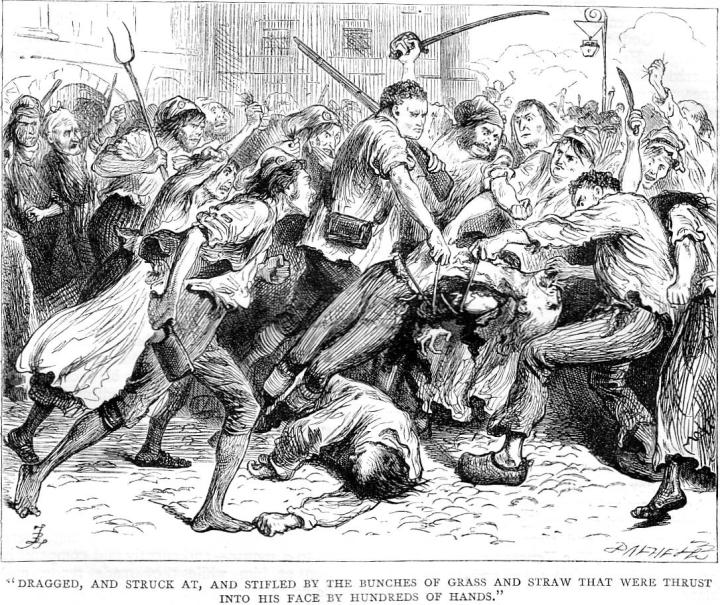
The idea of violent, irrational, and out-of-control crowds, was perpetuated by conservative observers of the great social tumult they saw in the French Revolution. People like Burke and Dickens did not understand the dynamics of such upheavals, the valid reasons for group action, and therefore focused only on the uglier side of such events, often caricaturing the protagonists and their motives.


People are every bit as emotional in small groups as they are in crowds. There is nothing contagious about emotions in crowds. People maintain emotional judgment while in the crowd. In fact, the leaders of protests harangue people to sing and chant as a way to unify the group. Just being in a crowd does not automatically unify the individuals. It takes work to do so. When faced with members of a crowd who become hysterical, rather than mindlessly joining in, other members of the crowd will distance themselves and exercise the same prudence that individuals or people in small groups will.

Is the crowd to social life what Freud’s id is to individual life?

Le Bon, Freud, Bion and the rest of the crowd psychologist we will soon meet think that at the social level the crowd is like the id, lurking on the margins of society waiting for a chance to jump out and wreak havoc. This is exemplified in the movie Lord of the Flies, by William Golding. In natural disasters these crowd psychologists imagine that the socialized ego is swarmed by the individualistic dictum, “every person for himself”. They imagine the results are pillaging and raping. The trouble is that research on behavior in natural disasters shows that people are consistently heroic and cooperative.

One hundred years of neglect of scientific research on crowds

Lastly, unlike individual psychology and group psychology the scientific study of crowds and masses lags way behind. It wasn’t until the late 1960s that the first research was done. Why is this? On the one hand, studying crowds is far more difficult because crowds are so large and their life-times short. But something else was going on. Why were Le Bon’s, Tarde’s and Sighele’s, speculations allowed to stand unchallenged and repeated mindlessly in social psychology textbooks for almost 100 years? In large part it was because their theories served the interests of the ruling class.

Historical Reasons for the Biases Against Crowds

Growth of cities

One of major changes in European history and geography was the gradual reversal of numbers of people living in cities compared to those of people living on farms.  People move to cities in part because there is more work, but also, as the saying goes, “city air makes you free”.  Some people felt trapped by the nosiness and stifling customs of rural life. Non-conformists to religious traditions, artists and hustlers with big dreams were drawn to cities for a chance to start fresh. Living on a farm, the general expectations was that you would engage in the same occupation as your parents. Moving to the city broke that tradition and it raised expectations. Especially those living in coastal cities who were exposed not only to people coming from different cities within Yankeedom, but people from other countries were also looking for work. Different languages, different religions, and different political traditions converged.

There are rarely, if ever, crowds in rural areas. While farmers may get together on holidays, everyone knows everyone else and rarely are strangers invited.  Even when farmers would go to town to get supplies, the overwhelming number of people knew each other and greeted each other. There were no stadiums or concert halls in which large numbers of people could congregate to watch professional sports or music. Long before the Industrial Revolution, crowds in cities would gather to hear political speeches. So, what we have in pre-industrial cities are relatively rootless people with raised expectations, surrounded by strangers from different cultures for whom being in a crowd is becoming normal.

The Great French revolutions

As most of you know, the French Revolution of 1789 overthrew both the king and the aristocrats as the merchants rose to power on the backs of artisans and peasants. The revolution was also anti-clerical. Churches and chateaux were burned to the ground. The aristocrats never forgot this. As if your memory needed any jogging, there were more revolutions in Paris in 1830 and 1848. In all these revolutions, crowds are violent and know where the upper classes live. Doesn’t it start to make sense that the study of crowds would never be objective so long as the upper classes were threatened by them and therefore controlled the research on crowds? In this case they made sure no research was done.

Industrialization

At the end of the 18th century and throughout the 19th century, cities became industrialized.  People were forced off the middle of streets to make way for wheeled vehicles accompanied by horses and later, trolley cars. Grid systems of streets were built which speeded up transportation and the circulation of goods. Industrial capitalists built factories in cities as opposed to artisan shops in the countryside (the putting out system). The emergence of factories had enormous revolutionary potential because it brought large numbers of people working under horrible conditions together. For 12-15 hours a day, at least six days a week, people have a common experience while all in the same place and the same time.

Formation of unions

It is no accident that unions first formed in factories. When common experience is concentrated at the same place and same time, people are likely to compare experiences and accumulate grievances. Some workers begin to recognize that they have collective power if they can organize themselves. They can strike for better working conditions and better wages. Unions made crowds more dangerous because crowds can, in an extremely chilling way, stop and start the work process itself. This is like cutting off the blood supply for vampiric capitalists.

Emergence of socialism

The first socialists were theoretical and utopian—they explored idealist conceptions of social transformation. William Godwin was the first theoretical anarchist, writing Enquiry Concerning Political Justice. In the early 19th century, there were utopian communities set up by Robert Owen, Charles Fourier and others but none of these communities were connected to unions or workers movements. It wasn’t until the writings of Marx and Engels that socialism was really connected to worker’s struggles. The socialism of Marx and Engels or the anarchism of Bakunin both said to workers, “it is not enough to have tiny little pieces of pie. You create all the wealth; you deserve the whole pie.”

In order to gain the whole pie, workers in crowds had to move in a mass, take over factories and run them for themselves, while confiscating the private property of the upper classes. For the upper classes, socialism and the prospects of crowds burning down their houses, and peasants taking over their land was their worst nightmare. The Paris Commune of 1871 was the first revolutionary situation that was inspired by socialism as a movement.

Stock Market instabilities

Crowd instabilities also came from the capitalist side, between 1873 to 1896 when the stock market was very unstable creating panics and depressions. [Instability—the dreaded cycle of boom and bust—is actually one of capitalism's intrinsic features. It derives from capitalism's mode of production which creates the absurdity of "overproduction in the midst of plenty."] This meant stock market traders were wheeling and dealing on the floor of the stock market at the same time that people who had money in banks were worried about their savings and, in some cases making runs on the banks.

Crowd Psychologists

Origins of Crowd Theory

Crowd theorists were social Darwinists whose ideas of a liberal society were of individuals who took care of only themselves. Beginning about 1870, crowd psychologists claimed that Darwinian evolution demonstrated that progress was a slow process, and any sudden changes based on violence were throwbacks to premodern times. Crowds were looked upon as akin to Herbert Spencer’s undifferentiated matter.

According to H. Stuart Hughes, (Consciousness and Society), beginning in the 1890s intellectuals became obsessed with the prospect that unconscious, primitive, and emotional forces were driving things. Crowd psychologists were united in rejecting sociological theorists such as Durkheim and Marx because they ignored emotions and unconscious motivation. What was really driving crowds, they thought, was below the level of consciousness. For crowd psychologists, individuals were both more than and less than the sum of their parts. The four major crowd theorists were Hippolyte Taine, Scipio Sighele, Gabriel Tarde, and Gustave Le Bon.

Crowd Theorists

Taine

Taine’s Origins of Contemporary France (written between 1876 and 1894) was a conservative attack on the Enlightenment. Taine blamed the Enlightenment ideas, including Rousseau’s, for what he considered the bloodbath of the French Revolution. Taine believed that the line between normal cognition and hallucinations, dreams and delusions, was closer than we might suspect. He cited evidence from research on organic lesions of the brain, hypnotism, and split personalities. He determined that the dramatic transformation of humans into savages is caused by what he called “the laws of mental contagion.” With the exception of the hypnosis model, Taine’s book embodies all the rudiments of French crowd psychology. For Taine, all leaders were the crazed dregs of society.

According to Taine, the Enlightenment failed to factor in the amount of time it took for humans to develop from barbarity to civility. Enlighteners weren’t interested in how people really were, but only as they could be measured by an abstract, ideal humanity. Taine thought the French Revolution was a relapse into primitive barbarism. Like Hume, Taine thought that reason was the passive servant of the passions. Bodily needs, animal instinct, prejudices which Taine thought were hereditary, were really driving people.

Criminalization of crowds (Sighele) 

Theories of hypnosis were split in two directions. Followers of Charcot claimed that being suggestible was a sign of psychopathology and only certain types of people could be hypnotized. The Nancy school of Bergheim argued that anyone could be hypnotized. The criminal school of Sighele sided with Charcot, arguing that crowds were composed of criminal individuals who were naturally suggestible. He followed the work of Lombroso who was a medical scholar of deviants in the military. Lombroso measured the skulls and anatomical characteristics of 3,000 soldiers.

According to Serge Moscovici (The Age of the Crowd), mass psychology was treated simply as part of criminal anthropology. Crowds were seen as mobs, scum, and made up of men who were out of control and would destroy anything in their path. Sighele claimed that hypnotism can explain the process by which individual minds become susceptible to outside forces, leading to actions that that are carried out automatically, unconsciously, and then spread to others by contagion. The conservative hand Sighele played was transparent in his labeling of social revolutionaries such as socialists, anarchists, or even striking workers as part of the criminal crowd. The hysteria of stock market traders was never seen as criminal.

Tarde

More than Taine or Sighele, Gabriel Tarde placed the crowd on a broader social spectrum. All social life, according to Tarde, is based on imitation, and the process of crowd formation and reproduction simply comes from the laws of imitation speeded up. He described the crowd as the first stage of association—rudimentary, fleeting, and undifferentiated. From this foundation, more stable and ongoing groups form, including corporations, political parties, and religious bodies such as churches or monasteries. Unlike other crowd psychologists, Tarde thought that literacy, newspapers, and mass communication would replace the crowd with what he called “the public.”

Tarde also thought that the extremes of behavior demonstrated in crowds are unique to cities. Unlike his right-wing crowd theorists, Tarde thought the madness of crowds is a product of civilization. He argued that crowd madness was uncommon in rural areas and among pre-state societies. Both Tarde and Le Bon supported the Nancy school, which suggested that there were social-psychological processes that anyindividual could fall prey to, if exposed to them. They believed that the solitary individual was superior to the group in all ways.

Le Bon

Le Bon concocted a mix of anthropological, social Darwinist, and psychological theories, which were in the same family as Taine and the racist Joseph Gobineau. He thought that cranial size could be used as an accurate measure of intelligence and he believed that people in primitive societies had small skulls. Le Bon thought the European race was superior, and only Caucasian males could transcend the constraints of biology.

Like Sighele and Tarde, Le Bon thought that what happens to an individual when in a crowd was analogous to what happens in hypnosis. All crowd theorists up to Le Bon agreed that the crowd was no more than what was already inside the psychology of individuals. They also believed that whatever destructive behavior transpired in a crowd was due to the lower-class origins of its members. Le Bon was the first to say that all personalities, regardless of class and intelligence, are susceptible to the pull of the crowd.

According to Serge Moscovici, Le Bon directly challenged Locke’s theory of the mind. As was par for the course in the Enlightenment, Locke believed that as the mind of humanity was gradually ridding itself of religious terrors, there would be fewer and fewer secrets. Le Bon, in contrast, said that revolutions shake the mind from its perch, sending it tumbling and howling into the abyss of the primitive world, which is driven by heredity, instinct, custom, and race. For Locke, visions and dreams were overridden by simple and complex reasoning. For Le Bon, crowds could not follow reason but instead learned by association, just as individuals do in dreams.


Strike! Chile's movement against grotesque social inequality has become semi-permanent, with social disturbances that have included enormous demonstrations and waves of strikes throughout the country. The police and military have acted with brutality, as usual, yet this has not quelled the protests or intimidated the masses. Their demands—supported by many intellectual and political leaders, including religious figures— are all perfectly rational and justified, and almost everyone in the crowds understands them completely.


Furthermore, crowd theorists claimed that people in crowds do not deliberate, but are mesmerized by leaders through the power of hypnotic suggestion. When Locke argued that the truth can be seen with open eyes, he neglected to note that crowds are driven by unconscious primitive animalism, which takes over and spreads by what Le Bon called “contagion.” This contagion does not lead to prudent, rational judgment but instead can lead to cruelty or heroism. These extreme reactions are amplified by the feeling of anonymity that grips individuals, allowing a sense of individual responsibility to evaporate.

Le Bon belonged to a liberal middle-class tradition that argued against both revolution and the weakness of liberal parliamentary systems. Despite his argument’s mediocre quality, rhetorically flattering the reader and lacking depth, Le Bon must have struck a nerve. According to Moscovici, no French thinker other than Georges Sorel and Alexander de Tocqueville has had an influence as great as Le Bon. Le Bon published The Crowd in 1890 and it was a best seller. Why was this? He mixed the disciplines of politics and psychology in an age of growing disciplinary specialization. Le Bon probably tapped into the fears that the middle and upper class and upper classes had about what would happen eventually if the new “democracy” was to expand.

Distorting the work of Alfred Espinas

It is worth noting that crowd psychologists distorted the work of Alfred Espinas on wasps and hornets to create an analogy between human crowds and insect societies. Espinas argued that societies were more than an aggregate of individuals and pointed out that alarm and danger were transmitted by visual contagion. Far from viewing this intensely social life of insects as a liability, he saw it as a strength in building bonds through cooperation.

Crowd psychologists seized on his discussion of the invisible communication of wasps and hornets when confronted with an enemy to draw an analogy to crowds. Just as insects communicate collectively when faced with danger, so crowd behavior becomes contagious among spectators in a theater or when aroused by a great orator. Unlike Espinas, they saw very little, if anything, constructive in this. Crowd psychologists thought the communicability of emotions beyond the individual was proof of the primitive mentality of the crowd.

Crowd Psychologist Distortions

Here are Susanna Barrows’ (Distorting Mirrors) damning conclusions about crowd-psychologist theories:

  • Taine, Sighele and Le Bon did not do any empirical research (Tarde was a possible exception).
  • Taine’s work contains grave errors in the scientific method. The idea of empirical investigation was wholly alien to him.
  • What evidence they collected was extremely selective to support their case (again, with the possible exception of Tarde).
  • Statistics indicate that women committed many fewer crimes than men, yet women were blamed for a disproportionate amount of the violence that occurred.
  • Le Bon indiscriminately lumped together socialists and anarchists with common criminals.
  • Crowd psychologists distorted the work of Espinas on wasps and hornets to make an analogy between human crowds and insect societies.

The Legacy of the 20th Century

The events of the 20th century hardly provided a break for poor conservatives hoping for a return to religion, God, kings and aristocrats. The Russian revolution, the stock market crash in 1929, Fascism in Germany and Italy and Spain, the Spanish revolution, the Chinese Revolution and the Cuban Revolution vanquished those hopes. This does not even count the Zoot Suit race riots in 1943, Watts in 1967 or the Rodney King riots in 1992.

Mass Media Propaganda Towards Crowds and Riots Carries Forward Obsolete Crowd Psychology

Check any newspaper or TV news program in Yankeedom and watch how the crowd and the rioters are treated when they describe a protest or a natural disaster. If it is a riot, does the paper ever show the variety of responses that go on during the riot? No, they focus only on the rioters and assume everyone in the crowd was complicit. When they describe the origin of the riot, do they consider the research which says the police are usually the perpetrators of the riot? Not on your life! The police are depicted as restoring order rather than as being the perpetrators of disorder. Lastly, in a natural disaster do the newscasters show the overwhelming instances of cooperation, compared to natural disaster participants helping themselves in supermarkets and sporting goods stores? No, they don’t. Rather the echo chamber of capitalist media blares out “looting, looting, looting” just like they declared “weapons of mass destruction” in the lead-up to the attack on Iraq twenty years ago.

Conclusion

I began this article with a questionnaire designed to expose your prejudices against crowds. I contrasted these biases against what research on mass psychology actually shows about crowd behavior. The heart of my article is to show why these biases continue in spite of scientific research to the contrary. I identified the growth of cities, the revolutions in France in the 19th century, the process of industrialization, the formation of unions, the rise of socialism and stock market instabilities in the 19thcentury. What do these events have to do with biases against crowds?

The answer can be found in the theories of mostly right-wing crowd theorists who wrote in the 2nd half of the 19thcentury. These theorists and their ruling class masters were terrified that crowds of working-class people would take their land, confiscate their resources and burn their chateaux to the ground. There was a great deal at stake for them. To call the people in crowds enraged, childish, criminal, beastly, stampeding, savage, irrational, impulsive, uncivilized, primitive, bloodthirsty, cruel and fickle is to dismiss, embarrass and mock anyone who participates. It is also a warning to future workers to stay away from crowds.

We socialists have been the victims of a 150-year propaganda campaign that was started by crowd psychologists in the 1860s and has been perpetuated by all sources of media throughout the 20th century. Amazingly, social psychologists who pride themselves on filling their textbooks with empirical evidence have given this discredited crowd theory a pass. There is so much money for research on what sells products and little or no money is available to study what moves crowds and masses. It is vitally important for the ruling classes to forestall the great day of reckoning by scaring people away from joining crowds that will be one of many vehicles for overthrowing them.

Image of Le Bon from Imgur @i.imgur.com

Bruce Lerro, a senior contributor to The Greanville Post, has taught for over 25 years as an adjunct Professor of Psychology at Golden Gate University, Dominican University and Diablo Valley College in the San Francisco Bay Area. He has applied a Vygotskian socio-historical perspective to the three books he’s written, found on Amazon. He currently co-edits a cultural-political blog,  Planning Beyond Capitalism, with Barbara Maclean.

If you find the above useful, pass it on! Become an "influence multiplier"! 
The battle against the Big Lie killing the world will not be won by you just reading this article. It will be won when you pass it on to at least 2 other people, requesting they do the same. 


Did you sign up yet for our FREE bulletin?
It's super easy! Sign up to receive our FREE bulletin.  Get TGP selections in your mailbox. No obligation of any kind. All addresses secure and never sold or commercialised. 

[newsletter_form]


This work is licensed under a Creative Commons Attribution-NonCommercial 4.0 International License


ALL CAPTIONS AND PULL QUOTES BY THE EDITORS NOT THE AUTHORS
 

black-horizontal

Published: June 21, 2021 0 comments
0 FacebookTwitterPinterestEmail
AMERICAN STUDIES

A Few Thoughts on Identity, Morality, Politics and Liberals

by Bergeracpas Published: October 1, 2020
written by Bergeracpas 10 minutes read

Please make sure these dispatches reach as many readers as possible. Share with kin, friends and workmates and ask them to do likewise.

EDITED AND HOSTED BY THE GREANVILLE POST


by Gary Olson
Dateline: September 30th, 2020


To know who I am is a species of knowing where I stand.

— Charles Taylor

Part One

In the early 1980s, which now seems a few lifetimes ago, I began offering a  college seminar course titled “The Politics of Personal Identity,” quickly dubbed “POPI” by students. It was designed as a capstone course and limited to twelve seniors. Most of the identity groupings  around today were addressed in readings, films and guest speakers.  During the final weeks of the course,  each student was responsible for giving a 45-minute oral presentation: “Who Am I? What Do I Believe? Why Do I Believe It?” This was followed by a lengthy period of questioning from the other seminar members and myself. Each of our guest speakers gave presentations on this topic and I presented my own on the last day of class. Germane to this was an exploration one’s political beliefs and their consequences was the critical component of the course and in what follows below.

Before exploring identities like race, gender, class, ethnicity and others, we attempted to establish a framework by including the work of Canadian philosopher and political activist Charles Taylor and specifically, his pioneering ideas on the politics of identity.1

For Taylor, “Selfhood and the good, or in another way, selfhood and morality, turn out to be inextricably intertwined themes. We are selves only in that certain issues matter to us. What I am as a self, my identity, is essentially defined by the way things have significance for me… We are selves only in that we move in a certain space of questions, as we seek and find an orientation to the good.” By his light, “Who I am” is most crucially this space of moral orientation “within which my most defining relations are lived out.”

And this isn’t just a strong preference or attachment. It means that people are saying that if they were to lose this commitment or identification, “they would be at sea, as it were, they wouldn’t know anymore, for an important range of questions, what the significance of things was for them.”


There is a sense of the ‘self’ that conveys to these beings of requisite depth to their identity or those who at the very least are struggling to find one. Others, who we judge as shallow, also have commitments but we see them as conventional and not the result of deep searching. And, as Taylor notes, those without any framework at all are pathologically amoral.

An important corollary is that one must include oneself in the mix because as Erich Fromm wisely counsels, “Love Thy Neighbor as Thyself” means nothing unless we realize that the discovery of my own self is inseparably connected with the discovery of any other self.”2

We also read some work by the character actor and playwright Wallace Shawn, including this passage about how to act in a morally responsible way:

My daily obligation was, first and foremost, to learn how to make a correct
And careful study of the world. If I didn’t know what the world was like, how
Could I know what action to take?  And so it turns out that morality insists upon accuracy —
painstakingly steady and researched.3

I hoped that Shawn’s words would resonate with the students, most of whom had also taken my intro course: International Politics: How the World Works, the bookend course to POPI.  I was gratified that virtually all of the seminar participants made the connection and often referenced the intro course. (Note: I’m painfully aware of the immense difference between an intro course with two sessions for fourteen weeks to examine a subject versus the forced, frustrated and  episodic nature of most exchanges about politics on Facebook and elsewhere.)

And further, one cannot be a self strictly on one’s own. For starters,  who did I interact with that helped me achieve self-realization? Who are those around me right now who contribute to my self-understanding? Beyond the standard sources, how widely have I searched? Is there evidence to support my conclusions or am I relying only on tradition, feelings and the accepted authorities? How has the “community” or culture withIn which I identify, affected my moral stands? Finally, it’s virtually impossible to have a sense of who/where I am without some grasp of how we got there. This can be painful and tempting to avoid, especially as one advances in age and possible regrets loom. Taylor asks us to consider what type of life is worth living?  “E.g., what would a rich meaningful life, as against an empty one, or what would constitute an honorable life or the like?”

In sum, my argument was that there’s a virtually seamless web connecting knowing ourselves, knowing how the world works, and knowing that something needs to be done — starting with oneself. Uncertainty, deliberation and experimentation about the specific course of action don’t detract from the wisdom found in the Asian proverb “To know and not to act is not to know.”4

Part Two

If we can answer to ourselves “This is where I stand,“ we have a fundamental moral orientation that has grown out of a careful examination of how the world works and we possess an identity that permits us to define what is important to us and what is not.

If we have serious uncertainty about ourselves and what is of value to us, our very identity is called into question. And here, I think, is Taylor’s most salient point:  “To lose this orientation, or not to have found it, is not to know who one is.”  In short, an identity crisis occurs because qualitative distinctions about how to live our lives are missing. Taylor notes that we also know people who we consider terribly shallow who also have their own sense about what’s important but who haven’t thought very deeply about the world or the origins of their conventional ideas.

I didn’t tell the class that several faculty turned down my request to speak and expressed uneasiness about the topic. I couldn’t help wondering if this was because they’d never really thought through questions of identity.  A college professor can hide behind a role and never need reveal his or her beliefs. In any event, for me, this threw into sharp relief a critical issue  that also became a discussion topic in the seminar. That is, with the exception of some red diaper babies, most of us who define ourselves as radicals were once liberals. By virtue of searing historical experiences, patient veterans of past struggles, contact with other cultures, reading outside the mainstream and just plain luck, we ended up embracing a radical political viewpoint.

My hypothesis and cautionary note to younger people is that the older one gets the harder it becomes to rethink one’s identity and question beliefs in which one has a considerable material and psychic investment,  without risking Taylor’s aforementioned identity crisis. The danger of peering too deeply, especially in mid-life or beyond, is the prospect of discovering that one has lived a trivial, insubstantial life that hasn’t been the prelude or harbinger of anything meaningful.

And the personal cost of not doing this is really incalculable. This is because the prevailing economic and social forces within which we live deny us the experience of genuine love, life’s most rewarding experience and in Fromm’s words, “The only sane and satisfying answer to the problem of human existance.”  Fromm, who died in 1980, isolated the dilemma for our political reality,  “The principle underlying capitalist society and the principle of love are incompatible.”

It’s  been my observation that in the face of this reality, many people  adopt “liberal” beliefs and behaviors that they hope  will stave off or neuter the gnawing discomfort that Fromm is correct and what this will mean for their personal political identity. Here’s a short list:

—  The world is complicated and not black and white.
—   But I’m colorblind.
—   Vote Blue, No Matter Who.
—   People are greedy.
—   We need "compassionate capitalism”
—   Remain convinced that the Democratic Party can be reformed
—   Talk about “giving something back“
—   Distance themselves from  longtime friends who strongly disagree with them
—   Display “Hate Has No Home Here” yard signs.
—   Listen to NPR, PBS News and even CNN to reinforce their views
—   Buy into Russia-gate
—   Embrace non-violence, the rule of law and incremental change
—   You’re stuck in the 1960s!
—   The perfect is the enemy of the good
—   The U.S. isn’t perfect and has  faults but look at (fill in the blank).
—   Drives a Prius and believes that individual recycling is the answer to climate change.
—   Always supports the lesser of two evils.
—   The problem is unregulated capitalism
—   Get outside of your comfort zone and look at the other party’s website to get the full picture.
—   Women and minorities deserve an equal opportunity to become corporate CEOs.
—   But the Supreme Court!
—   We can’t we just all get along?
—   We need more people willing to cross the aisle.
—   Knowledge about MLK’s political maturation begins and ends with “I Have A Dream.”

I take no pleasure in taking this a step further but I sense it needs saying in order  for leftists to make more productive use of their time and energy. Australian political analyst Caitlin Johnstone has listed several reasons why liberals hate and fear leftists. Here are just four of them:

First, because as noted earlier, one’s worldview is an important component of one’s identity and “exposing its flaws and one’s hypocrisy can feel like a personal attack”

Second, because if the leftists are right “everyone who taught them everything they thought they knew is wrong.”

Third, because change is scary.

Fourth, because the aforementioned “psychological discomfort known as cognitive dissonance actually hurts, and those who provoke it can often be perceived as the cause of the pain.”5

Finally, we know “the self,” especially in a hyper-individualistic, empathy-anesthetizing,  neoliberal capitalist culture, can become detached from the collectivity and less appreciative of the communal nature of life. There’s strong incentive to disavow one’s own role  and complicity in the suffering of others here and abroad and failing to help make the world safer for loving our neighbors. Over my lifetime (I’m 76) I’ve watched this occur countless times, especially recently. However, it’s neither inevitable nor excusable, especially if one’s had the luxury of time, travel, education and access to varied sources of information. It’s really never too late to begin the process.

  1. Charles Taylor, Sources of the Self (Cambridge: Harvard University Press, 1989). [↩]
  2. Erich Fromm, The Art of Loving (New York: Bantam Books, 1956), p.49. [↩]
  3. Wallace Shawn, Appendix to Aunt Dan & Lemon (1987). [↩]
  4. Gary Olson, Empathy Imperiled: Capitalism, Culture and the Brain (New York: Spring Publishing, 2012), See, especially, “Dangerously Empathic Samaritans,” p. 6-10. [↩]
  5. Caitlin Johnstone, “Why Liberals Hate Leftists,” September 26, 2020. [↩]
 
Gary Olson is Professor Emeritus of Political Science at Moravian College, Bethlehem, PA. He can be reached at: olsong@moravian.edu. Read other articles by Gary.


[post-views]

Creative Commons License

This work is licensed under a Creative Commons Attribution-NonCommercial 4.0 International License


black-horizontal


[premium_newsticker id=”154171″]


Published: October 1, 2020 0 comments
1 FacebookTwitterPinterestEmail
SOCIAL PSYCHOLOGY

A Nonviolent Strategy to Liberate Syria

by 5019904877561 Published: November 22, 2016
written by 5019904877561 18 minutes read

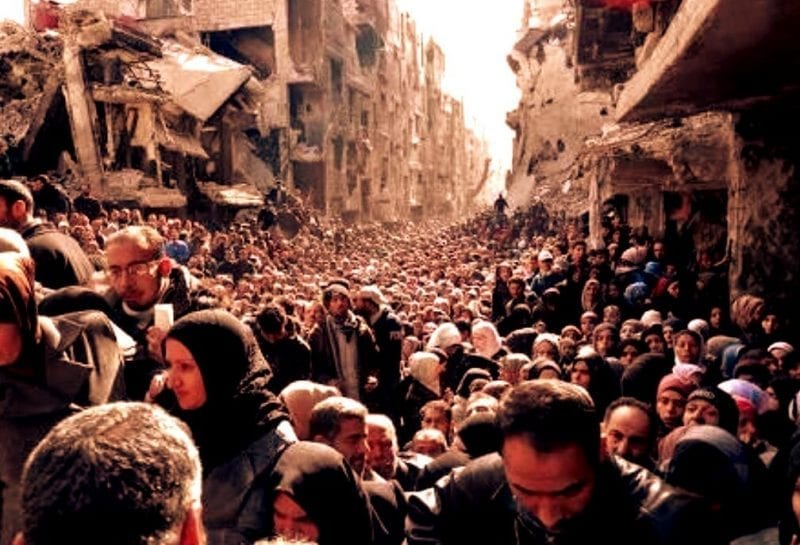
[Photo: Literally rivers of Syrians abandon a nation largely broken up by the imperial assault.It is time for a better way.]

=By= Robert J. Burrowes

Editor's Note
In this essay, Mr. Burrowes gives a short history of what has become a civil war in Syria. I found this step back to be useful. So much has happened since, and the situation in Syria so degraded and explosive, that looking again at the beginnings can be instructive. He then goes on to detail a path through to a nonviolent resolution.
In early 2011, as the Arab Spring was moving across North Africa and the Middle East, small groups of nonviolent activists in Syria, which has been under martial law since 1963, started protesting against the brutal dictatorship of Bashar al-Assad and demanding democratic reforms, the release of political prisoners, an increase in freedoms, abolition of the emergency law and an end to corruption.

By mid-March these protests, particularly in cities such as Damascus, Aleppo and Daraa, had escalated and the ‘Day of Rage’ protest on 15 March 2011 is considered by many to mark the start of the nationwide uprising against the Assad dictatorship. The dictatorship’s reaction to the protests became violent on 16 March and on 18 March, after Friday prayers, activists gathered at the al-Omari Mosque in Daraa were attacked by security forces with water cannons and tear gas, followed by live fire; four nonviolent activists were killed.

Within months, as the nonviolent protests expanded and spread, the regime had killed hundreds of activists and arbitrarily arrested thousands, subjecting many of them to brutal torture in detention. This pattern has continued unchecked. For the earliest of a succession of reports that document this regime’s violence against nonviolent activists, see the Human Rights Watch report ‘”We’ve Never Seen Such Horror” Crimes against Humanity by Syrian Security Forces‘. For the most recent report, see the UN Human Rights Council report ‘Out of Sight, Out of Mind: Deaths in Detention in the Syrian Arab Republic‘.

In recent commentaries on the war in Syria, both long-time solidarity activist Terry Burke – see ‘U.S. Peace Activists Should Start Listening to Progressive Syrian Voices‘ – and long-term Middle East scholar Professor Stephen Zunes have encouraged the anti-war movement to listen to Syrian voices in framing their response, particularly given the tendency within some sections of it to support ‘the extraordinarily brutal Assad regime – a family dictatorship rooted in the anti-leftist military wing of the Baath Party’  (see ‘Anti-war movement must listen to voices within Syria’s civil war‘).

One such Syrian voice is that of scholar and nonviolent activist Professor Mohja Kahf. In her account of the Syrian uprising against the Assad dictatorship – see ‘Then and Now: The Syrian Revolution to Date. A young nonviolent resistance and the ensuing armed struggle‘  – Professor Kahf offers the following introductory paragraphs:

‘The Syrian uprising sprang from the country’s grassroots, especially from youth in their teens, and adults in their twenties and thirties. They, not seasoned oppositionists, began the uprising, and are its core population. They share, rather than a particular ideology, a generational experience of disenfranchisement and brutalization by a corrupt, repressive, and massively armed ruling elite in Syria.

‘The uprising began nonviolently and the vast majority of its populace maintained nonviolence as its path to pursue regime change and a democratic Syria, until an armed flank emerged in August 2011.

‘The Syrian Revolution has morphed. From midsummer to autumn 2011, armed resistance developed, political bodies formed to represent the revolution outside Syria, and political Islamists of various sorts entered the uprising scene. Since then, armed resistance has overshadowed nonviolent resistance in Syria.

‘…political bodies and support groups for the revolution’s militarized wing, have become venues for internal power struggles among opposition factions and individuals, and entry-points for foreign powers attempting to push their own agendas into a revolution sprung from Syrian grievances, grown from the spilling of Syrian blood on Syrian soil.

‘Many in the global peace community can no longer discern the Syrian uprising’s grassroots population through the smoke of armed conflict and the troubling new actors on the scene. Further, some in the global left or anti-imperialist camp understand the Syrian revolution only through the endgame of geopolitics. In such a narrative, the uprising population is nothing but the proxy of U.S. imperialism.

‘Such critics may acknowledge that the Assad regime is brutal, but maintain from their armchairs that Syrians must bear this cost, because this regime has its finger in the dike of U.S. imperialism, Zionism, and Islamism. Or, perhaps they agree that a revolution against a brutal dictator is not a bad idea, but wish for a nicer revolution, with better players. Eyes riveted to their pencils and rulers and idées fixés, such critics abandon a grassroots population of disenfranchised human beings demanding basic human freedoms in Syria. This is a stunning and cruel failure of vision.

‘The voices of the original grassroots revolution of Syria are nonviolent, nonsectarian, noninterventionist, for the fall of the Assad regime, and for the rise of a democratic, human rights upholding Syria that is bound by the rule of law. They are still present in this revolution. Who will hear them now, after so much dear blood has been spilled, so much tender flesh crushed under blasted blocks of cement, so much rightful anger unleashed?’

Other Syrian voices offer a similar account. See, for example, the recent book by Robin Yassin-Kassab and Leila al-Shami titled ‘Burning Country: Syrians in Revolution and War‘ reviewed in ‘Book Review: Burning Country‘.

If Syrians and their solidarity allies are to develop and implement a successful nonviolent grassroots strategy to end the war in/on Syria and remove the Assad dictatorship, then we need a sound strategic framework that guides the comprehensive planning of our strategy. Obviously, there is no point designing a strategy that is incomplete or cannot be successful.

A sound strategic framework simply enables us to think and plan strategically so that once our strategy has been elaborated, it can be widely shared and clearly understood by everyone involved. It also means that nonviolent actions can then be implemented because they are known to have strategic utility and that precise utility is understood in advance. It is counterproductive to take random action, especially if the opponent is powerful and committed (even if that ‘commitment’ is insane, which is frequently the case).

There is a simple diagram presenting a 12-point strategic framework illustrated here in the form of the ‘Strategy Wheel.’
Burrowes Nonviolent Strategy Wheel

In order to think strategically about nonviolently resolving a violent conflict, a clearly defined political purpose is needed; that is, a simple summary statement of ‘what you want’. However, given the complexity of the multifaceted conflict in the case of Syria, it is strategically simpler to identify two political purposes. These might be stated thus: 1. To end the war in/on Syria, and 2. To establish a democratic form of government in Syria (which, obviously, requires removal of the dictatorship).

Once the political purpose has been defined, the two strategic aims (‘how you get what you want’) of the strategy acquire their meaning. These two strategic aims (which are always the same whatever the political purpose) are as follows: 1. To increase support for your campaign by developing a network of groups who can assist you. 2. To alter the will and undermine the power of those groups who support the war/dictatorship.

While the two strategic aims are always the same, they are achieved via a series of intermediate strategic goals that are always specific to each struggle. To keep this article reasonably straightforward, I have only identified a set of strategic goals that would be appropriate in the context of ending the war in/on Syria. For a basic set of strategic goals appropriate for ending the dictatorship, see ‘Strategic Aims‘.

Before listing the strategic goals for ending the war, I wish to emphasise that I have only briefly discussed two aspects of a comprehensive strategy to end the war in/on Syria: its political purpose and its two strategic aims (with its many subsidiary strategic goals). For the strategy to be effective, all twelve components of the strategic framework should be planned (and then implemented). See Nonviolent Defense/Liberation Strategy

This will require, for example, that tactics that will achieve the strategic goals must be carefully chosen and implemented bearing in mind the vital distinction between the political objective and strategic goal of any such tactic. See ‘The Political Objective and Strategic Goal of Nonviolent Actions‘.

Strategic goals to end the war in/on Syria

I have outlined a basic list of strategic goals below although, it should be noted, the list would be considerably longer as individual organizations should be specified separately.

Many of these strategic goals would usually be tackled by action groups working in solidarity with Syria campaigning within their own country. Ideally they would be undertaken by activist groups with existing expertise in the relevant area (for example, experience in campaigning against a weapons corporation) but this is not essential.

Of course, individual activist groups would usually accept responsibility for focusing their work on achieving just one or a few of the strategic goals (which is why any single campaign within the overall strategy is readily manageable).

It is the responsibility of the struggle’s strategic leadership to ensure that each of the strategic goals, which should be identified and prioritized according to their precise understanding of the circumstances in Syria, (so, not necessarily precisely as identified below) is being addressed (or to prioritize if resource limitations require this).

So here is a set of strategic goals to end the war in/on Syria:

(1) To cause the women in [women’s organizations WO1, WO2, WO…] in Syria to join the liberation strategy by participating in [your nominated nonviolent action(s)/campaign(s) and/or constructive program activities]. For example, simple nonviolent actions would be to wear a national symbol (such as a badge of the national flag and/or ribbons in the national colors) and/or to boycott all media outlets supporting the war. For this item and many items hereafter, see the list of possible actions that can be taken here: ‘198 Tactics of Nonviolent Action‘.

(2) To cause the workers in [trade unions T1, T2, T…] in Syria to join the liberation strategy by participating in [your nominated nonviolent action(s)/campaign(s) and/or constructive program activities]. For example, this might include withdrawing their labor from occupations that support the Syrian military forces.

(3) To cause young people in Syria to resist conscription into the Syrian military forces.

(4) To cause young people in Syria to refuse recruitment into the Free Syrian Army, al-Qaeda and its affiliates/allies, the Islamic State (Daesh) and its allies.

(5) To cause the members of [religious denominations R1, R2, R…] in Syria to join the liberation strategy by participating in [your nominated nonviolent action(s)/campaign(s) and/or constructive program activities].

(6) To cause the members of [ethnic communities EC1, EC2, EC…] in Syria to join the liberation strategy by participating in [your nominated nonviolent action(s)/campaign(s) and/or constructive program activities].

(7) To cause the activists, artists, musicians, intellectuals and other key social groups in [organizations O1, O2, O…] in Syria to join the liberation strategy by participating in [your nominated nonviolent action(s)/campaign(s) and/or constructive program activities].

(8) To cause the students in [student organizations S1, S2, S…] in Syria to join the liberation strategy by participating in [your nominated nonviolent action(s)/campaign(s) and/or constructive program activities].

(9) To cause the soldiers in [military units M1, M2, M…] to refuse to obey orders from the dictatorship to arrest, assault, torture and shoot nonviolent activists and the other citizens of Syria.

(10) To cause the police in [police units P1, P2, P…] to refuse to obey orders from the dictatorship to arrest, assault, torture and shoot nonviolent activists and the other citizens of Syria.

(11) To cause young people in [the US, NATO countries, Russia and other countries fighting in Syria] to refuse recruitment into their respective military forces.

(12) To cause conscripts into the military forces of [NATO countries, Russia and other countries fighting in Syria] that still use conscription to conscientiously refuse to perform military duties.

(13) To cause military personnel in the military forces of [the US, NATO countries, Russia and other countries fighting in Syria] to refuse deployment to the war in/on Syria.

(14) To cause young people in [your country] to refuse recruitment into the Free Syrian Army, al-Qaeda and its affiliates/allies, the Islamic State (Daesh) and its allies.

(15) To cause former soldiers in [your country] to refuse recruitment as mercenaries by corporations that supply ‘military contractors’ to fight in Syria.

(16) To cause the activists in [peace groups P1, P2, P…] in [your town/city/country] to resist the war on Syria by encouraging their members to boycott [all/specified nonmilitary products] of [weapons corporations W1, W2, W…]. For example, this might include boycotting all commercial flights that use Boeing and Airbus passenger aircraft given the heavy involvement of these corporations in the production of military aircraft.

(17) To cause the activists in [environment groups E1, E2, E…] in [your town/city/country] to resist the war on Syria by encouraging their members to boycott [all/specified nonmilitary products] of [weapons corporations W1, W2, W…]. For example, this might including boycotting all commercial products of General Electric given the heavy involvement of this corporation in the production of military engines, systems and services.

(18) To cause the workers in [trade unions or labor organizations T1, T2, T….] in [your town/city/country] to resist the war on Syria by encouraging their members to boycott [all/specified nonmilitary products] of [weapons corporations W1, W2, W…].

(19) To cause the women in [women’s organizations WO1, WO2, WO…] in [your town/city/country] to resist the war on Syria by encouraging their members to boycott [all/specified nonmilitary products] of [weapons corporations W1, W2, W…].

(20) To cause the members of [religious denominations R1, R2, R…] in [your town/city/country] to resist the war on Syria by encouraging their members to boycott [all/specified nonmilitary products] of [weapons corporations W1, W2, W…].

(21) To cause the members of [ethnic communities EC4, EC5, EC…] in [your town/city/country] to resist the war on Syria by encouraging their members to boycott [all/specified nonmilitary products] of [weapons corporations W1, W2, W…].

(22) To cause the artists, musicians, intellectuals and other key social groups in [organizations O4, O5, O…] in [your town/city/country] to resist the war on Syria by encouraging their members to boycott [all/specified nonmilitary products] of [weapons corporations W1, W2, W…].

(23) To cause the students in [student organizations S1, S2, S…] in [your town/city/country] to resist the war on Syria by encouraging their members to boycott [all/specified nonmilitary products] of [weapons corporations W1, W2, W…].

(24) To cause the consumers in [your town/city/country] to resist the war on Syria by boycotting [all/specified nonmilitary products] of [weapons corporations W1, W2, W…].

(25) To cause more individuals in [your town/city/country] to resist the war on Syria by conscientiously resisting paying [part/all] of their taxes for war.

(26) To cause more organizations in [your town/city/country] to resist the war on Syria by conscientiously resisting paying [part/all] of their taxes for war.

(27) To cause [weapons corporations W4, W5, W…] to convert from the manufacture of military weapons to [the specified/negotiated socially/environmentally beneficial products].

(28) To cause [banks B1, B2, B…] to cease financing the weapons industry.

(29) To cause bank customers to shift their deposits to ethical banks and credit unions that do not finance (or are otherwise involved in) the weapons industry.

(30) To cause [religious organizations R4, R5, R…] to divest from the weapons industry.

(31) To cause [superannuation funds S1, S2, S…] to divest from the weapons industry.

(32) To cause superannuation fund customers to shift their money to ethical funds that do not finance (or are otherwise involved in) the weapons industry.

(33) To cause [insurance companies I1, I2, I…] to divest from the weapons industry.

(34) To cause insurance customers to shift their policies to ethical insurance companies that do not finance (or are otherwise involved in) the weapons industry.

(35) To cause [corporations C1, C2, C…] that provide [services/components] for [weapons corporations W1, W2, W…] to cease doing so.

(36) To cause the workers in [trade unions or labor organizations T4, T5, T…] to withdraw their labor from [weapons corporations W1, W2, W…] [partially/wholly], [temporarily/permanently].

(37) To cause the workers in [trade unions or labor organizations T7, T8, T…] to withdraw their labor from [corporations C1, C2, C…] [partially/wholly], [temporarily/permanently].

(38) To cause [corporations C4, C5, C…] that provides [services/supplies] to [military bases MB1, MB2, MB…] to cease doing so.

(39) To cause the workers in [trade unions or labor organizations T10, T11, T…] who work in/supply [military bases MB1, MB2, MB…] to withdraw their labor [partially/wholly], [temporarily/permanently].

(40) To cause the workers in [trade unions or labor organizations T13, T14, T…] to withdraw their labor from [corporations C4, C5, C…] [partially/wholly], [temporarily/permanently].

(41) To cause [corporations C7, C8, C…] that manufacture and supply spy satellites for military purposes to cease doing so.

(42) To cause the workers in [trade unions or labor organizations T16, T17, T…] to withdraw their labor from [corporations C7, C8, C…] [partially/wholly], [temporarily/permanently].

(43) To cause [corporations C10, C11, C…] that provide [services/components] for the militarization of space to cease doing so.

(44) To cause the workers in [trade unions or labor organizations T19, T20, T…] to withdraw their labor from [corporations C10, C11, C…] [partially/wholly], [temporarily/permanently].

(45) To cause [corporations C13, C14, C…] that provide private military contractors (mercenaries) to fight in wars to cease doing so.

(46) To cause the private military contractors (mercenaries) who fight in wars to withdraw their labor from [corporations C13, C14, C…].

(47) To cause the soldiers in [military units M1, M2, M…] in [your town/city/country] to refuse to obey orders to [arrest, assault, torture and shoot, depending on your local circumstances] nonviolent activists campaigning against the war.

(48) To cause the police in [police units P1, P2, P…] in [your town/city/country] to refuse to obey orders to [arrest, assault, torture and shoot, depending on your local circumstances] nonviolent activists campaigning against the war.

(49) To cause individual members of the military forces at [Military Base MB1/Drone Base DB1/Navy Ship NS1/Air Force Base AFB1/Army unit AU1/Marines unit MU1] in [your town/city/country] to resign.

(50) To cause individual members of those corporations that employ/supply private military contractors (mercenaries) to resign.

As you can see, the two strategic aims are achieved via a series of intermediate strategic goals.

Not all of the strategic goals will need to be achieved for the strategy to be successful but each goal is focused in such a way that its achievement functionally undermines the power of those conducting the war.

The difference between success and failure in any struggle is the soundness of the strategy.


Screen Shot 2016-01-23 at 2.38.28 PMRobert J. Burrowes has a lifetime commitment to understanding and ending human violence. He has done extensive research since 1966 in an effort to understand why human beings are violent and has been a nonviolent activist since 1981. He is the author of ‘Why Violence?’ http://tinyurl.com/whyviolence His email address is flametree@riseup.net and his website is at http://robertjburrowes.wordpress.com


Note to Commenters
Due to severe hacking attacks in the recent past that brought our site down for up to 11 days with considerable loss of circulation, we exercise extreme caution in the comments we publish, as the comment box has been one of the main arteries to inject malicious code. Because of that comments may not appear immediately, but rest assured that if you are a legitimate commenter your opinion will be published within 24 hours. If your comment fails to appear, and you wish to reach us directly, send us a mail at: editor@greanvillepost.com

We apologize for this inconvenience.

horiz-long grey

Screen Shot 2015-12-08 at 2.57.29 PMNauseated by the
vile corporate media?
Had enough of their lies, escapism,
omissions and relentless manipulation?

GET EVEN.
Send a donation to

The Greanville Post–or
SHARE OUR ARTICLES WIDELY!
But be sure to support YOUR media.
If you don’t, who will?

horiz-black-wide
ALL CAPTIONS AND PULL-QUOTES BY THE EDITORS, NOT THE AUTHORS.


Published: November 22, 2016 1 comment
0 FacebookTwitterPinterestEmail
ASSHOLES, BASTARDS & CRIMINALS

8 Habits of Intolerant People

by TGP STAFF Published: January 20, 2014
written by TGP STAFF 0 minutes read
AlterNet [1] / By Mark Goulston [2]
comments_image
 intolerance-alter
January 18, 2014  |  

I find it difficult to believe that there still remain so many people who are intolerant of others; like those who are so vehemently against gay marriage even though other people’s intimate relationships do not directly hurt them. It turns out these people share some similar traits. Over my years as a psychotherapist, I have worked with many people who have personality issues. I have observed the following about those who are quick to anger, resentful and begrudging of others.

Continue Reading
Published: January 20, 2014 0 comments
0 FacebookTwitterPinterestEmail

Choose your language

Recent Posts

  • Europe Continues Self-Harming

    Published: July 2, 2026
  • Why the US Lost More Than a War Against Iran | Radhika Desai

    Published: July 2, 2026
  • IMPERIALISM: DECADENT & DOOMED W/JOTI BRAR EP 58 – EU GOVERNMENTS FIGHT THE PEOPLE WHO OPPOSE WAR

    Published: July 1, 2026
  • The REAL reason the US fears China

    Published: July 1, 2026
  • Alexander Mercouris: A New Putin? From Diplomacy to War

    Published: June 30, 2026

Search

Speaking for the suppressed is our mission

IF YOU THINK THE WARMONGERING MEDIA ARE A DISGRACE AND A HUGE OBSTACLE TO REAL CHANGE IN AMERICA…
why haven’t you sent at least a few dollars to The Greanville Post (or a similar anti-imperialist citizen’s media)?. Think about it.  Without educating and organizing our ranks our cause is DOA. That’s why our citizens’ media need your support.  
Click anywhere on the image.

Gateway

  • Log in
  • Entries feed
  • Comments feed
  • WordPress.org

Most Important Info Sources


Most Trusted:
Andrei Martyanov
Black Agenda Report
Caitlin Johnstone
Caleb Maupin
China Rising/Jeff J. Brown
Consortium News
Danny Haiphong
Don Hank
Free PalestineTV–Laith Marouf

Garland Nixon
George Galloway
George Hazim
Gilbert Doctorow —Armageddon
Glenn Greenwald
Godfree Roberts / Here Comes China
Information Clearinghouse
In Defense of Communism
Jim Kavanagh/The Polemicist
Jonathan Cook Blog
Julian Macfarlane
Michael Roberts
Mondoweiss
Moon of Alabama
Multipolarista
Oliver Boyd-Barrett
Orinoco Tribune
Revolutionary Blackout Network/ Nick Cruse
Richard Medhurst
Roger Boyd
Sabby Sabs
Scott Ritter/AskThe Inspector
Seek Truth From Fact Foundation (STFF)
Simplicius the Thinker
Sonar21/Larry C Johnson
The Cradle
The Electronic Intifada
The Grayzone
The Jimmy Dore Show
The New Atlas/ Brian Berletic
The Vineyard of the Saker
Thomas Fazi Dispatches
Voltairenet.org
William Schryver / imetatronink

DONATE to The Greanville Post! It’s your media.


“Nothin’ tougher than cat herding!”

NOW IN THE TOP 1% OF AMAZON’S ASIA TITLES. WITH A SPECIAL FOREWORD BY PEPE ESCOBAR. 568 PP, ILLUSTRATED.

About Us

Kitty studious philosopherTHE GREANVILLE POST (TGP) is an antidote to and refuge from the ubiquitous brainwash long afflicting most people in the United States and the rest of the collective West. TGP is an independent, (barely) reader-supported, non-dogmatic publication dedicated to seeking the truth wherever it may be found. Thus, we publish voices from any point in the political spectrum, left, right, up, down, except shitlibs, professional disinformers, media whores, and demagogues of the extreme right. TGP is already heavily shadowbanned; it could be gone tomorrow. That’s the lousy, uber-hypocritical times we inhabit, so read it while you can, and do pass its carefully selected articles to others: friends, kin and workmates. Incidentally, if you can send a donation, do so. For obvious reasons, we do not operate behind a paywall. Defeating the Big Lie is too important and urgent to subject the truth to the test of wallet power.

He does not believe in Western “objectivity”.

bandido no stinking badge

Legalities: Disclaimer, etc.


Disclaimer Notice
  • Facebook
  • Twitter

@2021 - All Right Reserved. Designed and Developed by PenciDesign


Back To Top
The Greanville Post
  • HOME
  • ESSENTIAL
  • MYTH-FREE HISTORY WITH JACQUES PAUWELS
  • MUST VIDEO
  • BLOWBACK
  • NATURE