
Oliver Boyd-Barrett

End Times for the Petrodollar (1)

Map of Saudi Arabia
As best as I now understand the matter, the Houthis have not captured or occupied any actual sovereign Saudi Arabian territory, but they have made major territorial gains against their Saudi-backed and equipped Yemeni opponents within Yemen over the past two weeks, seizing strategic islands and ports along the Red Sea coast.
So the situation has to be seen in terms of a continuance of a civil war (in which one party relies heavily on Saudi Arabia, and the other is a close ally but certainly not a creature of Iran), alongside a war between the Houthis and the Saudis. Instead of invading Saudi territory on the ground, the Houthi movement has relied on cross-border ballistic missile and drone strikes against Saudi military infrastructure.
I do note that under the centralizing tendencies of Saudi King Ibn Saud in the 1930s, in collaboration with Wahhabi Islamism, Saudi seized parts of Yemen and that it is some of these territories that the Houthis may now have their eyes on.
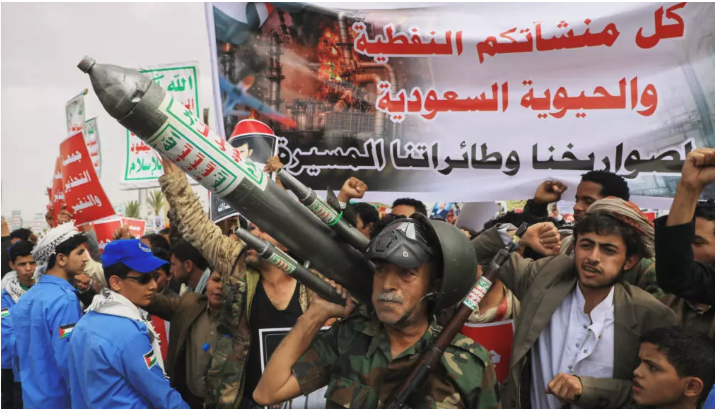
Houthi supporters rally in Sanaa, Yemen on July 17, 2026 near a banner in Arabic proclaiming, "All Saudi oil facilities are targets to our missiles and drones." © Osamah Abdulrahman, AP
More to the point, the Houthi blockade of Saudi tanks and vessels in the Red Sea is a robust, constraining force on Saudi traffic, especially given the mountainous nature of the Yemeni’s Red Sea coastline that affords the Houthis, now in control of the entirety of that coastline, an excellent vantage point from which to survey and if necessary attack. The US dare not make the situation worse because it is a very small step for the Yemenis to expand their blockade from applying only to Saudi vessels to applying to all international traffic. Further, the US was badly thrashed when, in March 2025, it attacked the Houthis on behalf of the Saudis and lost 9 Reaper drones worth $60 million a piece.
In addition to indignity, the Saudis must now deal with successful Houthi attacks on Aramco oil facilities and the East-West pipeline (badly damaged in four places) that for a few days provided the Saudis with an alternative route of delivery.
In essence, the flow of oil revenue to Saudi Arabia has now come to a complete halt. The gravity of the financial situation puts considerable pressure on the Saudis, as on other Gulf nations, to see their US Treasury bonds, which up until now have constituted the bedrock of the “petro-dollar” system under which in return for US “protection” (its credibility now shattered) and US purchases of Gulf oil, Saudi Arabia and other Gulf nations priced their oil in dollars and purchased US Treasuries, allowing the US to accumulate a debt that has now reached $40 trillion.
Major Saudi or UAE sales of US Treasury bonds will gravely increase the cost to the US of borrowing money and managing its existing debt load, and will accelerate inflationary pressures within the US.
No wonder that President Trump is now begging Zelenskiy to stop hitting Russian oil refineries. As has been patently obvious in my previous posts over the past year or so, NATO’s insane war with Russia over the body (almost literally) of Ukraine has already prompted Europe to burden itself voluntarily with vastly increased prices for oil and gas (by a factor of 5 to 10 in the case of gas) that have had a stagnating or recessionary impact on the whole of Western Europe, it has now, in conjunction with the Gulf and Red Sea crises (the result, basically of two insane, unnecessary, pointless and counterproductive, unprovoked attacks on the sovereign nation of Iran, allegedly at the request of Zionist Israel), started to crash the entire petrodollar system that has helped support US hegemony over the past eighty years, at the very moment that the BRICS have burnished their own arrangements and mechanisms to facilitate trade in local currencies.
The notion, recently canvassed in this post and elsewhere, that the Gulf crisis has been manufactured by US Treasury Secretary Bessent, seems increasonly implausible in this context.
The current price of Brent crude nowhere near reflects the real global seriousness of the current crisis. Why the price is not higher is open to many explanations and interpretations of which one, but only one, is China’s capacity to influence the demand for oil by relying more heavily on its extensive reserves. China too is a major holder of US Treasuries, and that too factors in to the equation.
King Ibn Saud permanently seized three key border provinces considered part of “historic Yemen” during the 1934 Saudi–Yemeni War. Following a swift military victory, Saudi Arabia annexed the fertile and strategic southern regions of Asir, Najran, and Jazan.
While Saudi forces under the command of Ibn Saud’s sons even managed to push deep into mainland Yemen and capture the major Red Sea port city of Hodeidah, Ibn Saud chose not to occupy the entire country. Instead, he used his leverage to dictate terms, withdrawing from Hodeidah in exchange for absolute control over the seized northern territories.
Najran and Jazan are legally recognized Saudi administrative regions. Asir is the third major southwestern Saudi Arabian province bordering Yemen. Historically, Asir, Najran, and Jazan were disputed frontier territories, as we have just seen, that became incorporated as official provinces of Saudi Arabia under the 1934 Treaty of Taif following the Saudi–Yemeni War.
While these regions remain entirely under Saudi government authority, their status in current events is defined by intense military activity rather than territorial occupation:
As for the current military Status of Najran, Jazan, and Asir (which lie to the northwest of Yemen along the eastern Red Sea coast, the Saudi Armed Forces and Saudi National Guard heavily secure the entire border zone. The cities function normally under Saudi civil administration, though they are heavily militarized. Because these three provinces sit directly on the rugged mountain border with Yemen, they are the primary targets for the Houthis. Just within the last week, a major flare-up in the war shattered a long-standing truce. The Houthis launched waves of ballistic missiles, projectiles, and drones into Jazan, Najran and Abha (the capital of Asir). These strikes hit Saudi Aramco energy facilities, triggered civil defense emergency sirens, and resulted in dozens of civilian injuries.
No foreign forces or Houthi rebels currently occupy these cities or provinces. They are sovereign Saudi territories experiencing active cross-border bombardment.
Recent Houthi Territorial Gains in Yemen
Following a breakdown of a long-standing ceasefire, Houthi forces launched a swift “Red Sea blitz” over the first two weeks of September 2026, expelling Saudi-backed government forces from vital maritime checkpoints. The Houthis successfully captured the port of Mokha, a highly strategic Red Sea port city. They also took Perim Island (Mayun), located directly inside the narrow Bab al-Mandab Strait, this island divides the crucial shipping lane linking Asia to Europe. Controlling it gives the Houthis direct leverage over local maritime traffic. Within the last 48 hours, Houthi officials confirmed the capture of two more strategic islands in the southern Red Sea, solidifying their grip on the Bab al-Mandab bottleneck. Heavy ground fighting continues as the Houthis push further into the mountainous Taiz province, Marib, and al-Jawf near the Saudi border.
Recent Houthi escalations include large-scale drone and missile strikes claiming “direct hits” on King Khalid Air Base in Khamis Mushait, as well as projectile strikes causing damage in Saudi border communities near the Red Sea.
