
Simplicius
How Russia is Responding to New Ukrainian 'Drone Threat' to Cut Crimean Corridor
The following is [part of ] a hefty ~4,400 word premium article on the current “drone scare” being manufactured by Ukraine to push the narrative that Crimea is being cut off. In it we explore what Ukraine has been achieving, with a detailed deep dive into how Russia has begun to counteract it, and why the hype will soon die out.
The first ~1,000 or so words are presented free to the public.
Special sale announcement: To kick off summer, we’re announcing a special 20% discount for all new paid signups, starting now. The offer will be valid for 3 days, until 6/17/26. And upon signing up, your 20% discount will last for 12 full months. But as stated, you have 3 days to signup at this special discount link: https://simplicius76.substack.com/7f259800
If you miss it this time, there will likely be another discount opportunity sometime down the line as part of a larger summer drive to boost subscriptions, which have recently slowed.
Please consider helping out by becoming a paid subscriber today, and getting access to the inner sanctum of the more detailed premium articles which are now typically released after every third free article.

The purpose is always to create a diversionary groundswell of “crisis dooming” which deflects from Ukraine’s own ongoing battlefield losses, which now mainly center on the collapsing Konstantinovka front, where Russian forces are set to capture their next large ‘Donbass fortress-town’.
That’s not to say Ukraine’s recent campaign has not had any effect at all, but simply rather that the effects are vastly exaggerated by the Western propaganda organs.
But first, to contextualize how it all developed, let us briefly delve into the reasons behind the changes which allowed Ukraine to leverage these long-range strikes in the way it’s currently doing.
The first and most important change which gave Ukraine a newfound advantage was the removal of Biden-era restrictions on the US providing targeting and authorizations for long-range strikes deep into Russia. The second, was the likewise apparent lifting of restrictions on Ukrainian Starlinks operating on Russian territory. Recall that in the beginning of the war, Elon Musk had famously said that Starlink would not be allowed to be used in an “offensive” manner. This was later swept under the rug when Ukraine desperately needed some new advantage to save its collapsing war effort—and so, Starlink was allowed to operate offensively, but was still restricted to Ukrainian territory only.
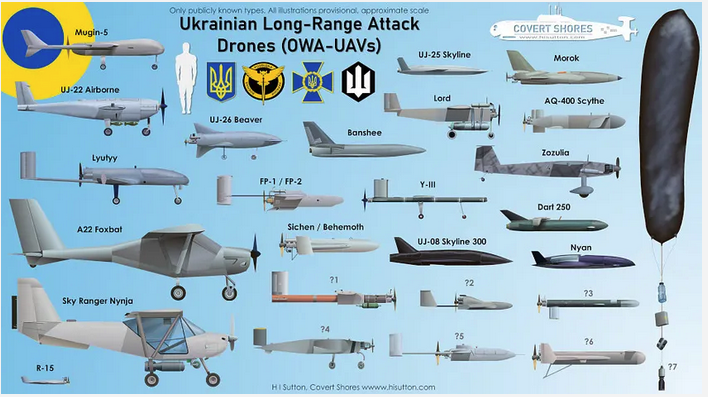
Now many reports claim that Starlink is used on Ukrainian FP-1/2 and other drones even outside Ukrainian territory.

Much of the current campaign against Crimea is also powered via Starlink. One of the newly emerging top drones for hitting Russian logistics along the ‘Crimean corridor’ is the US-made “Hornet”, which is variously seen with a Starlink panel on its back.
Here is a video of a Russian specialist disassembling the Hornet and commenting on the quality American construction of the drone, as compared to the usual ‘ad hoc’ drone designs slapped together in frontline workshops by volunteer engineering groups and such:

The Hornet drone in question is manufactured in California by a company backed by ex-Google CEO Eric Schmidt, and there is an increasing number of “partnerships” between Ukraine and Western nations for drone and missile production constantly being announced.

The latest video out of Ukraine of a series of strikes utilizing this very Hornet drone along Russia’s southern corridor (beware of nasty music background):
You can see the drones clearly have terminal AI guidance which allows them to hit targets even if jammed. How do we know they use Starlink? You’ll see soon in the next part.
That said, these Hornet drones are not infallible as this next Russian video shows:
Russia destroys some Ukrainian Drones before they reach target https://t.co/skizHEn30Q via @YouTube
— Patrice Greanville (@AddisondePitt) June 28, 2026
Finish reading in the next page—

Roger Boyd

This is part (1) of a series that will look at the dynamics of the regions and nations of Africa and the geopolitical implications
The Berlin Conference of 1884-1885 established the ground rules for the European dividing up of Africa, termed the “Scramble for Africa”. Over the next decades, the continent was turned into a set of European-created colonies; divided up between Britain, France, Belgium, Spain and Germany. Only Abyssinia (now Ethiopia) was able to maintain its independence.
Wikipedia
Britain, France, Italy, Belgium and Portugal then used WW1 to gobble up the German colonies for themselves, with Britain the biggest winner in the colony grab. German West Africa (modern day Namibia) and most of German East Africa (modern day Tanzania) were taken by the British Empire. The remains were taken by Belgium, with what are now the modern nations of Rwanda and Burundi, and a small piece added to the Portuguese Mozambique. Kamerun was divided by the French and British, as French Cameroon and British Cameroon.
In the north, the hold of Islam and domestic societal institutions and culture were strong and maintained their dominance. Elsewhere, the European powers imposed their versions of Christianity (Protestantism and Catholicism) and imposed their own socio-cultural institutions to a significant extent. While also exacerbating inter-ethnic conflicts by creating territories that cut across ethnic lines and choosing one ethnic group to act as vassal overseers of a colony; as with the Tutsi in Rwanda and Burundi. The socio-economic fabric was substantially remade into an imperfect reflection of the colonial master, while the chosen ethnic overseer elites were heavily integrated into the colonial society (e.g. going to school and university in the colonial country, trained within the colonial army). Thus was neo-colonial domination embedded on many levels, as shown in the French dominated Gabon:
Gabon was an African country, geographically shaped by the French, colonized by the French, forested by the French, led by a francophone assimilated elite who spoke French, read French writing, received French education, practiced French law, worked for French businesses, and who adopted a French system of government that was additionally dominated by France through a system called ‘cooperation’ (a term coined by the French in a series of military, economic, and diplomatic accords). (Yates 2012, Case Study: Neocolonialism in Gabon, para. 9)
It was only in the post-WW2 period that Africa started to throw off the shackles of colonialism, either by national struggle or by being granted independence by the colonial powers.
With Italy having been defeated in WW2, its colony of Libya gained independence in 1956, along with a Morocco and Tunisia where the populations had established national struggles for freedom. Egypt had gained partial independence in 1922, and after a military coup in 1952 (Nasser) gained full independence in 1956. The largest fight for freedom was that of an Algeria that had been fully integrated as a region of France proper, and had a large French settler population. In an utterly brutal war of independence from 1954 to 1962, Algeria gained its independence and the near total removal of the French settler population. These nations had maintained much of their pre-colonial socio-cultural heritage, including the Islamic religion, and the majority had established national liberation movements and armies. Thus, they were able to form fully independent national states; still of course open to continual Western attempts at subjugation.
At the opposite end of the continent, the white settlers of Rhodesia and South Africa declared their own independence and then fought extended wars against the majority black population. In Rhodesia, the indigenous population won through force of arms and took control of the country (Zimbabwe) in 1980, only to be faced with extensive Western sanctions designed to inhibit the development of the country. In South Africa, the handover to majority indigenous rule was achieved though an integration of the ANC leadership into the white elite; akin to the story of Animal Farm. National liberation struggles in Mozambique (1975), Angola (1975) and South West Africa (1990) lead to independent nations. Tanganyika (formerly German East Africa) gained a negotiated independence in 1961 under the independent leadership of Nyerere. Uganda (1962), Zambia and Malawi (both 1964) gained independence, and also operate as majority-governed relatively independent states. Angola fought an extended war, from 1961 to 1974, for its independence. Namibia achieved its independence through a three decade military and diplomatic struggle.
In the north and the south of the continent, fully functional independent states were established with majority indigenous rule. With South Africa as an exception, as an indigenous elite were co-opted by the still economically dominant white elite. In East Africa, Ethiopia stands out as never being colonized. Its occupation by Italy only lasted from 1936 to 1941, otherwise it stands out as maintaining its own socio-cultural and political-economic institutions. Eritrea was federated with Ethiopia in 1950 and fully subsumed within Ethiopia in 1962, then a three decade war of independence lead to it becoming an independent state in 1993. Djibouti gained independence from France in 1997.
The country of Somalia was formed out of British Somaliland (the northern part) and Italian Somaliland in 1960, and suffered from the differing colonial legacies of the British and Italian parts. In 1991, the ex-British part declared itself independent as Somaliland but is seen by the vast majority of nations as an autonomous part of Somalia. The Western powers have intervened extensively in Somalia to stop a truly local autonomous government from forming after may years of internal strife. Sudan gained independence in 1956, but inherited an extremely diverse ethnic mix which lead to the later civil with the country of South Sudan gaining independence from Sudan in 2011. With both Rwanda and Burundi gaining independence in 1962, but suffering from the ethnic tensions between the Tutsi and the Hutu. After a period national struggle (the Mau Mau struggle), Kenya also gained full independent status in 1963.
In northern, southern and eastern Africa relatively independent and functional nations were created, while of course still being the targets of foreign attempts at a neo-colonial subjugation. Western and Central African nations were not to be so lucky. The Belgian Congo is probably the worst case, with Belgium granting formal independence in 1960 only for the West to conspire in the murder of the first elected prime minister (Lumumba), and the placing of a “strong man” puppet in place. Utterly brutalized under Belgian colonial rule, and then a puppet dictatorship, what is now the Democratic Republic of Congo has continued to be undermined and exploited by foreign powers for its vast mineral resources.
France was only pushed out of Morocco and Algeria through liberation struggles. Its elite were not about to set the rest of their colonial conquests truly free. Instead, it constructed a neo-colonial set of structures, such as the CFA Franc monetary system, widespread regional French military bases, and French corporate dominance. Within this neo-colonial empire, known as Francafrique, were the nations of Benin, Burkina Faso, Ivory Coast, Guinea-Bissau, Mali, Niger, Senegal, Togo (all West African CFA Franc), Cameroon, Central African Republic, Chad, Republic of Congo, Equatorial Guinea, Gabon (all Central African CFA Franc). With the newly independent countries possessing little of the native administrative and professional ranks required to effectively manage and run a nation. There are plans to replace the Western CFA Franc with a new more independent currency, the Eco, but these have been postponed a number of times.
The overlapping ECOWAS free trade, infrastructure and security union has also been dominated by French and US influence in a neo-colonial manner. It had included Benin, Burkina Faso, Cape Verde (separated from Guinea-Bissau in 1980), The Gambia, Ghana, Ivory Coast, Liberia, Mali, Mauritania, Niger, Nigeria, Senegal, Sierra Leone, and Togo; with Mauritania leaving in 2000 and Burkina Faso, Mali and Niger leaving in 2025 to establish their own Alliance of Sahel States confederation. The organization is now dominated by a Nigeria that is closely aligned with the US and UK militaries. The UEMOA economic and monetary union overlaps ECOWAS, headquartered in Burkina Faso, with a membership of Benin, Burkina Faso, Ivory Coast, Guinea-Bissau, Mali, Niger, Senegal and Togo.
There has been widespread and continued Western interference in these African nations to remove independent-minded leaders (e.g. Nkrumah in Ghana) or aid local “strong men” in maintaining power against populist uprisings. There have also been extensive efforts through Western state and EU agencies, “independent” NGOs, and the UN apparatus to “guide” the internal institutions and development of these nations.
With the fall of the Soviet Union, and therefore a balance to Western power in the region, Western intervention increased across Africa; even into previously relatively independent nations such as Tanzania. With the return of great power politics, with China (economically and financially) and Russia (militarily) offering alternatives to Western dominance, a new “scramble for Africa” has commenced. In later articles, I will cover the dynamics of this new scramble. These will follow the general pattern above: North Africa, Southern Africa, Eastern Africa, West and Central Africa. One of the biggest recent changes has been the forced retreat of French military and economic influence from West and Central Africa.
Subscribe to Great Power Politics, Elites & Energy
By Roger Boyd · Launched 5 years ago
Covering the dynamics between great power politics, elites and energy, utilizing a critical political economic and historical materialist perspective that moves away from a Western-centric viewpoint and dominant International Relations methodologies.
Vanessa Beeley
SUBSTACK
The Syrian quisling President, selected by the enemies of Syria, has gone on record trying to explain what President Trump mean’t when he said Syria could deal with Hezbollah after Israel’s failure to defeat the Lebanese Resistance. In a recent interviewAbu Mohammed Al Jolani said:
From President Trump’s statement, the answer is that he was expressing frustration with what is happening in Lebanon and looking for other solutions, and that there could be a positive role for Syria through the Lebanese state and Lebanese institutions.
In tones dictated for him by MI6, Jolani went out on a limb to deny the potential for any military action against Hezbollah and Lebanon - he said Syria should support the ‘Lebanese state, strengthening its institutions, and building channels of communication among the political parties and active forces in Lebanon, including Hezbollah, in search of a security solution that everyone can accept.’
Taking the words of a terrorist operative in the pay of the entire regime-change alliance that finally brought the war of resistance to an end in 2024, would be foolish. It is far better to surveil the surrounding operations and actions on the ground that belie Jolani’s dulcet tones.
In my first article on the ‘Burning Borders” I go into some detail about the build-up of a strike force along the eastern Lebanese border with Syria. My information is from very reliable sources inside and outside Syria who remain anonymous for their security.
After Ukrainian President Zelensky visited Damascus in April 2026, I started to receive reports of Ukrainian forces gathering, firstly in Tartous and now in western Aleppo. The same Ukrainian build-up was seen in Idlib, during the year prior to the HTS attack on Aleppo that resulted in the capture of Damascus in December 2024. It must be presumed that Ukraine will again supply drone technology and equipment to the Jolani militia, while perhaps enabling Jolani to despatch foreign mercenaries to the Ukraine-Russia frontlines.
On June 20th the US-led coalition in Syria bombed the headquarters of the Turkistan party in the Idlib countryside. Also assassinated was Sami Al Oraydi, a senior leader and ideological figure in the armed group Haras Al Din. HaD were a thorn in the side of the Jolani bid for power in Idlib. I reported, previously, on the US Coalition efforts to weaken HaD on behalf of Jolani, striking headquarters and command structures with coordinates provided by Jolani.
Since Jolani was handed power and dominance over Syrian territory - there has been a concerted attempt to dismantle the ideological vanguard of ‘global jihad’. The landscape of Idlib in north-west Syria has become a complex arena where the strategic objectives of international security intersect with shifting local power dynamics. The ongoing elimination of Al Qaeda/ISIS figures by the international coalition should not be viewed in isolation from the overarching objectives of the US-Israel-led alliance and the operational alignment of local actors, led by Jolani and Hayat Tahrir As Sham (HTS). Understanding this operational framework is vital to predict Washington’s agenda to neutralise any cross-border threats to their control of Syria and to the security of “Israel”.
The Convergence: Jolani’s Alignment with the Coalition’s Objectives
There is a predictable ‘civil war’ waging on many levels inside Syria but particularly within the ‘jihadist’ movement itself. Since his rise to power, Jolani has undergone an orchestrated political transformation, shifting from allegiance to ISIS and then Al Qaeda, to the role of a ruler that seeks international legitimacy.
This campaign by Jolani to rein in his more ideologically extreme positions, places him in opposition to the ideological hardliners and traditional guardians of Al Qaeda’s doctrine. This poses a threat to his MI6-model of governance and his outward narrative of “moderation and pragmatism” that he takes great pains to present to the West and regionally.
This has led to two results. First, the HTS campaign to dismantle, imprison and undermine the foreign extremist fighters and veteran leaders who reject the Jolani regime project. Secondly, there is a concerted backlash from groups like ISIS who have been leading attacks against Jolani’s militia.
These campaigns by Jolani to root out and dismantle opposition are the model he used when in control of Idlib and the “Salvation Government”. While HTS did not have a monopoly on power within the SG, those in government could only remain in power with the blessing of HTS - typical mafia warlord turf management. HTS maintained control of economy (corruption) and security (foreign intelligence). Both sectors enabled Jolani to “coup-proof” his reign over Idlib. As a local journalist (2021) put it, “Al-Jolani is the safety valve of HTS’s different currents, which constantly compete for power and cash.” In 2026, not much has changed but the enemies of Jolani and his Western pivot have grown in numbers and strength.
This consistent internal Syrian dynamic is a valuable asset for Western intelligence agencies. The HTS crackdown enables the efficient assassination and monitoring of figures or groups that might pose a future threat to Western territories or regimes.
Back to Sami Al Oraydi, a highly influential Jordanian ideologue whose true significance extends far beyond a mere traditional military or operational assessment. Al Oraydi held a PhD in Islamic Sharia Law and represented the foremost doctrinal and jurisprudential authority for Al Qaeda in the Levant. The path to this position evolved through various historic stages.
In 2014-2016 Al Oraydi assumed the position of the chief religious authority of Jabhat Al Nusra (Al Qaeda in Syria). He formulated the group’s ideological, extremist literature to ensure that the militia remained under the doctrinal umbrella of Al Qaeda’s central leadership.
In 2016, Jolani severed ties with JAN and changed the name of the group, first to Jabhat Fatah Al Sham and then to Hay’at Tahrir Al Sham. Al Oraydi led the faction that rejected this move by Jolani, on ideological grounds. He judged that Jolani’s move was motivated by political and Western-influenced “pragmatism” which was later proven to be correct.
Al Oraydi formed the Guardians of the Faith (Haras Al Din) in 2018 in response to Jolani’s ‘betrayal’ of the Al Qaeda doctrine. Haras Al Din then became the official Al Qaeda branch in Syria. Not that this means that the militia under the command of Jolani were any less brutal or sectarian in their campaigns against the Syrian people. You can put a terrorist in a suit and tie but you cannot take the terrorism out of the terrorist. The ethnic cleansing campaigns against minorities across all of Syria are evidence that Jolani may have abandoned the visible hardliner ideology but he still retains the DNA of a sectarian supremacist.
In 2020 Al Oraydi warned the Takfiri groups in Idlib of being subjected to “international understandings”, describing the international understandings as a “trick”. He said “the attempts of some people who resort to the criminals and international understandings and agreements under the pretext of policy and common interests, can not trick us.” One must assume he was referring to Jolani at this point. One year later, in 2021, Jolani performed his first rebranding interview with ‘journalist’ Martin Smith of PBS Frontline, during which he distanced himself posing any threat to the US or Europe and began the process of achieving his removal from the US terrorist designation list.
Al Oraydi assumed the position of the chief religious authority and became the principal ideologue opposing HTS local agendas in Idlib and was officially designated a ‘Specially Designated Global Terrorist’ by the US in April 2023. The US State Department’s ‘Rewards for Justice’ programme has offered a cash reward of up to $5 million for any information leading to his arrest or location.
Al Oraydi was among the primary threats to Jolani’s leadership. His extremist-ideological leadership and preservation of Al Qaeda’s core doctrine mean’t that he was key to their recruitment drives and opposition to the Jolani Western pivot. His assassination by the US-led coalition signals the need to protect the Jolani leadership at this stage in the Zionist expansionist project and campaign to degrade all regional resistance groups.
The ‘ideological decapitation’ strategy
By assassinating figures of Al Oraydi’s calibre in this cycle of directed elimination, the US-Zionist alliance is implementing a strategy of ideological decapitation. Military and field commanders are easily replaceable from among the ranks of ISIS or Al Qaeda. Compensating for the loss of ideologues who wield influence beyond that of military leadership will pose a major dilemma for these Takfiri factions. To some degree, it will deprive the group of its religious legitimacy, undermine internal cohesion, trigger internal conflict and weaken its attraction to potential funding, arming and recruits.
We reached the stage of culling the terrorist leaders and factions that are no longer “fit for purpose” in order to sustain the Jolani leadership which is currently essential for Washington and Tel Aviv to maintain a stranglehold over the Syrian population and territory.
Tactical Success versus Strategic Sustainability
From a military perspective, this US-Zionist approach appears, on the surface, to be highly productive in curbing immediate external threats. However it does entail structural risks, excessive reliance on military and operational solutions removes the imminent threat but the political and societal vacuum remains a festering sore inside Syria since December 2024. There is also potential that the assassinated ideologues are elevated to the status of “martyr” by their followers ensuring revenge operations, backlash against the perpetrators and allies of the West as they are perceived by these factions and the creation of dangerous underground cells that will lie dormant until triggered.
Looking ahead to the security landscape in the Levant
A realistic assessment of the situation in north-western Syria shows that the international coalition’s tactical successes have become deeply intertwined with the survival strategies pursued by local forces such as Hay’at Tahrir al-Sham.
Every al-Qaeda leader who is neutralised certainly reduces the immediate risk of external attacks against the West, but at the same time, it contributes to consolidating al-Jolani’s autocratic authority in Idlib, thereby lending indirect credibility to the argument that previously designated organisations can secure a place in the regional game simply by acting as ‘policemen’ against more radical factions. A classic gangs and counter gangs strategy.
A military analyst who left Syria recently told me:
Looking ahead, it appears that these surgical operations will continue to undermine al-Qaeda’s operational capabilities and keep it on the defensive and in retreat, with the aim of ensuring its survival and securing loyalty to al-Jolani as a strategic objective.
However, long-term stability will not be achieved through drone strikes alone; as long as the broader Syrian political conflict and sectarian killing sprees continue with no end in sight, this environment will remain fertile ground for the reproduction and expansion of extremist ideology.
It should be argued that the US-Zionist military operations are nothing more than a tool for crisis management and containment in an increasingly pressurised and explosive Syrian environment. Long term this is also not a cure for the phenomenon of cross-border extremism that may well backfire on the sponsors of these terrorist organisations to overthrow the former Syrian government and to destabilise the nation that represents the backbone of the Resistance Axis in the region.


Yesterday Syria witnessed the first session of the trial of Syria’s former Grand Mufti, Ahmad Badr al-Din Hassoun, which opened before the Fourth Criminal Court in Damascus.
Continue reading on the next page

Oliver Boyd-Barrett
 Horns of the Mercouris-Doctorow Dilemma
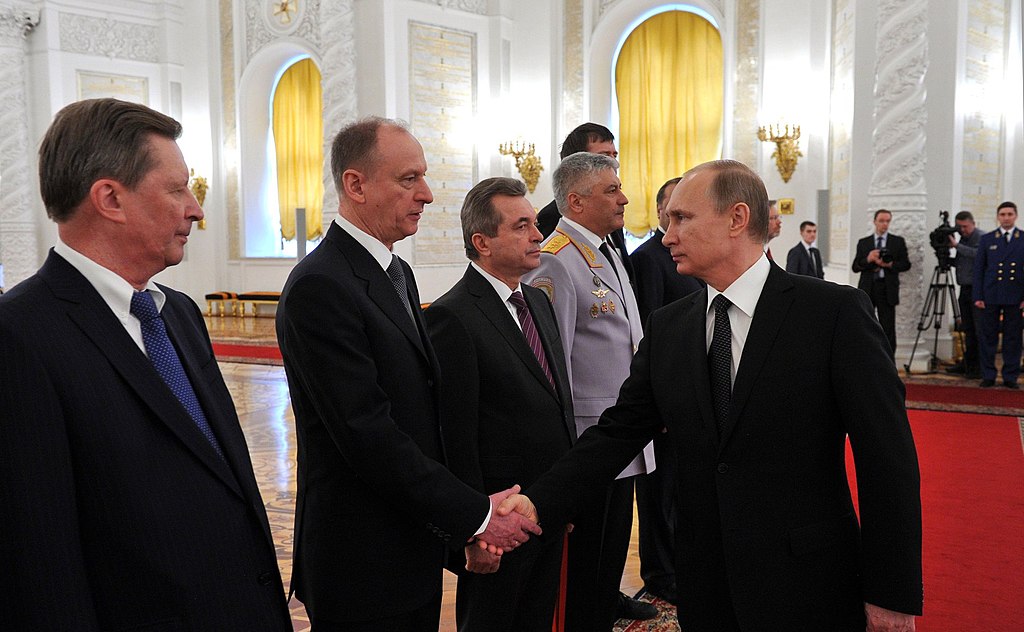
Putin greeting Siloviki: Russia's patriotic administrative spine.
I have referred recently to a growing conflict of perspective between Mercouris and many who think who like him, on the one hand, and that of Gilbert Doctorow and Doctorow’s growing band of like-thinkers (including, he tells us, many in Russia and China who have demonstrated enthusiastic interest in his recent article entitled “Is Russia Losing the War?”), who are vexed by Russia’s almost superhuman refusal to be provoked by more and more direct, escalatory and Western supported attacks from Ukraine and Western-direction of Ukraine’s war effort.
Mercouris, unlike Doctorow, is a faithful supporter of the doctrine of war by attrition that Putin and his government have self-evidently pursued over the past - I won’t say the full four years, but for much or most of this four-and-a-half-year-old conflict.
The Doctorow camp believes that Putin has the capability of putting an end to this war in any one or all of a variety of ways, and these include (1) the use of Russia’s most advanced weapons of which at least one, the Oreshnik, need not be nuclear to have nuclear-comparable impact, or (2) the application of these or other weapons as demonstrations of Russian force but used against targets, not in Ukraine but in the West - targets that Russia, under international law, would be entitled to strike, including missile-production factories or, again, (3) striking so hard on Kiev as to obliterate the major decision-making centers once and for all, so that the West would not even know who to support given the absence of those whom they could otherwise support.
These views also align with the Karaganov solution that I have also addressed in several recent posts. Putin has an added obligation to consider these alternatives, perhaps less elegant solutions namely, in honor of the families of fallen soldiers, families that over-represent the poorer, more backward parts of the Russian Federation, and whose support Putin must cherish if he would not perish.
I have long ago become very skeptical of claims about dead and wounded but, on the basis of the empirical evidence that I have seen, I do think Ukraine has suffered far more damage of this kind than has Russia. Yet, in saying that, the price paid by Russia in lives and wounded is still appalling. And I can see enough evidence every day of the week that despite constant claims or insinuations from Mercouris and many other Russia-favoring sources that the Ukrainian army is about to collapse, that it doesn’t actually collapse. This is not just because Ukraine has had a huge dollop of help in the form of Western aid in drone production and drone sophistication and is less dependent on its army, but because the Ukraine army is in no way as ineffective as these sources would have us believe.
I, myself, find some merit in the Doctorow position. I also am vexed by what Doctorow, I think fairly, describes as “indecision” on the part of the Putin government (a criticism he extends, with equal fairness, in my view, to Xi Jinping and China). Do these people think that they can stand by patiently and let the West destroy itself on their behalf? If so, I think that is a pretty conceited and unrealistic position and I would fire any general who would have me believe such fairy tales.
I picked up on this conflict in my post yesterday, arguing that if Russia (that is to say, Putin) is really committed to preserving a future for the Russian Federation, then Putin or his successor(s) will need to act now, militarily, using any of the approaches I have so far identified or others that I don’t have time to pursue now, that will stun the West and bring about an end to the war with sufficient conviction that we, the human race as a whole, can concentrate on the things that really matter: safety from climate change, the end to a world controlled by the selfish interests of billionaires and trillionaires, and their corporate manifestations, and exertion to achieve the maximum possible positive social development, self-realization and happiness.
Why do I think the West is, or perhaps I should more cautiously say, may be stunnable? Mainly because I believe this generation of Western leaders is stupid to the point of reckless idiocy. If one wants an example of astonishing, innovative courage in leadership I might turn to George Washington (in this summer of the 250th anniversary of American independence), and then weep before the memory of all of the civil, political and social accomplishments (though not forgetting the discordant scream of slavery) that the US’ corporate, plutocratric, monopoly capitalist class has thrown to the trash bin in its lust for easy and illegal wealth. First of all.
Then, secondly, I don’t see that the interests of the US and of Europe are meaningfully aligned in this particular moment of their respective histories. I see a mountain of rhetorical froth and bubble from Europe that I do not believe Europe is capable of delivering on in the short term and probably never will and that, even if joined with the much more powerful resources of the US, leaves me more impressed by what NATO now lacks than what it actually has.
One thing it lacks is ideological substance or conviction. The West is a mordant cluster of former or not-so-former imperial cliques whose self-confidence today sucks on the advantages of centuries’ worth of kleptomaniac imperialism to which these elites think they are perfectly entitled because their “civilization” is - just, you know - just so wonderful and inspiring (the Louvre, Shakespeare, John Locke, Adam Smith, Catholicism, Protestantism, and so on and so monotonously forth). Well, I dealt with that nonsense in yesterday’s post.
The important thing is this. If we could reasonably expect that no matter how evil is the current, fabricated, zenophobic Russophobia that has generated the conflict from whole cloth (Great Britain its greatest culprit, after some several hundred years of bear-baiting) will come to an end, that illusions and lies will be dispelled, that reason and hope will prevail, that the West will not further push its madness to World War Three, then yes, Putin’s incremental war of attrition is wise.
But if, in reality, there is going to be war, regardless of what Putin or Russia does or says - and this is where I believe we currently are and to which the evidence best points - then of course to defend itself, Russia must prepare and because the longer that Russia takes to prepare the greater will be the ultimate struggle, then it is best if Russia acts sooner rather than later. Do we expect that Russia will sacrifice itself to accommodate the greed, vanity and illusions of the West?
Dream on.
Here in the West we would be engaging with appropriate humility were we to refrain from making any such judgements with confidence, since our own interests are intimately bound up with the conclusions that we draw. We are looking at a world, to be franks, that is no longer impressed by us, or thinks it owes us anything at all, that finds us somewhat risible and disgusting, is no longer intimidated by anything about us, and from a position in which we ourselves grow - every day more - depressed by the rate at which the positive claims on behalf of our civilization are sinking into the dung heap of self-glorious affirmations.
Putin’s war of attrition reassures us, perhaps, as it gives us a lot of time to adjust, to accommodate, to interfere, to spin and tells us that we are not having to deal with a force so relentless that we need to re-examine anything we are doing with particular urgency. And I do suspect that this is exactly what Putin’s strategy has given us to date and, if so, then he is yielding to us the strength that should, by right, be his. Is he so captivated by the dream of a tunnel beneath the Bering Strait and of raising a chummy glass to Trump that he would do damage to the Russian soul, to Slavic civilization?
Zelenskiy’s Threats to Belarus, and Possibly Back
Readers will recall that the latest escalatory movement from Ukraine, with the backing of its Western sponsors, is to threaten that it will invade Belarus on the pretext that along its border with Ukraine Belarus allows a string of electronic boosters of some kind that enable Russia to send drones down the full length of the Belarussian-Ukrainian border with a view to then turning south and hitting targets in northeastern Ukraine. This is a threat of some substance because Belarus has only a small army of around 65,000, is a large territory, and probably hosts far fewer Russian soldiers than is often assumed even if it does host launching facilities for Russian missiles including Oreshniks and nukes.
Zelenskiy appears to be pulling back from this threat by claimed, or lying, that the electronic boosters have been switched off.
Lukashenko stated today, June 25, 2026, that he had warned representatives of Ukrainian President Volodymyr Zelensky against attempting to “drag Belarus into the war,” asserting that any such actions would instantly change the nature and quality of the conflict. He urged the envoys to convey to the Ukrainian President that they need to “reach a substantial agreement” rather than escalate tensions. If Ukraine “thinks it can speak to us like that,” Lukashenko said, the nature of the conflict would shift drastically, hinting at a severe military escalation if Belarus is provoked.
Zelensky announced on June 24 that the border signal-boosting repeaters—which Ukraine threatened to strike if not removed—had officially ceased operating as of June 22. Lukashenko’s compliance in disabling the equipment highlights his effort to prevent direct Ukrainian strikes on Belarusian soil. Lukashenko emphasized that Belarus’s position remains “peace-loving” and that he has no desire to fight the Ukrainian people. However, he explicitly stated that in any critical situation, Belarus will stand firmly with Russia. The latest warnings follow an unexpected shift earlier in June, when Lukashenko publicly apologized to Zelensky for past harsh remarks, noting that Belarus is “very vulnerable militarily” and that a direct war would be disastrous. Now we know: Lukashenko, in the final analysis, must side with Russia. Ukraine will have extended the war, spread his forces more thinly and further exhausted the West.
 Plus: Introducing the author's new video channel, the WMD-Channel.
MEDIA • GEOPOLITICS & EMPIRE
Jun 24, 2026
Ready for more?

Compiled by Patrice Greanville
Why 432 Park Avenue and Millennium Tower are Sinking Faster (Complete Documentary)
 Construction Files
Jun 24, 2026 #BillionairesRow #Skyscraper #SanFrancisco

