


A GlobeScan report
By World Public Opinion org
Giving Voice to Public Opinion Around the World
April 6, 2011
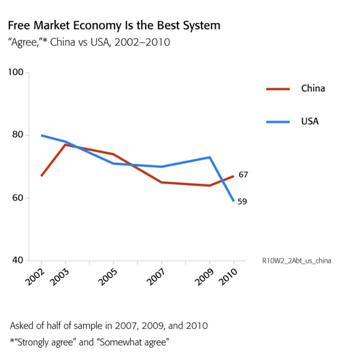
 American public support for the free market economy has dropped sharply in the past year, and is now lower than in China, according to a GlobeScan poll released today.
The findings, drawn from 12,884 interviews across 25 countries, show that there has been a sharp fall in the number of Americans who think that the free market economy is the best economic system for the future.
When GlobeScan began tracking views in 2002, four in five Americans (80%) saw the free market as the best economic system for the future–the highest level of support among tracking countries. Support started to fall away in the following years and recovered slightly after the financial crisis in 2007/8, but has plummeted since 2009, falling 15 points in a year so that fewer than three in five (59%) now see free market capitalism as the best system for the future.
GlobeScan Chairman Doug Miller commented: “America is the last place we would have expected to see such a sharp drop in trust in the free enterprise system. This is not good news for business.”
The results mean that a number of the world’s major emerging economies have now matched or overtaken the USA in their enthusiasm for the free market. The Chinese and Brazilians, 67 percent of whom regard the free market system as the best on offer, are now more positive about capitalism than Americans, while enthusiasm in India now equals that in the USA, with 59 percent rating the free market as the best system for the future.
Among the 20 countries polled in both 2009 and 2010, an average of 54 percent today rate the free market economy as the best economic system, unchanged from 2009.
Americans with incomes below $20,000 were particularly likely to have lost faith in the free market over the past year, with their support dropping from 76 percent to 44 percent between 2009 and 2010. American women have also become much less positive, with 52 percent backing the free market in 2010, down from 73 percent in 2009.
The poll was conducted by telephone in China and the US, and by telephone, in-person, or online in the 23 other countries between June 24 and September 18, 2010 by the international polling firm GlobeScan and its national partners. Before today’s public release, only clients of GlobeScan’s “Radar” reports have had access to these results. National results are considered accurate within +/- 3.0 to +/- 4.9 percent, 19 times out of 20.
GlobeScan Chairman Doug Miller added: “The poll suggest that American business is close to losing its social contract with average American families that has enabled it to prosper in the world. Inspired leadership will be needed to reverse this trend.”
Fieldwork was conducted in Argentina, Australia, Brazil, Canada, Chile, China, Colombia, Ecuador, Egypt, France, Germany, Ghana, India, Indonesia, Italy, Japan, Kenya, Mexico, Nigeria, Pakistan, Peru, the Philippines, Russia, Spain, Turkey, the United Kingdom, and the USA. Interviews were conducted via face-to-face, by telephone, or online (Japan only) between June 24 and September 18, 2010. Polling was conducted by GlobeScan and its research partners in each country. Some urban-only surveying was conducted in certain developing countries, following generally accepted research standards in each country. The margin of error per country ranges from +/-3.0 to 4.9 percent, 19 times out of 20.
For more information about GlobeScan see www.GlobeScan.com
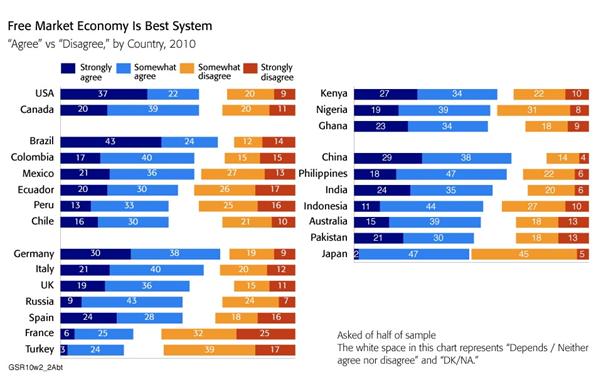
Please tell me if you strongly agree, somewhat agree, somewhat disagree, or strongly disagree with each of the following statements?
READ AND ROTATE STATEMENTS. CODE ONE EACH.
2bt) The free market system and free market economy is the best system on which to base the future of the world
01 — Strongly agree
02 — Somewhat agree
03 — Somewhat disagree
04 — Strongly disagree
VOLUNTEERED (DO NOT READ)
05 — Depends / neither agree nor disagree
99 — DK/NA
Original article HERE.
