

 Nima R. Alkhorshid
DIALOGUE WORKS
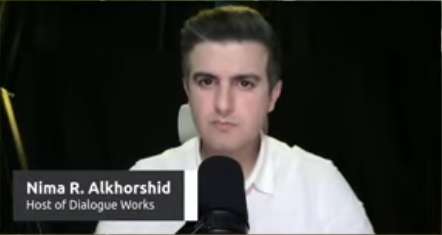
Nima chats with Prof. Marandi, Pepe Escobar,
Larry C. Johnson & Scott Ritter
| Traducir—Translate! | |
| Make fonts bigger>>> | Resize text-+= |
FIRST FEATURE
Summary
The video features an in-depth discussion with Professor Marandi about the recent martyrdom of the Supreme Leader of Iran, an event that has significantly impacted Iranian society and the broader geopolitical landscape. The professor reflects on the leader’s legacy, his role in shaping Iran’s resistance axis, and his steadfast support for oppressed peoples globally, including Palestinians, Venezuelans, Cubans, and South Africans.
He highlights the leader’s personal sacrifices, political resilience, and exceptional leadership qualities during times of war and internal challenges. The discussion covers Iran’s strategic positioning amid ongoing conflict with the United States and Israel, including Iran’s military tactics, diplomatic maneuvers, and regional alliances. Professor Marandi also explains the constitutional processes in Iran following the leader’s death, emphasizing the continuity and stability of the Iranian political system despite external pressures and internal difficulties. He underscores the growing solidarity within Iran and among its allies, as well as the miscalculations of Western powers who underestimated Iran’s resilience. The conversation ends on a hopeful note, recognizing the martyr’s contribution to a broader global struggle against imperialism and oppression.
Highlights
- [01:10] 🕊️ The Supreme Leader of Iran was martyred in a US-Israeli attack, deeply impacting Iranian society and politics.
- [03:05] 🌍 Iran’s leadership has historically supported oppressed peoples worldwide, including Palestinians, Venezuelans, Cubans, and South Africans.
- [06:20] 💪 The Supreme Leader was a man of exceptional personal sacrifice, including warfront experience despite having no initial military training.
- [14:00] 🔥 Iran’s response to attacks has been swift and effective, strengthening national unity despite enemy efforts to destabilize the country.
- [19:15] ⚔️ Iran is currently engaged in a multi-front conflict against US and Israeli forces, leveraging strategic regional alliances.
- [27:30] 🏛️ Iran’s constitution ensures political continuity through a council until a new Supreme Leader is appointed, maintaining stability.
- [38:00] 🚢 Iran has closed the Strait of Hormuz and is striking key enemy assets, signaling a strategic escalation but avoiding a global economic crisis.

SECOND FEATURE
Scott Ritter: Iran TARGETS the USS Abraham Lincoln Aircraft Carrier — Obliterating US Bases & Israel

Streamed live on Mar 1, 2026
Summary
The video features Scott Ritter providing an in-depth analysis of the ongoing conflict between Iran, the United States, and Israel as of March 1, 2026. Ritter critiques the U.S. and Israeli military strategies, the political dynamics in the Persian Gulf, and the broader implications of the war on regional and global stability. He offers historical context, theological insights about Iran’s political-religious structure, and assessments of intelligence and military operations.
Key Insights and Analysis
Decapitation Strike and Its Consequences
- The U.S. and Israel initiated the conflict with a “decapitation strike” targeting Iran’s Supreme Leader Ali Khamenei and senior commanders, killing Khamenei and up to 40 senior officials.
- Ritter argues this was a strategic mistake that guaranteed defeat for the U.S. and Israel, as it transformed Khamenei into a martyr and unified Iranian society around their faith and government.
- The Islamic Republic is not dependent on any one individual; it is a constitutional and religious system with mechanisms for continuity. An emergency council is currently governing in place of the deceased Supreme Leader, and the Assembly of Experts will appoint a successor.
Theological and Political Context of Iran’s Regime
- The Islamic Republic is both a constitutional republic and an Islamic republic based on the Shia 12er doctrine, emphasizing the Guardianship of the Supreme Jurist (Vilayat-e Faqih), a religious-political leadership concept.
- Khamenei’s role was akin to a religious pope figure, deeply revered within Shia Islam. His martyrdom has strengthened the resolve and faith of the Iranian people, consolidating their support for the regime.
Regional Dynamics and the Gulf States
- The Gulf Arab states, including Bahrain, Kuwait, Qatar, and the UAE, have provided logistical and intelligence support to the U.S. and Israel but have been targeted by Iranian missile and drone strikes.
- Ritter dismisses Gulf Arab military capabilities, particularly Saudi Arabia’s, as incapable of mounting effective offensive operations against Iran. Historical failures in Yemen illustrate this incompetence.
- The Gulf monarchies are described as corrupt, decadent, and disconnected from their populations, who are predominantly Shia in some states like Bahrain, heightening the risk of internal uprisings supported by Iran.
- Iran’s targeting of Bahrain, home to the U.S. Navy’s Fifth Fleet headquarters, is viewed as an attempt to foment regime change in Gulf monarchies.
Intelligence Failures and Targeting Errors
- Ritter criticizes U.S. and Israeli intelligence for poor targeting, exemplified by the bombing of a girls’ school in southern Iran, which he attributes to faulty intelligence or Iranian deception tactics.
- Iran is adept at feeding false intelligence streams, creating decoys, and preserving critical military assets, complicating efforts to neutralize their missile capabilities.
Iranian Military Response and Escalation
- Iran has launched precise missile strikes against Israeli military and strategic targets, demonstrating advanced intelligence and missile capabilities that have overwhelmed Israeli defenses.
- Iranian strikes on U.S. and British tankers in the Strait of Hormuz are part of a broader strategy to assert control over critical maritime chokepoints.
- U.S. naval forces, including the USS Abraham Lincoln carrier strike group, remain deliberately distant to avoid being vulnerable to Iranian hypersonic missiles.
THIRD FEATUREPepe escobar & larry Johnson
Iran strikes, Hezbollah joins?
Pepe Escobar & Larry C. Johnson: US-Israel HIT Tehran, Iran DESTROYS Tel Aviv, Hezbollah NOW Joins
Iran strikes, Hezbollah joins?
Pepe Escobar & Larry C. Johnson: US-Israel HIT Tehran, Iran DESTROYS Tel Aviv, Hezbollah NOW Joins
Streamed live 6 hours ago (Mar 2, 2026)
Summary
The Iran Conflict and Regional Dynamics (March 2026)
Overview:
The discussion centers on the recent escalation of conflict involving Iran, the United States, Israel, and Gulf Arab states. The speakers provide a detailed geopolitical, military, and economic analysis of the unfolding war, its causes, consequences, and the broader regional and global implications.
Key Themes and Insights
Failed Decapitation Strategy:
The U.S. and Israel initiated the conflict by assassinating Iran’s Supreme Leader and high-ranking commanders, expecting the Iranian regime to collapse. This was a major miscalculation, as Iran’s political-military system is decentralized and not dependent solely on one leader.Iran’s Rapid and Coordinated Response:
Iran launched a counterattack within 30-45 minutes of the initial assault, showcasing advanced preparedness and resilience developed after learning from the 12-day war. The Iranian leadership had contingency plans, including replacements for key commanders.War of Attrition and Strategic Impact:
The conflict is characterized as a war of attrition, with Iran systematically targeting U.S. military bases in the Persian Gulf, effectively destroying many, and striking critical infrastructure in Israel and Gulf states. The U.S. military has retreated fighter jets to Cyprus and beyond due to vulnerability.Regional and Global Political Repercussions:
- Arab Gulf states, especially Saudi Arabia and Bahrain, are feeling abandoned as the U.S. fails to defend its bases and allies effectively, leading to internal unrest and rethinking of security alliances.
- UAE (MBZ) reportedly contacted Russia’s Putin, signaling a potential shift in alliances away from the U.S.
- Shiite populations across the Middle East and South Asia have rallied in support of Iran, indicating a broadening jihadist sentiment and resistance against U.S.-Israeli actions.
Economic and Geostrategic Dimensions:
- The war threatens global energy markets by closing the Strait of Hormuz, through which 21% of the world’s oil passes, causing oil prices to surge.
- The conflict is also viewed as part of a broader imperial struggle to control Eurasian connectivity corridors (including the China-led Belt and Road Initiative and the Russia-Iran-India north-south transport corridor).
- The U.S. is described as an empire in decline, increasingly desperate to annex and control territories rich in natural resources.
Military Technology and Supply Challenges:
- Iran is firing hundreds of ballistic missiles and drones daily, potentially sustained by Chinese and Russian technical support, including satellite intelligence and alternative navigation systems.
- The U.S. and Israel are rapidly depleting interceptor missile supplies (Patriot, SM-3), with production rates insufficient to keep pace with Iranian attacks.
- Iran’s missile and drone strikes are methodical, often using decoys to waste U.S. munitions.
- U.S. air operations are constrained by distance and the need for refueling, limiting direct strikes inside Iran.
Israel’s Vulnerability:
- Israel’s population (~7 million) and geographic size make it highly vulnerable to Iranian missile strikes targeting key cities (Tel Aviv, Haifa, Jerusalem), ports, refineries, and airfields.
- Israel is expected to suffer severe damage and may become unlivable if the conflict continues, with even Israeli leadership reportedly absent from the country during attacks.
U.S. Political and Strategic Failures:
- The Trump 2.0 administration pushed for war based on false assumptions and propaganda, ignoring diplomatic efforts that were underway.
- Early attempts by the U.S. to seek ceasefire negotiations failed as Iran declared no willingness to negotiate after the assassination of its Supreme Leader.
- The war has undermined U.S. influence in the Middle East and exposed the fragility of its alliances.
Russia and China’s Role:
- Russia and China are discreet but vital supporters of Iran, providing intelligence and military assistance.
- Moscow and Beijing view the conflict as part of a larger confrontation with U.S. global hegemony and are committed to preventing Iran’s defeat.
- Russia faces a complex dilemma due to significant Russian-origin populations residing in Israel and the geopolitical implications.
European and Western Involvement:
- European countries (France, UK) are perceived as weak and unlikely to engage militarily against Iran.
- There are concerns about the potential use of Ukrainian drone experts by Western powers to support Israel, reflecting a complex nexus of conflicts.
BEFORE you leave, PLEASE pay attention to this alert.
[t4b-ticker id="1"]
Print this article [bws_pdfprint display=’print’]
 This work is licensed under a Creative Commons Attribution-NonCommercial 4.0 International License •
ALL CAPTIONS AND PULL QUOTES BY THE EDITORS NOT THE AUTHORS

1 comment
The USA is not just a paper tiger,
The USA is a toilet-paper tiger.
Not only that,
The USA is a soggy toilet-paper tiger,
Not only that,
The USA is a disintegrating soggy toilet-paper tiger,
Not only that,
The USA is a shit stained disintegrating soggy toilet-paper tiger.
Not only that,
The USA is a shit stained disintegrating soggy toilet-paper tiger, now being flushed down the toilet by Iran.
Floooooooooossshhh!!!!!
https://www.youtube.com/watch?v=yd_uJiRcl0Q
https://www.youtube.com/watch?v=XO4uDiGFCB4